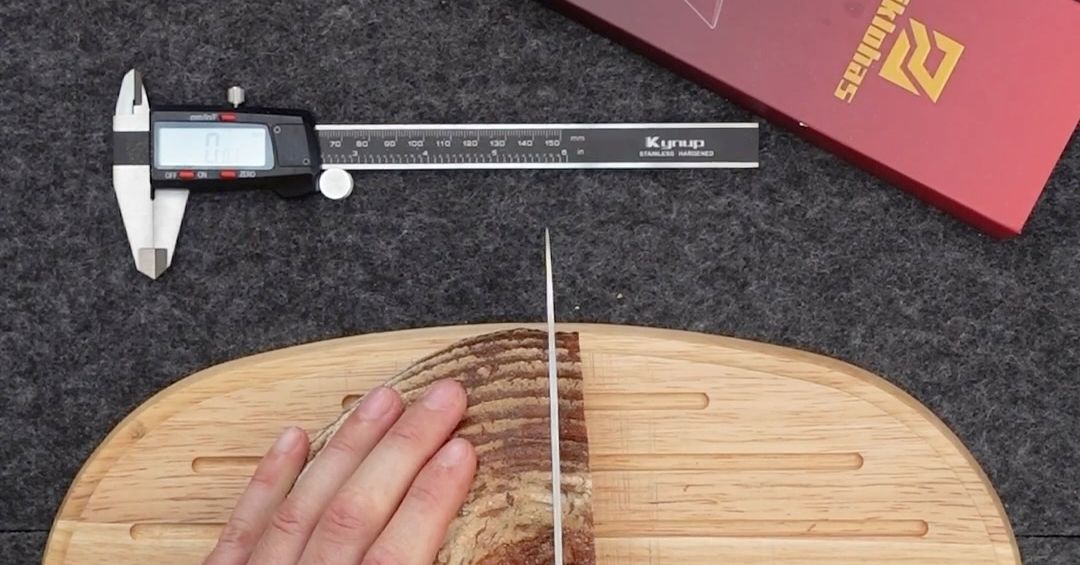
A German creator known online as Germanbreadcutter has built an audience of more than 100,000 followers by doing one thing with unreasonable seriousness: cutting bread by hand and measuring how close the slice gets to uniform thickness.
The creator, Jan, asked WIRED not to publish his last name because he does not want coworkers connecting him to the account. Since February, he has posted daily bread-cutting attempts across Instagram, TikTok, and YouTube. The format is fixed enough to qualify as a protocol, which is more than can be said for much of the internet’s alleged testing.
Jan puts a loaf on a cutting board, greets viewers, then uses a bread knife to cut a single slice as evenly as possible. WIRED reported that he uses knives from Piklohas and Hoshanho, German and Japanese brands respectively. After the cut, he checks the slice around its edges with a digital caliper from Kynup, a manufacturer owned by a Chinese company. He records the variance in a spreadsheet he calls a “breadsheet.”
The metric is deviation, not vibes
The goal is a low maximum difference between measuring points. That makes the performance legible: a slice is better when its thickest and thinnest measured edges are closer together. The drama, such as it is, comes from watching a soft, uneven loaf behave badly under a human hand while a caliper waits to shame the result.
Jan’s current best recorded slice, which his audience calls the “Golden Slice,” came on June 27 in episode 136, according to WIRED. He cut a slice from a Frankenlaib, a traditional round German sourdough loaf, with a maximum thickness deviation of 0.08 millimeters. Fans treated the result like an athletic milestone, with comments praising the cut as a top-tier performance.
Jan told WIRED the project began after a friend cut an unusually impressive slice of bread at breakfast and showed it to him. “Since that moment, life hasn’t been the same,” he said. He said each loaf now becomes another attempt to cut as accurately as he can.
The tools are ordinary, the obsession is not
Jan links to the tools he uses and told WIRED he chose items that can be bought internationally. He said he does not currently have promotional arrangements with the brands. His day job is not in the food business, and he said he has never baked his own bread.
That has not limited the supply chain. Jan said Germany has enough good bakeries that he does not expect to run out of loaves to test soon. He works through a whole loaf before starting another, and viewers treat each new loaf as a new “season.”
His preferred subject so far is the Frankenlaib that produced the Golden Slice. His least favorite, he told WIRED, was a square whole-grain loaf, even though it produced good results. Jan said the geometry made it feel less impressive than cutting a traditionally shaped loaf, which is the kind of constraint that separates a hobby from a self-imposed laboratory.
The project also has failure modes. Jan has said the end of a loaf is harder to grip and stabilize, calling it his “Achilles’ heel” in one post cited by WIRED. Viewers often respond to weaker cuts with encouragement rather than revolt, which may be the internet’s most surprising measurement here.
Jan also told WIRED that the bread is not wasted. Every slice is eaten, he said, whether plain, with butter, with butter and jam, or with cheese. The spreadsheet gets the numbers. Breakfast gets the evidence.
This story draws on original reporting from WIRED.