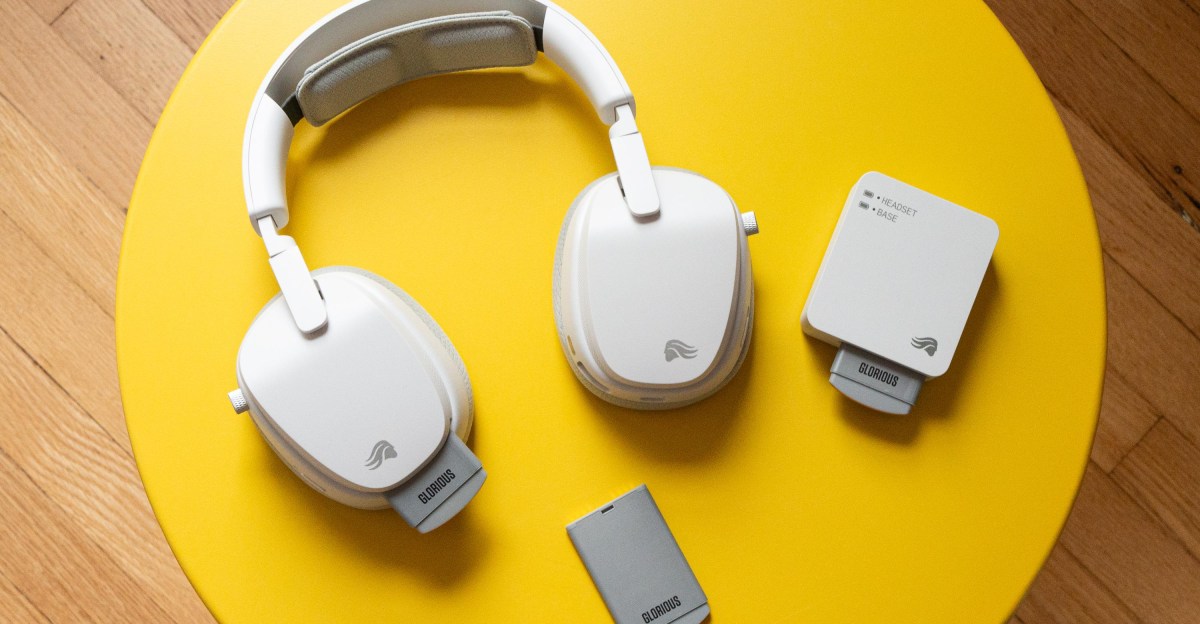
Glorious has built a wireless gaming headset around a battery trick that should have been standard in this category already: swapping the main pack does not cut the audio. The company’s $229.99 GHS InfinitePlay uses a secondary internal battery as a bridge, giving players time to pull one pack and insert another without the headset dropping out mid-game, according to Cameron Faulkner’s hands-on report for The Verge.
That matters because replaceable batteries in gaming headsets are only half a fix if the headset disconnects every time the user performs the swap. The Verge said SteelSeries helped make rechargeable swappable packs desirable in premium headsets, but competing models such as the SteelSeries Arctis Nova Pro Omni and Turtle Beach Stealth Pro 2 shut off when their removable batteries come out.
Glorious’ mechanism is more forgiving. The main battery slides into an exposed slot on the right ear cup like a cartridge. The Verge reports that the pack can go in with the branding facing either direction, as long as the textured edge points down. That edge sticks out enough to find by touch, so the swap can be done without staring at the headset like a raccoon solving a vending machine.
How the battery system works
The InfinitePlay ships with two battery packs, and Glorious rates each one for up to 85 hours, according to The Verge. A charging base keeps the spare topped up. During a swap, the headset falls back to its internal reserve battery, which Glorious says can run for up to three hours. In The Verge’s testing, audio continued through the exchange.
The Verge’s monthlong test found the battery life long enough that swaps were rarely needed during normal use. That is the less glamorous part of the design, and probably the more useful one: a hot-swap system only feels clever after the headset already avoids becoming another device that needs nightly cable penance.
The base station also stores the headset’s USB-C 2.4GHz transmitter. The Verge said the headset was used mostly with a PC, but the transmitter can be removed for use with a PlayStation 5 or Steam Deck. Bluetooth is also available, with the headset’s controls handling phone calls and music playback.
Controls, audio and trade-offs
The InfinitePlay has notched metal knobs on the backs of both ear cups. The Verge said they can control volume and game-chat balance, or call and media controls when paired to a phone over Bluetooth. The physical controls sound like the correct amount of machinery for a headset, which is to say: less app, more knob.
On sound, The Verge described the headset as better than expected from Glorious, a company newer to audio hardware. The report praised its bass, clarity and soundstage, while noting that buyers focused on sound quality can find stronger options at the same price, including the Fractal Scape.
The fit also appears to be a strength. The Verge said the ear cups rotate nearly 180 degrees, did not clamp uncomfortably over glasses, and use a bungee-style headband with adjustable side arms. The headset comes in black and white, though the black version reportedly shows scuffs and scratches more clearly. Components in the box are color-matched, so buyers cannot mix headset and base-station colors.
The omissions are familiar. The InfinitePlay lacks active noise cancellation and does not include a hard case. The built-in microphone sounded poor in The Verge’s test, with the detachable boom mic recommended instead. Glorious offers a companion app for settings, but The Verge said a browser-based version would make adjustment easier.
For players who care most about uninterrupted wireless use, the InfinitePlay’s pitch is unusually concrete. Glorious did not just add another battery. It added enough backup power to make replacing that battery feel like less of an outage and more like reloading a cartridge.
This story draws on original reporting from The Verge.