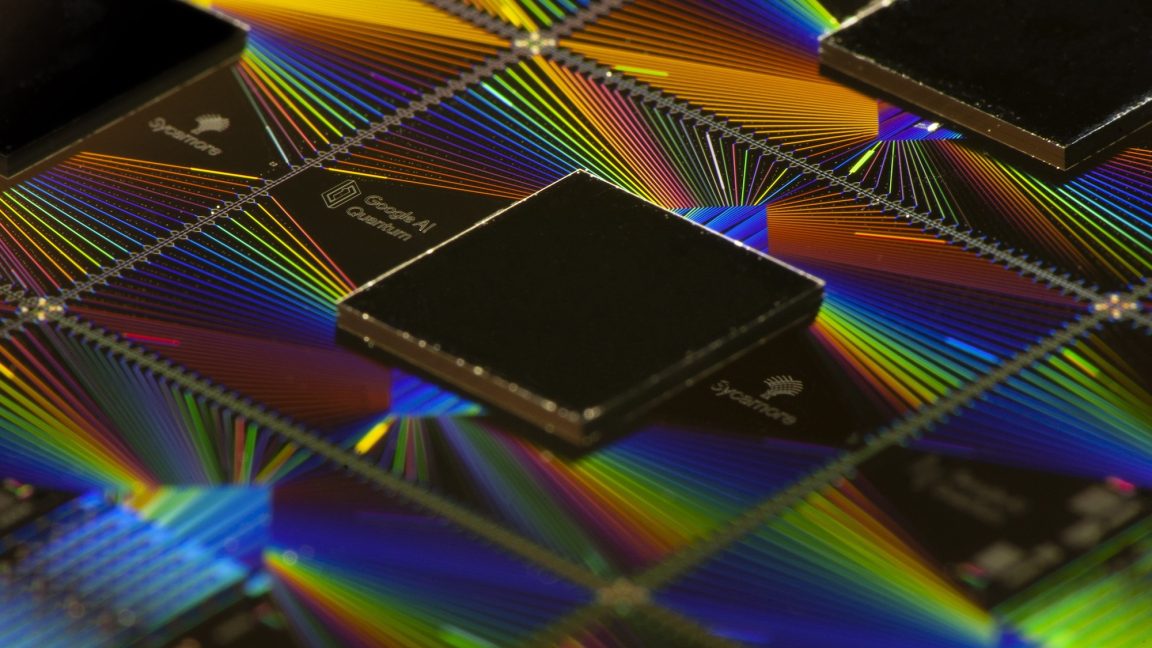
Google researchers have shown a way for a quantum processor to adjust its own control settings while error correction is running, according to a paper published in Nature. The result is early, and it does not make today's machines ready for long useful workloads. It does address a boring problem that becomes brutal once a quantum calculation has to run for a long time: the machine's knobs drift.
The issue applies to hardware such as superconducting qubits, including the transmon devices used by Google and several other quantum-computing groups. A transmon is built from superconducting circuitry coupled to a resonator and driven by microwave pulses. Those pulses come from control electronics outside the refrigerator, including classical computers and microwave sources.
Before running a calculation, operators calibrate the system by trying different microwave frequencies and amplitudes, then keeping the settings that produce lower error rates. That works for short jobs. Google says that when its systems show signs of slipping out of calibration today, the practical answer is to stop the computation and recalibrate. That is a lousy plan for the long, complex algorithms quantum computing advocates eventually want, including the class of workloads often discussed in connection with breaking current encryption.
The Nature paper's observation is that bad calibration leaves fingerprints in the same place as ordinary quantum errors. Error-corrected logical qubits are built from many physical qubits. Some physical qubits hold data, while others are measured to detect error patterns, known as syndromes. Google researchers wrote that errors caused by poor calibration produce detectable syndromes like other errors do.
The hard part is separating random noise from a control setting that has gone stale. Google's team used reinforcement learning for that job. During computation, the system makes small simultaneous changes across many control parameters and watches how the statistics of error-detection events shift. From that feedback, it estimates which control changes should reduce particular errors.
In one experiment, the system managed two logical qubits on a calibrated processor. The two logical qubits used different error-correction codes, one surface code and one color code. With the reinforcement-learning controller active, Google reported a 20 percent improvement in the system's ability to detect and correct errors in the logical qubits compared with running without those steering corrections.
The method has a catch, and it is not a subtle one. A controller trained near one operating point may fail if the hardware drifts too far away. Google's proposed answer is continual reassessment: keep testing small policy changes and update the controller as conditions shift.
That creates its own cost. Exploring worse settings during a live computation temporarily degrades error correction. The researchers tested the trade-off in simulations using a very small error-corrected qubit and found that the approach helped when drift was slow enough. They also showed real-time operation on a larger error-corrected qubit with the learning system controlling roughly 40,000 parameters.
This is not a near-term shortcut around the larger quantum-computing mess. The field still needs enough reliable physical qubits, dependable logical qubits, and methods for producing the states required for universal computation. Current machines run short enough algorithms that calibration drift is not yet the main bottleneck. Google's paper, Nature DOI 10.1038/s41586-026-10759-2, shows that one future failure mode may be manageable before it becomes the problem everyone is yelling about.
This story draws on original reporting from Ars Technica.