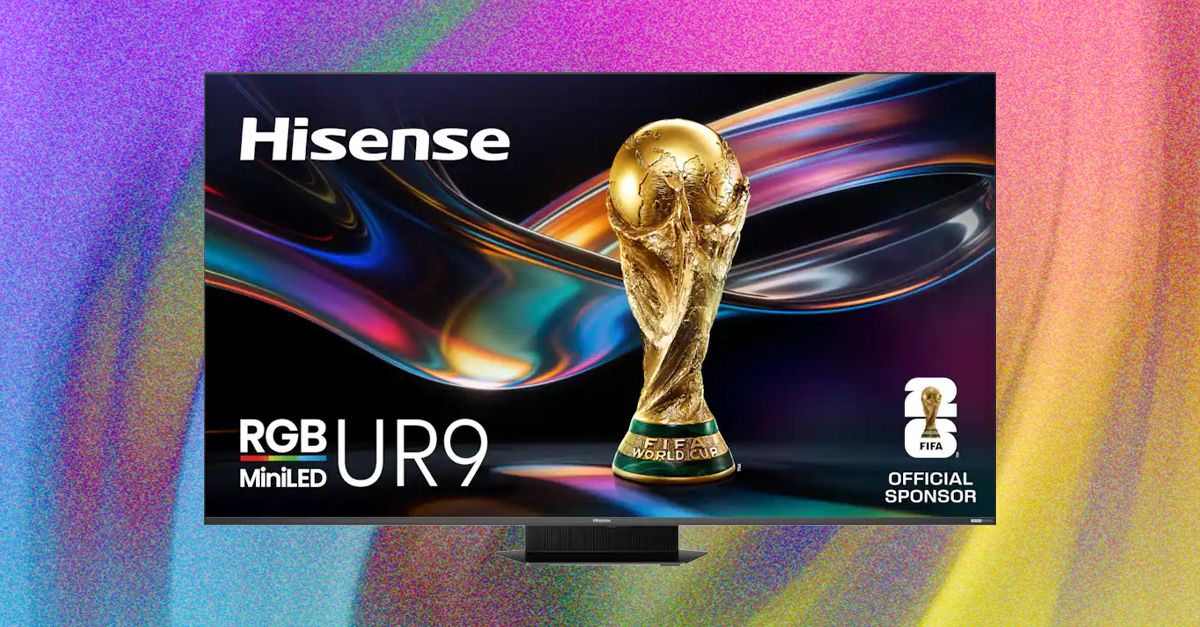
Hisense has pushed RGB mini-LED television tech into a lower price bracket with the UR9, according to a Wired review by John Brandon, who rated the 65-inch model 8 out of 10 after testing it for movies, sports and games.
The set is listed at Best Buy for $2,000, down from $2,200. That still is not budget-TV money, unless your budget was assembled in a different tax bracket, but Wired frames it as relatively inexpensive for this display category. The UR9 sits at the top of Hisense’s lineup and competes against newer RGB sets from Sony and TCL, plus pricier micro-RGB models from LG and Samsung.
The display mechanism is the point. Conventional LED and QLED TVs use white or blue LEDs behind an LCD panel. RGB mini-LED changes the backlight by using red, green and blue light sources, which can give the TV more precise control over color, brightness and contrast. Wired notes that LG and Samsung describe their micro-RGB systems as more advanced because they use smaller LEDs, though Brandon writes that both approaches aim at broadly similar image gains.
Brandon found the UR9’s picture to be the main reason to care. In his testing, the TV produced strong contrast, bright colors and deep blacks while watching films including The Last Duel, Awake, Tron: Ares and The Creator. Benchmark material from Spears & Munsil showed good skin-tone separation and contrast, according to Wired, though some colors were not perfect: grass appeared a little brown in one scene, and a red cactus was less saturated than expected.
Wired also says the UR9 covers 100 percent of the BT.2020 color gamut. That is a serious spec if it holds up across real content, though the review found the picture controls uneven. Motion Clearness helped with a World Cup soccer ball, and Dynamic Color Enhancer made some video look more vivid. Other options, including blue-light reduction, smoother gradients and contrast tools, had limited effect in Brandon’s tests.
The TV’s gaming hardware is less subtle. The UR9 supports 180 Hz refresh and up to 330 Hz variable refresh rate when connected to a high-end PC through the DisplayPort on the side, using a USB-C 40 Gbps cable, according to Wired. Brandon tested it with an Alienware 16X Aurora laptop using an Nvidia GeForce RTX card and reported responsive play in Crimson Desert, Forza Horizon 6 and 007 First Light. He also tested an Xbox Series X with Senua’s Saga: Hellblade II and Subnautica 2, finding the images colorful and rich compared with budget televisions.
The hardware checklist is mostly solid. Wired reports three HDMI 2.1 ports, Wi-Fi 6E, Ethernet, optical audio, coaxial and two USB ports. The TV is 1.8 inches thick and uses Google TV. Setup was mostly straightforward, though Brandon ran into a Google Home QR-code bug and had to enter his Google credentials manually. The missing 3.5 mm headphone jack is an odd omission.
The weakest physical part appears to be the remote. Wired calls it too busy, with an awkwardly placed mute button, too many shortcuts, a Kids button for Kidoodle, a profile-switching button and a customizable shortcut. Brandon did praise the backlighting and easy-to-find Netflix and Amazon Prime buttons.
Wired’s bottom line is that the UR9 does not beat higher-end LG micro-RGB models on customization and does not fully displace OLED for black levels. It does, however, make RGB mini-LED look less like a showroom flex and more like a real option for people buying a high-end TV without volunteering for maximum wallet damage.
This story draws on original reporting from WIRED.