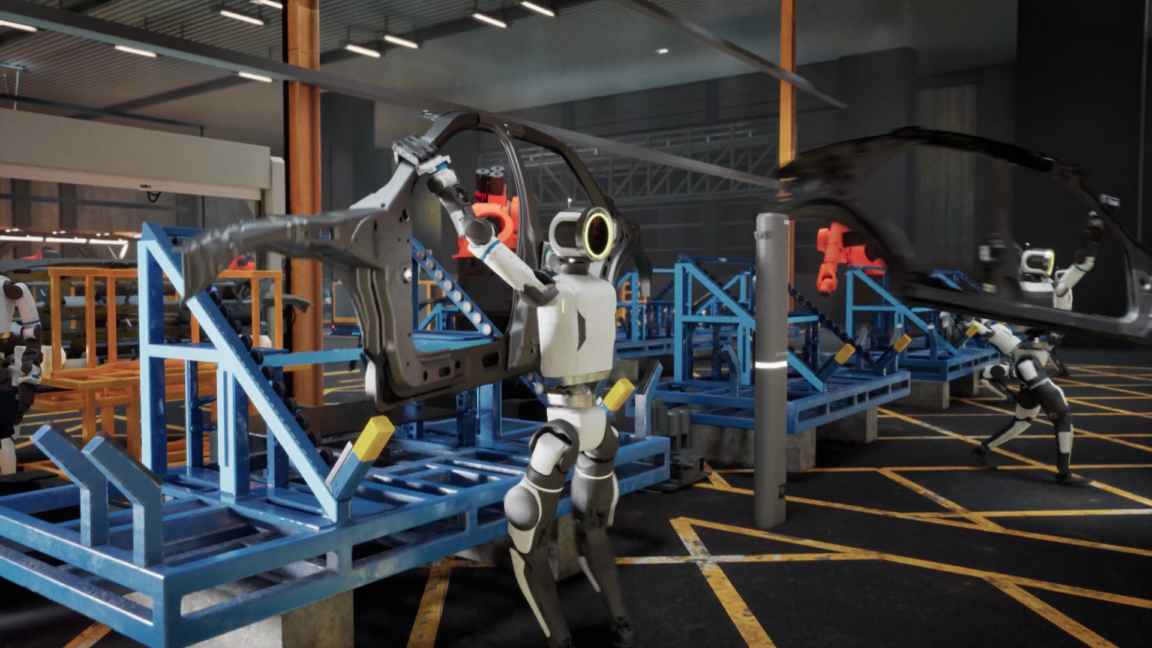
Thousands of unionized Hyundai Motor workers in South Korea have begun partial strikes after contract talks stalled over pay, retirement terms, and the company’s plan to introduce humanoid robots into auto production.
The walkouts at Hyundai’s Ulsan manufacturing complex are the auto industry’s first factory stoppage centered on humanoid robots, according to The Wall Street Journal. The Korea Times reported that workers cut both day and night shifts short by two hours from July 13 through July 15, with four-hour strikes planned from July 20 through July 22 after 15 bargaining sessions failed to produce a deal.
The dispute puts a very concrete labor fight around a technology that automakers have mostly discussed in demo videos and investor presentations. Hyundai Motor Group wants to use Atlas, the humanoid robot built by Boston Dynamics, across Hyundai and Kia factories. Reuters reported that Hyundai is moving to make Boston Dynamics a wholly owned subsidiary.
Atlas is a two-legged robot standing more than 6 feet tall and capable of lifting more than 100 pounds, according to Boston Dynamics. The Korea Herald reported that Hyundai aims to deploy more than 25,000 Atlas robots across Hyundai and Kia plants. The company plans to begin in US factories in 2028, but it has not given a schedule for other sites.
The union, which represents more than 39,000 Hyundai workers in South Korea, is asking the company to change hourly production jobs to fixed-salary roles, The Wall Street Journal reported. The point is blunt enough: if robots reduce available hours, workers want paychecks that do not shrink with the schedule. The union is also seeking to raise the retirement age from 60 to 65 and wants larger bonuses.
Cost is driving much of the tension. Samsung Securities analyst Esther Yim told Bloomberg that an Atlas unit is estimated to cost about $130,000 and could recover that cost in roughly two years of operation. Bloomberg also cited James Hong of Macquarie Securities Korea, who said that if the price falls to $100,000, operating costs could drop below the US federal minimum wage of $7.25 an hour and sit well under a typical autoworker’s pay.
Georgia will be Hyundai’s first Atlas test
Hyundai plans to put Atlas to work first at Metaplant America, its electric vehicle factory outside Savannah, Georgia, starting in 2028. Those workers are not unionized, although the United Auto Workers is trying to organize the site.
Metaplant America is already stuffed with automation. IEEE Spectrum reported that the plant uses more than 850 robots for tasks including unloading parts, stamping steel components, assembling frames, and installing doors. It also runs 300 automated guided vehicles that move parts around the factory while avoiding people.
Boston Dynamics’ four-legged Spot robot is already used at the Georgia plant for exterior quality inspection in the weld shop, according to Boston Dynamics. The Atlanta Journal-Constitution reported that Atlas units at the site are expected to start with sorting and organizing auto parts.
Jerald Roach, a general assembly executive at Hyundai’s Metaplant, told the Atlanta Journal-Constitution that the humanoid robots would not threaten human jobs. He said human hands remain needed for soft parts such as hoses, wires, carpets, and trim panels, where touch and feel still matter.
Hyundai has also agreed to employ 8,100 full-time workers at Metaplant America by 2031 under its economic development agreement with Georgia. State and local officials offered an incentive package estimated at $2.1 billion. The Atlanta Journal-Constitution reported that the plant had more than 3,800 employees by the end of 2025.
Hyundai is not alone. Tesla is developing its Optimus humanoid robot for factory use, BMW has tested Figure AI humanoid robots at its Spartanburg, South Carolina, plant, and Chinese automakers including BYD are experimenting with similar systems. The International Federation of Robotics said more than 1 million robots were already working in auto factories worldwide by 2021, about one-third of all industrial robots.
The newer pitch is that humanoid robots can fit into factories built for people and eventually handle many tasks, rather than repeating one fixed motion like a conventional robot arm. That claim still depends on progress in AI training, hardware durability, safety, and cost. Workers in Ulsan are not waiting for the marketing deck to become reality before bargaining over who absorbs the risk.
This story draws on original reporting from Ars Technica.


