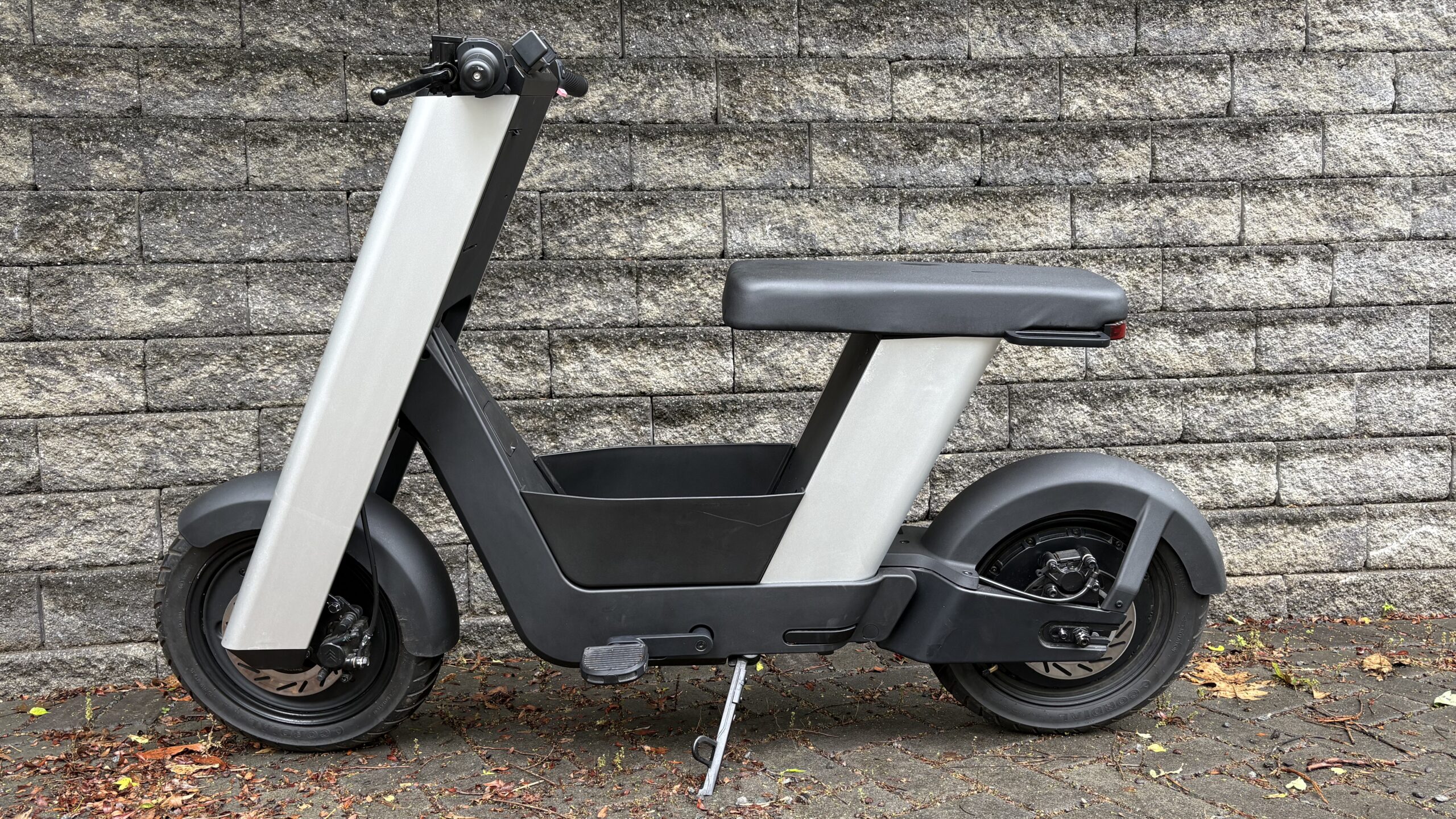
Infinite Machine Olto bike lanes is the product’s central argument: put nominal e-bike hardware on a scooter-shaped electric vehicle and let riders use urban cycling infrastructure. Hands-on reviewers broadly agree that the Olto can qualify for e-bike-style modes, but they found its real-world riding position, throttle controls and roughly 175-pound weight make it behave much more like a small electric scooter.
That distinction matters before anyone treats a software setting as a universal permission slip. The available reporting does not include a statute, regulator classification or local guidance establishing where the Olto may legally operate. Rules for e-bikes, throttles and bike lanes vary by jurisdiction and can also depend on the selected mode.
Can the Infinite Machine Olto use bike lanes?
The evidence supports no blanket answer. Infinite Machine pitches the vehicle for roads and bike lanes, Fortune reported, while The Verge said the Olto app asks for a rider’s location and adjusts available behavior to local rules. Those are company and reviewer accounts, not an official legal determination. Prospective riders need to check the rules where they ride, including whether a particular class or throttle setting is permitted.
The mechanical workaround is unusually candid. Ars Technica reported that the Olto’s low, broad seat leaves too little room for a rider’s legs to make a normal pedal rotation. Its reviewer also could not pedal the vehicle without electric assistance. A switch can disengage the cranks, after which the pedals can be parked forward on deployable supports and used as footrests.
Joseph Cohen, Infinite Machine’s chief executive, told Fortune that he advised its reporter against using the pedals and that customers generally leave them in the peg-like position. That is a scooter interface wearing bicycle-required jewelry.
What modes and speeds does the Olto have?
Ars Technica describes a Class 2 configuration with throttle or pedal assistance capped at 20 mph, and a Class 3 setting with pedal assistance to 28 mph but no throttle. The Verge reported more app options: a 15 mph Limited mode, Class 2 and Class 2+ settings that top out at 20 mph with different acceleration, Class 3 at 28 mph, and an Unlocked setting described for private property and off-road use.
Reported on-road speed results do not line up cleanly. Ars Technica said its reviewer saw a boost function take the Olto to roughly 30 mph. The Verge reported reaching about 36 mph, without identifying the mode or test conditions. InsideEVs described a brief boost to 28 mph from a 20 mph setting. Those accounts show why the stated mode ceiling and what a vehicle does in a particular test should not be collapsed into one number.
Weight is the other awkward fact. Ars Technica put it at about 175 pounds and said it was difficult to reposition by hand; Fortune reported 176 pounds. Reviewers praised its acceleration, thick tires and scooter-style comfort, but that mass changes low-speed maneuvering and raises the stakes of sharing constrained lanes with pedal bicycles. Fortune framed that as a policy concern, not evidence of a collision trend or a regulatory finding.
The Olto was reported by The Verge as a $3,495 vehicle. It may be a practical short-trip machine for riders whose local rules allow it, but its legal bicycle status cannot settle the more basic question of what it is like to ride. On that point, the pedals have already given the game away.
This story draws on original reporting from Ars Technica.