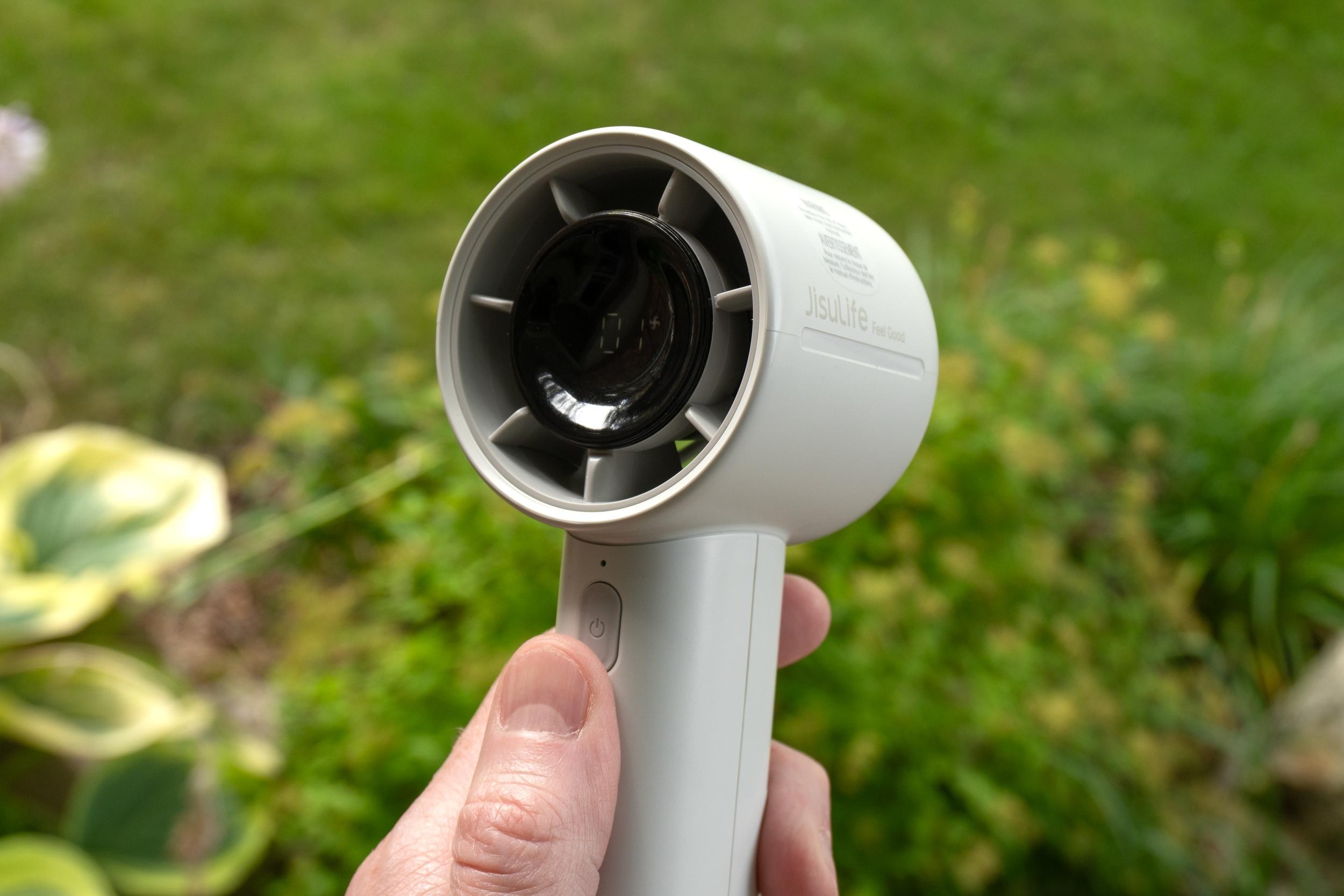
A JisuLife Life10 S review by The Verge’s Andrew Liszewski lands on a blunt conclusion: the cheap rechargeable handheld fan did the summer job better than more expensive personal-cooling gadgets in the ways that matter day to day.
Liszewski reported buying two JisuLife Life10 S units at Costco for CDN $25 each at the start of summer. The same model was listed at $32.99 on Amazon and $29.99 through JisuLife. That puts it well below Dyson’s $99.99 HushJet Mini Cool and SharkNinja’s $149.99 Shark ChillPill.
JisuLife, a Chinese company, sells a broad range of handheld fans, including models closer to $100 with extras such as phone reverse charging and 100 speed settings. The Life10 S is far less ambitious. That is the point. It is the kind of gadget you can toss into a bag for baseball games, concerts, hikes, and other sweaty outdoor errands without treating it like jewelry.
Is the JisuLife Life10 S fan worth buying?
Based on Liszewski’s testing for The Verge, the Life10 S is worth considering if battery life, noise, and price matter more than premium industrial design. It has a 5,000mAh battery, five fan speeds, a USB-C charging port, a small LCD readout, and a rear sliding power switch that helps stop accidental activation inside a bag.
The mechanism is not complicated: a front button cycles through the five speeds, while the display shows remaining battery when powered on and the current speed setting. Liszewski said the screen can be difficult to read because it sits behind a reflective black cover, but the fan remains usable without checking it constantly.
The standout number is runtime. The Verge’s test found the Life10 S ran for a little over 16 hours at half power, which Liszewski said was enough airflow for hot days. Dyson estimates its HushJet Mini Cool can run up to six hours at its lowest setting. Liszewski said the Dyson unit lasted just over an hour at full power in his use.
Dyson still wins on raw airflow. Liszewski reported that the HushJet Mini Cool moves more air than the JisuLife fan when both are at maximum output. The tradeoff is sound. He described the Dyson as loud even at its lowest setting, with a high-pitched tone similar to Dyson vacuums. The JisuLife fan was not silent at top speed, but its lower-pitched sound was easier to tolerate for long sessions near the face and ears.
How does it compare with Dyson and Shark?
The Dyson HushJet Mini Cool is the more engineered and visually polished device, according to The Verge, but the Life10 S won in the practical test: less irritating noise, far longer runtime at a useful setting, and a far lower price.
The Shark ChillPill is a different kind of product. SharkNinja says it combines a fan with a metal cooling plate that can reduce skin temperature by up to 16 degrees Fahrenheit in seconds. Liszewski said he had not tested it. SharkNinja estimates up to 11 hours of runtime on the lowest setting and about an hour and a half at maximum power.
Liszewski also tried wearable neck fans, which he said were less effective for his family than handheld models. In his experience, the airflow felt weaker because it was spread across the device, and the motor sat close enough to the ear to create a persistent drone.
The practical read is unglamorous: for personal cooling, battery life and tolerable noise can beat fancy shapes and spec-sheet flexing. The JisuLife Life10 S is basic hardware, but The Verge’s testing suggests basic hardware may be exactly what a hot day needs.
This story draws on original reporting from The Verge.


