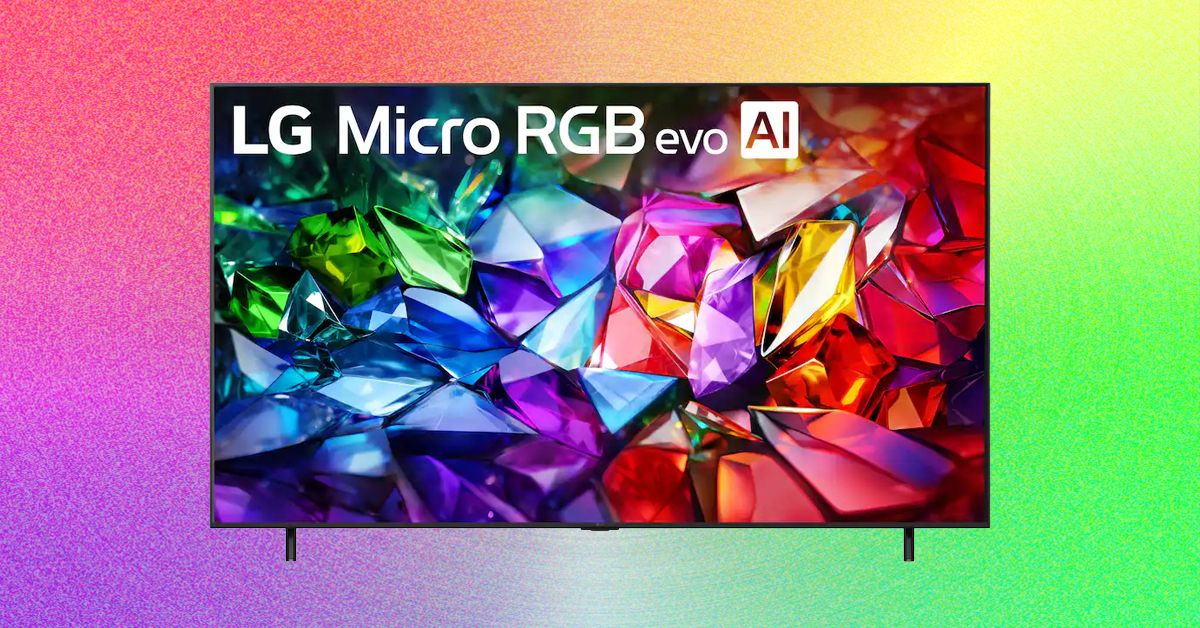
LG’s new Micro RGB Evo TV landed well in WIRED’s testing, with reviewer John Brandon giving the 75-inch model an 8 out of 10 after finding that its color, brightness and contrast can compete with high-end OLED and QLED sets. The catch is the usual flagship-TV nonsense: it costs a lot, and getting the best image means spending time in menus instead of watching the thing.
Brandon tested the 75-inch Micro RGB Evo, the smallest model in LG’s line, which retails for $5,000 and was listed at $4,500 at Best Buy and LG. LG also sells 86-inch and 100-inch versions priced at $7,000 and $8,000, respectively.
The set uses micro RGB backlighting, a newer display approach that uses tiny red, green and blue LEDs to improve color control, brightness, contrast and black levels compared with traditional LED TVs. Brandon notes that micro RGB is distinct from mini RGB, which uses larger LEDs and theoretically offers less fine-grained control over the picture.
That distinction matters because LG is asking buyers to pay more than many competing sets. WIRED compared the LG with Samsung’s Micro RGB R95H, TCL’s RGB Mini-LED RM9L, Hisense’s UR9 RGB MiniLED and Sony’s Bravia 7 Mark II. Brandon’s verdict: LG and Samsung’s micro RGB models produced better overall picture quality than the mini RGB sets, though the improvement may not justify the price gap for every buyer.
Strong hardware, fussy software
The 75-inch unit weighs 88.6 pounds, according to Brandon, and can sit flush to a wall if mounted. He used the included stand, which attached with two screws. The TV includes four HDMI 2.1 ports, including one with eARC audio passthrough, plus Ethernet, optical audio, coaxial and two USB 2.0 ports. It supports Wi-Fi 5, while WIRED notes Hisense’s UR9 uses Wi-Fi 6E.
LG runs the TV on webOS 26 rather than Google TV. Brandon found the software crowded with preinstalled apps, including free channel apps and a webcam app he did not need. He also criticized the non-backlit remote, saying the home button is hard to find in the dark, the input control is not obvious and muting requires holding the volume button.
Privacy-sensitive buyers do get one useful switch: Brandon says disabling LG’s Live Plus feature stops the TV from tracking viewing for recommendations. Voice control through LG’s assistant handled some settings changes, though its search results did not surface free options on Tubi or Plex for the older film Malice, according to the review.
The panel shines after tuning
WIRED’s testing found the Micro RGB Evo strongest when picture settings were adjusted. Brandon said Filmmaker mode looked more accurate, while Vivid and CinemaHome modes made darker colors stand out more. The TV supports the full BT.2020, DCI-P3 and Adobe RGB color gamut specifications, and Brandon reported especially rich color in Disney+ titles including Guardians of the Galaxy Vol. 2 and Inside Out.
In Spears & Munsil benchmark tests, Brandon found skin tones better than on the Hisense UR9, Sony Bravia 7 II and TCL RM9L. He also saw strong brightness and color in grass, flowers and sunset scenes. OLED still had an edge in some contrast-heavy scenes, particularly black foreground detail against dark backgrounds.
Gaming results were mixed. With an Xbox Series X, the TV automatically enabled Game Optimizer mode and ran at 120 Hz. With a gaming laptop, Brandon said the set supported 165 Hz with low latency. LG’s claimed Motion Booster variable refresh rate mode, which should support 330 Hz, produced flickering and rainbow effects in PC games during testing. LG representatives told WIRED they are investigating.
Brandon’s bottom line is that LG’s Micro RGB Evo can look excellent, but it asks buyers to pay premium money and then do calibration homework. Hisense’s cheaper UR9 may be good enough for buyers chasing bright, vivid images. LG’s set appears aimed at people who want one of the best micro RGB panels available and are willing to pay for the last few inches of picture quality.
This story draws on original reporting from WIRED.