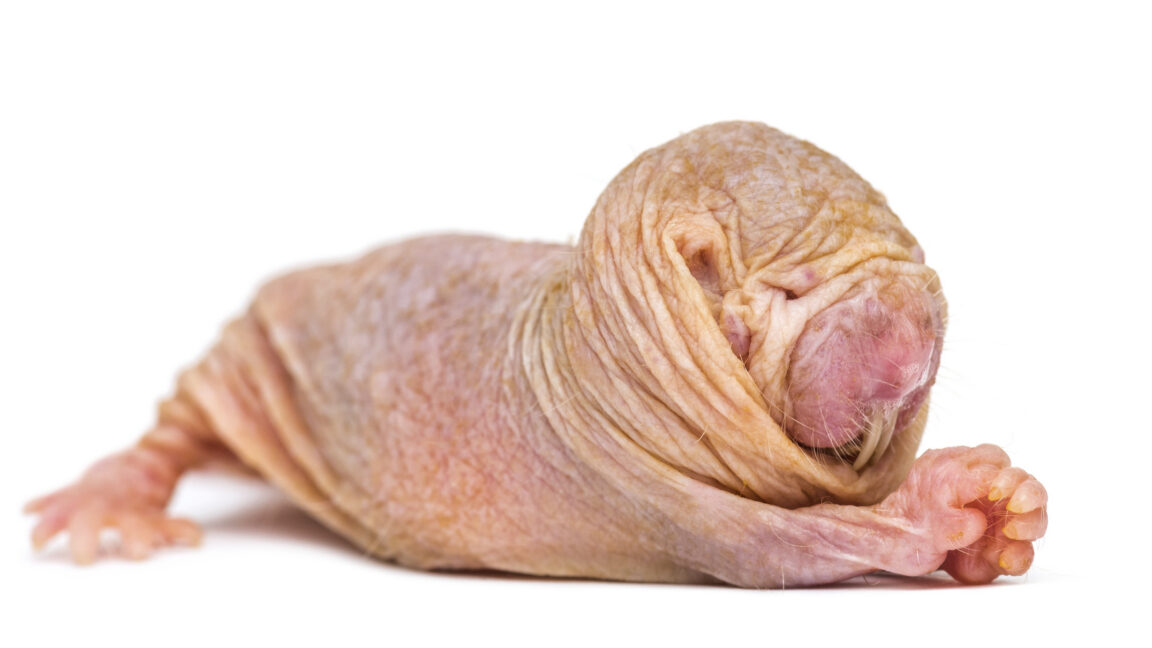
Naked mole-rat queens appear to police reproduction with chemistry, not just teeth. Researchers at the Max Delbrück Center for Molecular Medicine in Berlin report in Nature that breeding females produce a scent molecule, isopropyl myristate, that suppresses fertility in other females and can keep a queenless colony from replacing its ruler.
That matters because naked mole rats run mammal society in a very un-mammal way. A colony can contain more than 100 animals, but only one female breeds. The rest live as workers, foragers, soldiers, and higher-ranking animals that might get a shot at reproduction if the queen disappears. Scientists had suspected aggression helped maintain that order. Gary Lewin, a neurobiologist at Max Delbrück and senior author of the study, said the new work points to an olfactory control system doing much of the work.
The animals are built for smell. Lewin said naked mole rats have about 1,200 olfactory receptor genes, more than mice and far more than humans. They also live underground and have poor vision, so odor is not a decorative sense for them. It is infrastructure.
How the researchers found the signal
Lewin’s team collected body odors from individual mole rats by holding absorbent plastic tubes near them for about half an hour, then ran the captured volatile molecules through mass spectrometry. Across hundreds of animals, the researchers found roughly 100 chemical components and could distinguish colony-specific odor signatures.
Those signatures had consequences. When animals from different colonies met, they sniffed each other for about 40 seconds and attacked strangers, sometimes lethally, according to the study. When the scientists temporarily disabled olfactory sensory neurons, that stranger-directed aggression vanished. In Lewin’s description, the animals stopped fighting once they could not smell the difference.
The more consequential finding was a compound detected in queens and not in nonbreeding animals: isopropyl myristate, an ester. The team found that queens secreted it from their genitals and spread it through tunnels as they moved. Its levels rose and fell with the queen’s reproductive cycle, peaking when she was fertile or pregnant, Lewin said.
The molecule also had the right physical behavior for a burrow-wide signal. Although volatile, it remained detectable on cage surfaces about 24 hours after application. For an animal whose colony tunnels can stretch up to three kilometers, persistence is not a small engineering detail.
A contraceptive cue
The team then tested whether the molecule did anything beyond announcing the queen’s presence. In T-maze experiments, higher-ranking females avoided the scent. Lewin said the researchers suspect those animals may avoid queens in normal colony life because queens can be aggressive toward potential rivals, though he said the study did not prove that explanation.
Functional ultrasound imaging showed that puffing isopropyl myristate onto an animal’s nose activated a large part of the olfactory cortex, according to Lewin. Hormone measurements tied the signal to reproduction. In nonbreeding females, prolactin levels were high while progesterone was low. When a queen was removed, prolactin fell and progesterone rose. Reintroducing isopropyl myristate reversed those changes, the researchers found.
The strongest test removed the queen but left her chemical calling card. Mating pairs kept away from a queen usually began breeding within four or five weeks, according to the study. Daily application of isopropyl myristate prevented pregnancy. In queenless colonies dosed daily for three months, the researchers reported no replacement queen emerging and no deadly succession fights.
Lewin compared the mechanism to eusocial insects, where queens can use pheromones to stop worker daughters from developing ovaries. The mammal version is not identical, but the logic is familiar: a reproductive monopoly enforced by a chemical broadcast.
The broader implications are unresolved. Lewin noted that isopropyl myristate has been found in breast secretions from lactating humans, but said its function there is unknown. The Nature paper identifies a reproductive control signal in naked mole rats. It does not show that the same molecule regulates fertility in people or other mammals.
This story draws on original reporting from Ars Technica.