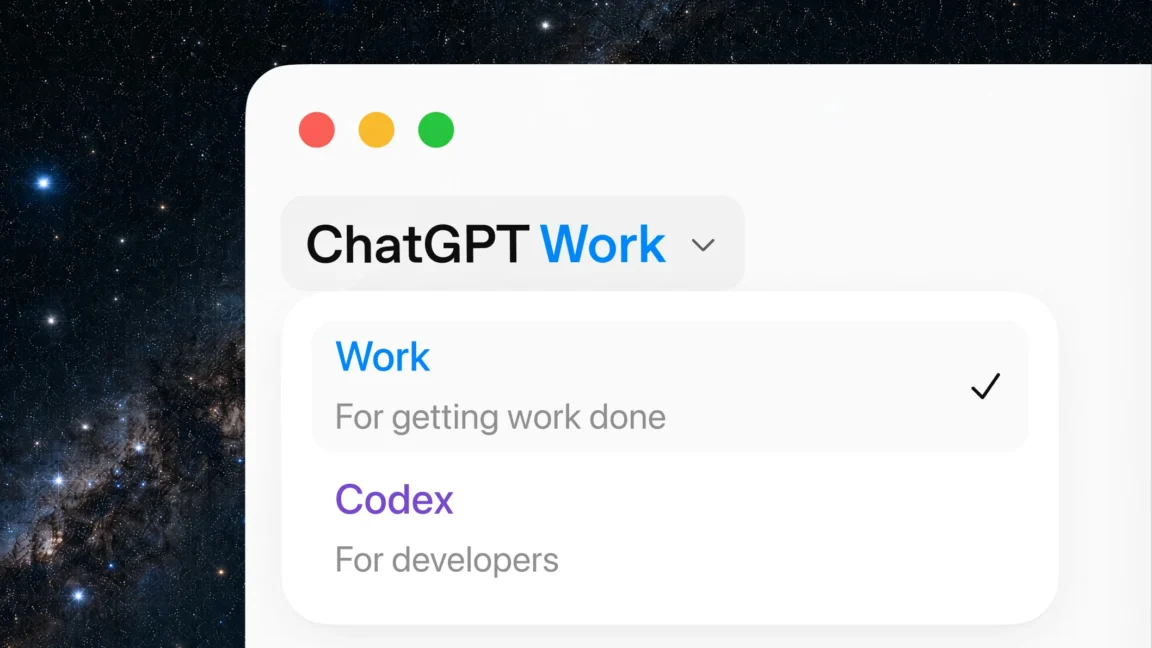
OpenAI has launched ChatGPT Work, a new agentic mode meant to carry out longer office tasks across files, browsers, and workplace apps. The pitch is blunt: give the system a goal, connect it to the tools where the work lives, and let it produce something closer to a finished deliverable than a chat response.
OpenAI says the tool can stay on a project for hours when needed. That is a direct attempt to fix a limitation Ars Technica found last year while testing Agent Mode in OpenAI’s Atlas browser, where automated tasks tended to stop after a few minutes and struggled with work that required persistence.
The company is asking users to test ChatGPT Work on tasks they already understand, such as budget analysis or sales meeting preparation. OpenAI also says the system can string together larger workflows, including customer research, campaign briefs, and localized marketing materials. For actions OpenAI considers important, the company says the tool will wait for user approval.
Workplace access, with admin controls
ChatGPT Work can connect to Slack, Microsoft Teams, Google Drive, SharePoint, and other workplace systems through custom plugins, according to OpenAI. The desktop version can also read and change local files, and it includes a browser for online resources.
OpenAI says an updated ChatGPT Chrome extension will let users run web-based tasks from the browser. At the same time, the company says it is retiring Atlas, its own browser, less than nine months after launch. That is a quick reversal for a product that was supposed to make browsing and chatting feel like one surface.
The system can decide on its own when it needs outside resources to complete a request, OpenAI says. Users can also point it at a specific connected app by using an “@” reference. For companies that do not want an AI agent rummaging through everything with a login token, OpenAI says access can be restricted through its Compliance API and enterprise or admin controls.
Scheduled Tasks are also part of ChatGPT Work. OpenAI describes them as a more capable version of scheduled automation, able to run repeated jobs on a timetable or in response to monitored events. The company says these tasks can continue when a user is away from a desk and can be checked from a phone.
Codex folds in, and the meter keeps running
OpenAI is also rearranging its product lineup around the launch. The company says its coding-focused Codex app is merging with ChatGPT Work, while also saying Codex technology is built into ChatGPT Work and remains available as a separate view inside the new ChatGPT app. The Work view sits alongside it.
The existing ChatGPT desktop app is being renamed ChatGPT Classic. OpenAI says the basic conversational mode is being pushed into a requested “quick chat” button on desktop and a dropdown on mobile. The Codex view is not available on mobile, according to OpenAI.
The distinction affects billing. OpenAI says ChatGPT Work is designed for longer and more involved tasks than a normal chat request, and that those jobs may use more of a plan’s included usage. The company says ChatGPT Work uses the same billing structure as Codex, with plans reaching $100 per month and usage governed by credits.
For Enterprise and Edu customers, OpenAI says administrators can set overall spending limits, as well as limits for groups or individual users. That is a practical nod to the uncomfortable part of agentic software: a tool that runs longer can also burn through more tokens.
OpenAI announced ChatGPT Work alongside GPT-5.6, a new model the company says offers stronger performance per dollar for difficult work. OpenAI says the model runs in three tiers. The highest-performance tier costs $5 per million input tokens and $30 per million output tokens.
This story draws on original reporting from Ars Technica.