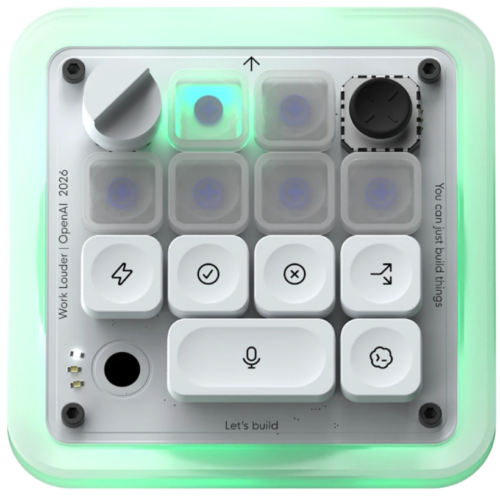
OpenAI is introducing its first branded hardware: a small, RGB-lit keyboard for people running several Codex agents at once. The device is called Codex Micro, costs $230, and is being sold as a limited-run collaboration with keyboard maker Work Louder.
The useful part is not the branding. It is the status display. According to OpenAI and Work Louder, six frosted keys across the top two rows can show live updates for as many as six Codex threads, including threads that are not currently visible on the user’s screen. For anyone trying to babysit multiple coding agents, that turns a chunk of desk hardware into a tiny traffic light system.
The color scheme is straightforward. A white key means a thread is idle. Blue means Codex is working. Green means the task is finished. Amber asks for a human response or decision. Red means the thread has hit an error. Pressing the illuminated key is meant to bring the relevant Codex window to the front.
A keyboard shell with OpenAI-specific behavior
Work Louder already sells a similar-looking product line called Creator Micro, a family of compact, square, customizable keyboards aimed at creative workers. The Codex Micro appears to differ mainly in how it is wired into Codex: the six frosted keys are assigned to agent status rather than being generic shortcut keys.
That makes the device less like a new category of computer and more like a purpose-built control surface. It does not replace the Codex interface. It gives users a peripheral that can signal when an agent needs attention, without forcing them to keep every task window open and visible.
The launch lands while OpenAI is also the subject of hardware rumors, including reports about a personalized smart speaker and other audio-based devices. Codex Micro is much narrower than that. It is a branded accessory for a specific workflow: watching automated coding threads, clicking into the one that needs a human, and ignoring the ones still grinding away.
The companies describe the product as limited-run, so this is not yet evidence of OpenAI becoming a general-purpose hardware vendor. It does show OpenAI putting its name on desk hardware tied directly to its software, which is a more concrete step than the usual vapor cloud around AI gadgets.
This story draws on original reporting from Ars Technica.