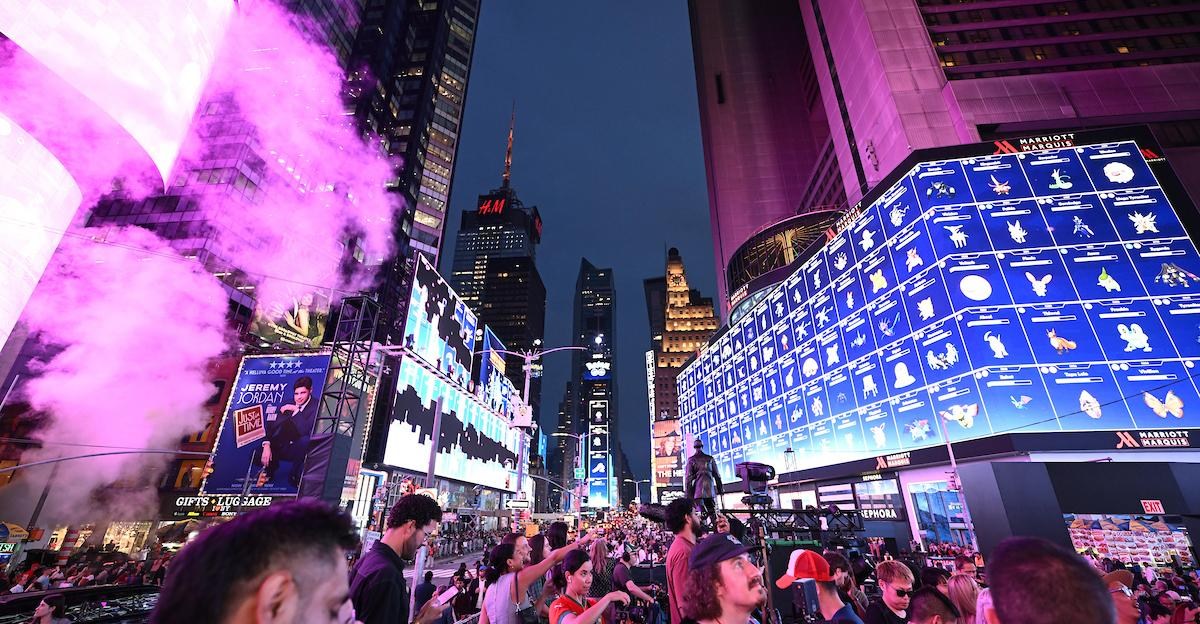
Scopely used Pokémon Go’s 10th anniversary event in New York City to do the thing Niantic sold in the game’s first trailer: get a crowd in the real world to gang up on a legendary pokémon.
On Thursday evening, almost 2,000 players gathered in Times Square for a special Mewtwo battle, according to The Verge. Many of the attendees were Pokémon Go influencers. The staging was not subtle: Times Square’s screens briefly went dark before the billboards lit back up with an escaped Mewtwo that Mega Evolved, The Verge reported, citing the event display.
The point was less about one more raid boss and more about whether Pokémon Go’s old promise still works at city scale. The 2015 trailer showed players sprinting through real streets, converging on a public space, and fighting Mewtwo together. When the game launched in 2016, that was still aspirational. Raids, the system that lets groups fight powerful monsters at fixed locations, had not yet been added.
Pokémon Go’s basic loop has remained recognizable since launch. The game uses location data to place catchable pokémon and activities on a map of the player’s surroundings. For raids, players physically approach an in-game gym, join a timed battle, and combine their damage output to defeat a boss before trying to catch it. That is the machinery behind the fantasy, with GPS, servers, and crowd logistics doing the unglamorous work.
Scopely frames it as a promise kept
Scopely, which bought Niantic’s games business last year, presented the Times Square raid as a milestone for the live game. In a press release, Michael Steranka, Scopely’s vice president of product, said that hosting more than a thousand people in one local raid battle had once seemed out of reach. He called the Times Square event a fitting way to mark 10 years of community play.
The company has reasons to talk about competence now. Pokémon Go’s first major in-person event in Chicago in 2017 became an example of how not to run a location-based game gathering. Thousands of players arrived, but network congestion and software problems disrupted the event. Niantic later accepted responsibility for the failure.
Steranka joined Niantic that year to help coordinate the Chicago event. During a press briefing this week, he said he believed at the time that he “should have been fired” over how it went. He also said the Pokémon Go team responded by meeting offsite in Seattle to study the failure and work out fixes rather than assigning blame.
Scopely now treats these gatherings as a central part of the business, not fan-service confetti. The company told Wired that Pokémon Go has been downloaded more than 800 million times since launch and generated $1 billion in 2025. Those figures are company claims, but they explain why Scopely talks about the game as long-running infrastructure rather than a nostalgia app with Pikachu on it.
Ed Wu, Scopely’s games president, said in a statement that Pokémon Go has grown from an invitation to explore nearby places into a game that connects players through local meetups and larger celebrations. Wu did not give specifics when asked by The Verge how the team plans to change the game next. He said Scopely is looking at how different generations introduce one another to Pokémon and how gyms can support local communities.
The anniversary event continues this weekend with the 2026 global Pokémon Go Fest. According to The Verge, the event will add more Mewtwo encounters and cooperative challenges across the game’s map. New mainline Pokémon titles are also scheduled for next year, giving Scopely another likely wave of monsters, and players, to feed into Go.
This story draws on original reporting from The Verge.