Rocket Lab has unveiled the GHOST portable spaceport system, saying it could make Electron and HASTE launches more mobile, while Blue Origin has started developing a second New Glenn launch pad at Cape Canaveral. Both announcements concern launch-site capacity, though neither establishes an operating capability yet.
GHOST, short for Global Hypersonic & Orbital Spaceport Technology, is Rocket Lab’s proposed deployable ground system for its Electron orbital rocket and HASTE suborbital test vehicle. Rocket Lab says the system is intended to support multi-launch campaigns and national-security missions from locations beyond its established sites. The company’s “launch-anywhere, launch-anytime” description is a company claim; no operational deployment date was disclosed in the reporting.
What is Rocket Lab’s GHOST portable spaceport for?
GHOST is meant to move the ground infrastructure needed to launch Electron or HASTE, rather than requiring every mission to originate from a permanent Rocket Lab pad. Ars Technica reported that the idea grew from a HASTE customer’s request for greater mobility. HASTE is Rocket Lab’s suborbital vehicle for hypersonic testing, while Electron is its small orbital launcher.
Rocket Lab currently launches from New Zealand’s North Island and Wallops Island, Virginia. The company has also announced plans to fly from Alaska’s Pacific Spaceport Complex, Ars Technica reported. GHOST would represent a further expansion of potential launch locations if Rocket Lab delivers the system as described.
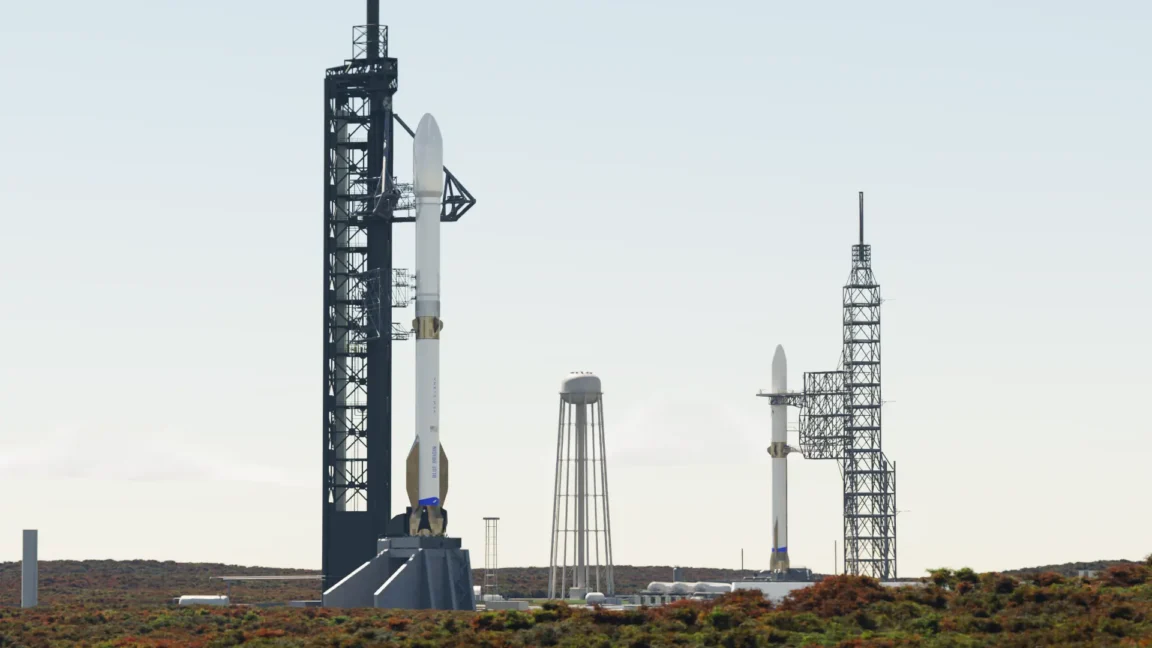
Blue Origin, meanwhile, said August 12 that it had begun construction of Launch Complex 36B at Cape Canaveral Space Force Station. The new site is being developed for New Glenn’s planned 9x4 vehicle, according to the company. The project would return Complex 36 to a two-pad arrangement, but LC-36B is under development, not an active launch site.
How would Blue Origin use two New Glenn pads?
Blue Origin has described a common operating approach across two pads using a mix of horizontal and vertical integration. Spaceflight Now reported that the company plans to assemble New Glenn’s stages in a horizontal integration facility near LC-36A, move the vehicle to the pad, then lift it upright by crane. The approach uses existing infrastructure and avoids building a new transporter-erector, according to Blue Origin’s description cited by the outlet.
The second-pad project arrives while Blue Origin works through the aftermath of a New Glenn anomaly. Chief executive Dave Limp said early analysis pointed to the aft section of the first stage, Spaceflight Now reported. The outlet also reported that pad damage and the investigation moved the first Blue Moon Mark 1 cargo-lander mission to early 2027, while NASA Administrator Jared Isaacman said Blue Origin was committed to resuming launches before the end of 2026. Those are targets and expectations, not a confirmed return-to-flight date.
Rocket Lab is pitching portable infrastructure for smaller vehicles; Blue Origin is building fixed capacity for a much larger one. The common thread is flexibility, but each remains a plan with hardware and operations still to prove.
This story draws on original reporting from Ars Technica.