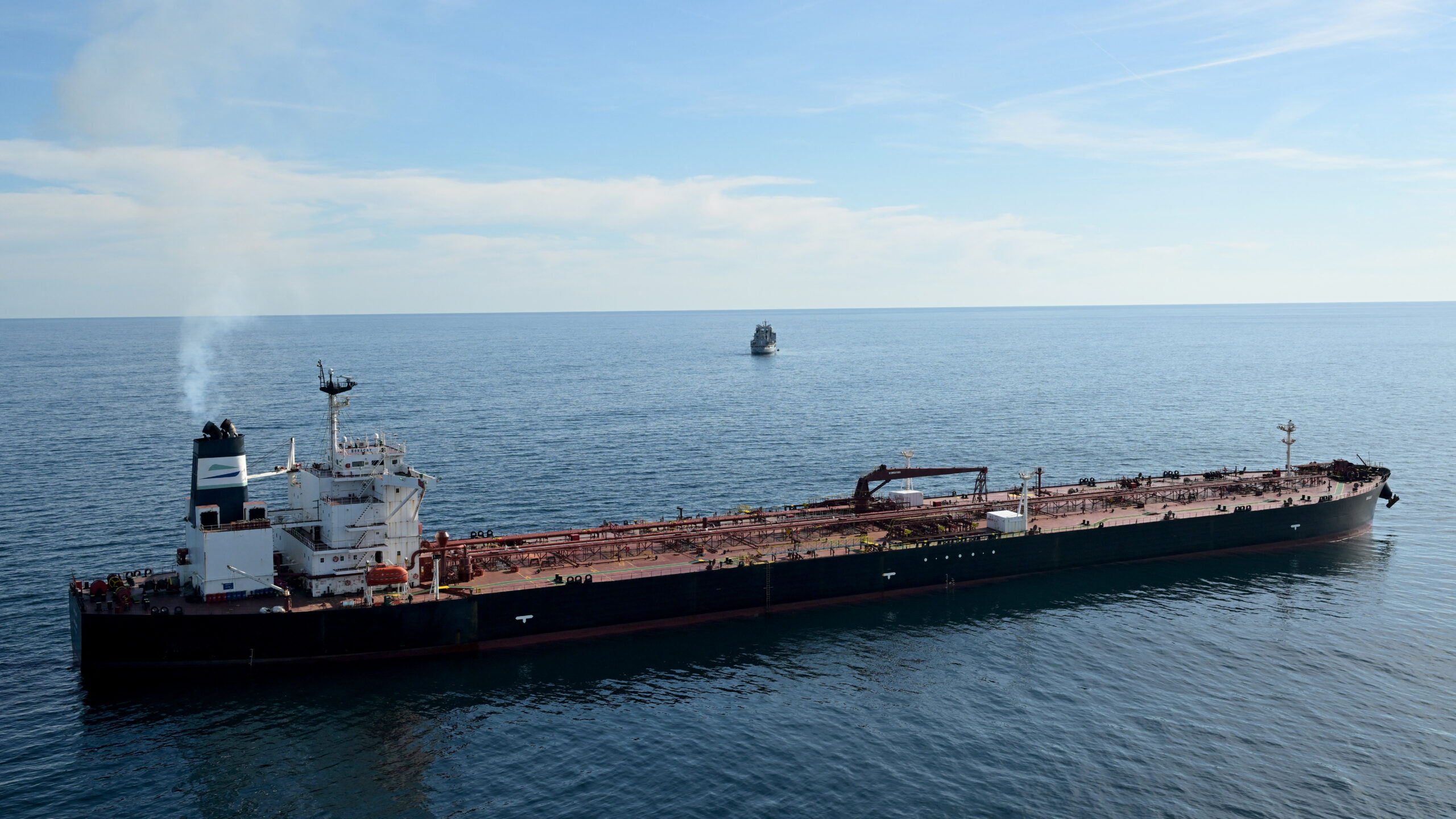
A UK defence think tank says a string of drone flights over European airports, military bases and infrastructure may have been run from Russian-linked commercial ships, including vessels in the so-called shadow fleet used to move sanctioned Russian oil.
The International Institute for Strategic Studies said its assessment used automatic identification system ship-tracking data and other public information to compare vessel movements with drone incidents across Europe. The report covers 144 drone sightings between August 2024 and February 2026 in a dozen NATO countries and Ireland that IISS judged unlikely to be recreational flights or activity tied directly to the war in Ukraine.
IISS did not say every sighting was Russian, or even that every report described a real drone. Its claim is narrower and more useful: the pattern fits an effort by the Kremlin to test air defences, stress civilian and military response systems, and make small airspace violations feel routine without crossing the line into an armed attack.
The report said 48 percent of the identified sightings occurred over military bases, 26 percent over critical infrastructure such as ports, energy sites and industrial facilities, and 18 percent over civilian airports. Most were reported at night or before dawn. Media accounts often described the aircraft as professional or military-style drones.
Only one case has been confirmed
The clearest attribution came in February 2026, when Sweden’s military said it observed and jammed a drone launched from the Russian signals-intelligence ship Zhigulevsk in Swedish territorial waters. The incident happened while the French aircraft carrier Charles de Gaulle and escort ships were nearby during a Sweden visit.
That case matters because it shows the basic mechanism is real: a Russian vessel can launch a drone at sea for surveillance. The rest of the IISS case relies on pattern-matching, proximity and capability, which is suggestive rather than conclusive.
IISS named several Russian drone types that could fit some incidents. The Merlin-VR, a fixed-wing Russian drone, can be launched by catapult from a ship and recovered by parachute, according to the report. Russian vertical-take-off drones, including the Legioner E29, would need little deck space. The report also said commercial or homemade drones could be modified to muddy attribution.
The Orlan-10 appears repeatedly in the assessment. IISS said the fixed-wing drone has a 500-kilometer operating range, endurance of up to 12 hours, and speeds between 90 and 130 kilometers per hour. Those characteristics would allow launch from a vessel outside visual range of some European coasts. The Orlan-10 can carry optical and thermal sensors, communications-monitoring equipment and modules that spoof GPS and other navigation signals, according to IISS.
Bases, airports and suspicious ships
In November 2024, drones were reported over RAF Lakenheath, RAF Fairford, RAF Feltwell and RAF Mildenhall in the UK, bases used by US Air Force personnel and aircraft. The Guardian reported in June 2026 that RAF Lakenheath is due for more than $1.6 billion in upgrades, including facilities connected to housing a nuclear arsenal.
IISS said those UK incidents coincided with the presence of the Hav Dolphin, an Antigua and Barbuda-flagged cargo ship with a Russian crew, docked in the UK. German authorities later investigated the same ship after it anchored near Kiel in May 2025, around the time drones were seen near the German submarine base at Eckernförde.
Other reported incursions included flights over Kleine-Brogel Air Base in Belgium, Ramstein Air Base in Germany, Volkel Air Base in the Netherlands and France’s Île Longue submarine base. Stars and Stripes has reported that Kleine-Brogel houses US nuclear weapons under NATO nuclear sharing, and IISS said Volkel hosts aircraft capable of carrying US nuclear bombs.
The report also highlighted the tanker Boracay, which Danish authorities investigated after September 2025 drone sightings disrupted airports across Denmark, including Copenhagen Airport, and temporarily closed Aalborg Royal Danish Air Force base. After French naval commandos boarded the ship, IISS said they found a Chinese captain and two Russians employed by Moran Security Group, a Russian private military company founded by former Federal Security Service officers. One had also worked for Wagner Group.
According to IISS, interviews indicated the Russians were tasked with intelligence gathering, vessel protection and ensuring the captain followed Russian interests. A French court later sentenced the captain in absentia to one year in prison and fined him $172,000 for failing to obey orders to stop the ship.
The European Union is developing a European Drone Defence Initiative to help countries detect, track and defeat drones with interoperable systems. The system is not expected to be fully functional until the end of 2027. IISS warned that hardware will not solve the harder questions: who has authority to shoot, jam or seize, and how far European governments are willing to go against Russian-linked ships loitering near their coasts.
This story draws on original reporting from Ars Technica.