Samsung has introduced the Galaxy Z Flip 8, and the clearest change is not a bigger inner display or a camera overhaul. It is the outside screen, which Samsung is turning into a more complete phone interface for people who do not want to open the handset every time they check something.
The Verge’s David Imel, who spent three hours with the device, reported that the Flip 8 looks much like the Galaxy Z Flip 7. The main hardware outline is familiar: a 6.9-inch FHD+ AMOLED display inside, a 4.1-inch Super AMOLED cover display outside, a base configuration of 12GB of RAM and 256GB of storage, and a 4,300mAh battery.
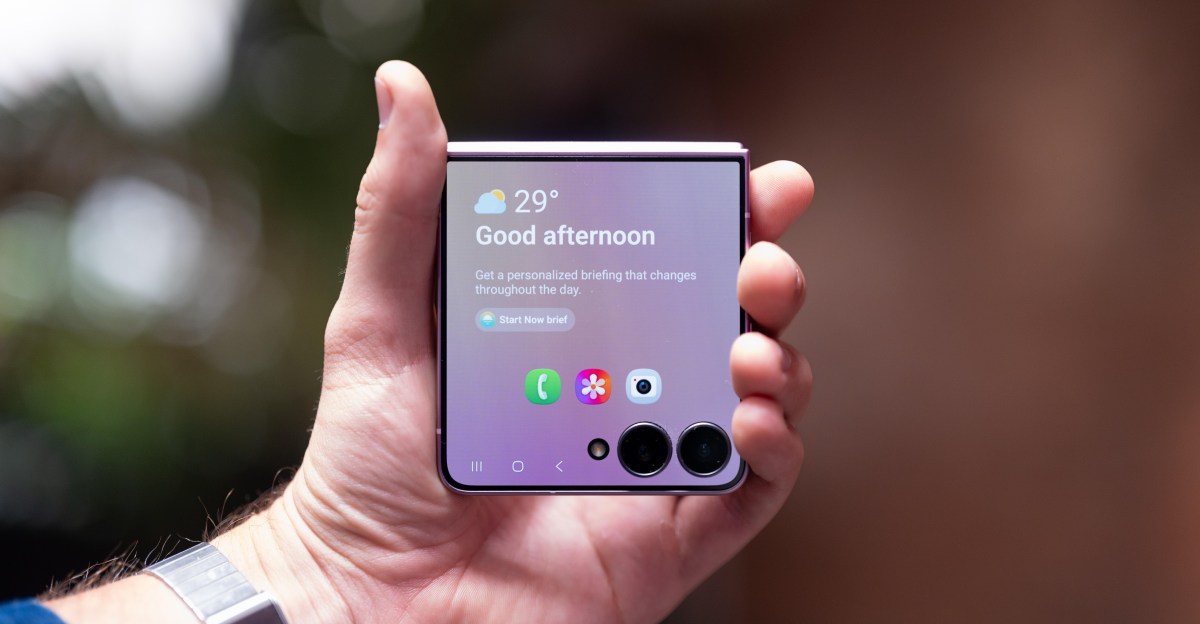
The difference is how much Samsung now lets users do while the phone is closed. The outer display has three new gestures. A swipe down from the top left opens notifications, a swipe down from the top right opens quick settings, and a swipe up from the bottom brings up something close to an app drawer.
That last part is the practical shift. On earlier models, running apps on the cover screen leaned on Samsung’s Good Lock software, which worked more like an enthusiast workaround than a default mode. On the Flip 8, Samsung has made cover-screen app access a native feature. The result, according to Imel, is a flip phone that can behave more like a small square smartphone when shut, which may be useful or may defeat part of the self-restraint appeal of a clamshell device.
Thinner body, new display stack
Samsung says the Galaxy Z Flip 8 is the thinnest and lightest flip phone currently on the market. The company lists it at 13.1mm thick when folded, 6.1mm when open, and 180g. That still leaves it thicker than a standard slab phone when closed, and The Verge notes that Samsung’s Galaxy Z Fold 8 Ultra is thinner when unfolded at 4.1mm.
Samsung attributes part of the slimmer design to its Flex Titanium display technology, also used in the new Z Fold 8 and Z Fold 8 Ultra. According to Samsung, the display stack uses a thinner titanium film beneath the OLED panel and tighter bonding between the base plate and the display module. The company also claims the display is 20 times more durable. That is Samsung’s durability claim, not an independent torture-test verdict, so keep the confetti in the drawer for now.
The battery changed internally as well. Samsung has moved the Flip 8 to silicon carbon battery technology, which can store more energy in a given physical space than conventional lithium-ion cells. Samsung told The Verge it uses less silicon than some competitors for safety and longevity reasons. In this phone, that does not translate into higher capacity or faster charging compared with the Flip 7. It lets Samsung make the battery smaller while keeping the same 4,300mAh capacity.
Cameras stay put, software gets more ambitious
Anyone waiting for Samsung to bring its higher-end foldable camera hardware to the Flip line will have to keep waiting. The Flip 8 uses the same camera hardware as the Flip 7, according to The Verge: a 50-megapixel main camera and a 12-megapixel ultrawide. It does add Samsung’s Super Steady Horizontal Lock feature.
Samsung also showed a new “Now Brief” widget generator. In the demo seen by The Verge, the phone created a custom widget to show pollen levels each morning. Imel reported that Samsung presented the feature as flexible enough to generate many types of widgets, though longer testing will be needed to see how well that holds up outside a controlled demo.
The Galaxy Z Flip 8 starts at $1,199.99. That is $100 more than the Flip 7’s $1,099.99 launch price for the same starting memory and storage configuration.
This story draws on original reporting from The Verge.