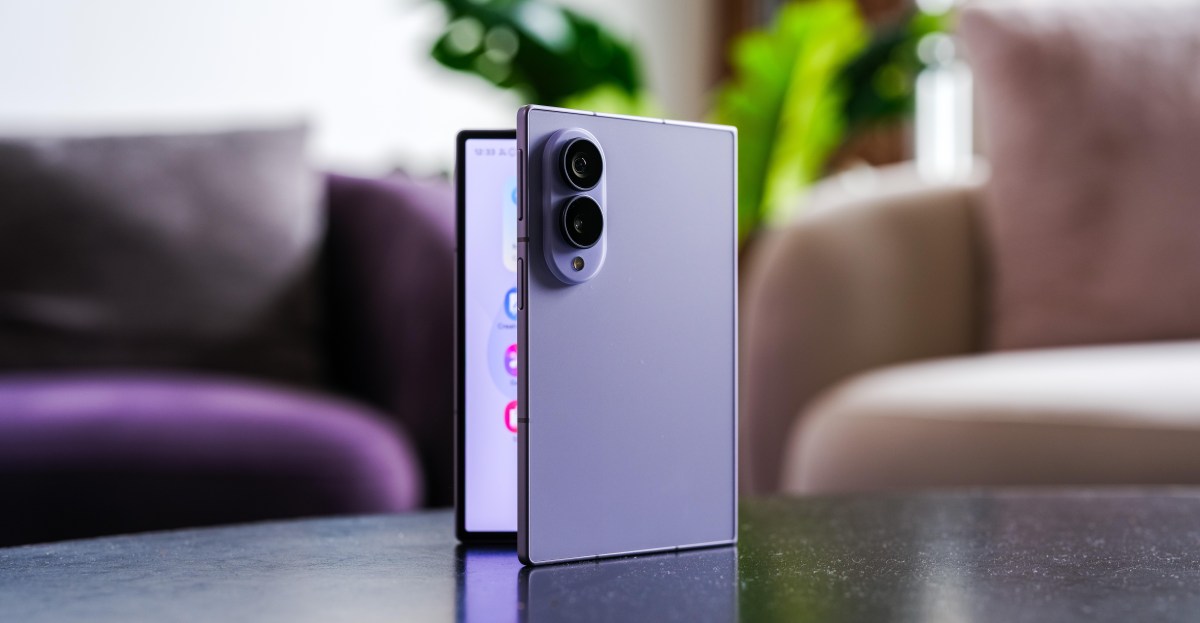
Samsung has given the Galaxy Z Fold 8 a new body shape, and that change does more than make the company’s foldable lineup harder to parse. The $1,899.99 phone is shorter and wider than earlier Galaxy Z Fold models, with a 4:3 inner display aimed more at video, reading and games than the split-screen productivity pitch Samsung has pushed for years.
The Verge’s Dominic Preston, who handled the device after Samsung’s July foldable launch, said the squat design was more comfortable in person than it looked in photos. He compared its height to a passport, with a slightly narrower width, and said the open phone felt closer to a small tablet than Samsung’s previous squarer Folds.
Samsung is now splitting the Fold job in two. The Galaxy Z Fold 8 Ultra, priced at $2,099.99, keeps a taller closed shape, a squarer inner screen and a triple rear camera setup similar to the older Fold line. The regular Z Fold 8 gets the wider panels and a simpler camera system, making it feel less like a direct successor to the Z Fold 7 and more like a side branch.
The pricing makes the naming a little too convenient. Samsung raised the top-end Fold price by $100 compared with the Z Fold 7, while the regular Z Fold 8 sits $100 below that older model’s launch price. Buyers still looking at a nearly $1,900 phone are unlikely to mistake this for thrift.
A wider screen with some tradeoffs
The inner display uses a 4:3 aspect ratio. According to Preston’s hands-on report, that means most YouTube and streaming video still shows black bars, but the picture is larger than on Samsung’s prior Fold shape. Samsung says the wider model is built for media consumption, while the Ultra is meant for heavier multitasking, with enough room for two phone-sized apps side by side.
Closed, the Z Fold 8 has a 10:16 cover display. Preston said the width was less awkward than expected, though he raised the obvious concern that a case could make one-handed use worse. Samsung has said Instagram is among the apps being optimized for the shorter screen.
Inside, Samsung uses Qualcomm’s Snapdragon 8 Elite Gen 5, tuned with Samsung, and a 120Hz OLED main display with a claimed 3,000-nit peak brightness and an anti-reflective coating. The software includes Gemini Intelligence task automation and Samsung’s Now Nudge feature, which suggests actions across apps, such as adding calendar entries or sending emails.
The battery improves, the camera gets thinner
Samsung is also using silicon-carbon batteries in its new foldables for the first time. The chemistry adds silicon to the graphite anode, which can raise energy density, though silicon expansion and long-term stability remain engineering problems. BD Yang, executive vice president of Samsung’s core component technology team, told The Verge that Samsung focused on managing reactivity, swelling and battery life rather than chasing capacity alone.
The Z Fold 8’s battery is rated at 4,800mAh, up from 4,400mAh in the Z Fold 7. That is still well behind Honor’s Magic V6, which The Verge lists at 6,660mAh.
The camera setup is the obvious compromise. Samsung dropped the telephoto camera from the regular Z Fold 8, leaving two rear cameras with 50-megapixel sensors for the main and ultrawide. The main camera may be a step down from the Z Fold 7’s 200-megapixel unit, though sensor size, aperture and real-world processing will decide more than megapixels alone.
Samsung also remains at IP48 for its new foldables, which means limited dust resistance compared with Google’s Pixel 10 Pro Fold. The company says it reworked the hinge and display stack with titanium-alloy film and a titanium plate, while new magnets make the phone easier to open and close. Qi2 magnetic charging support is still absent.
This story draws on original reporting from The Verge.