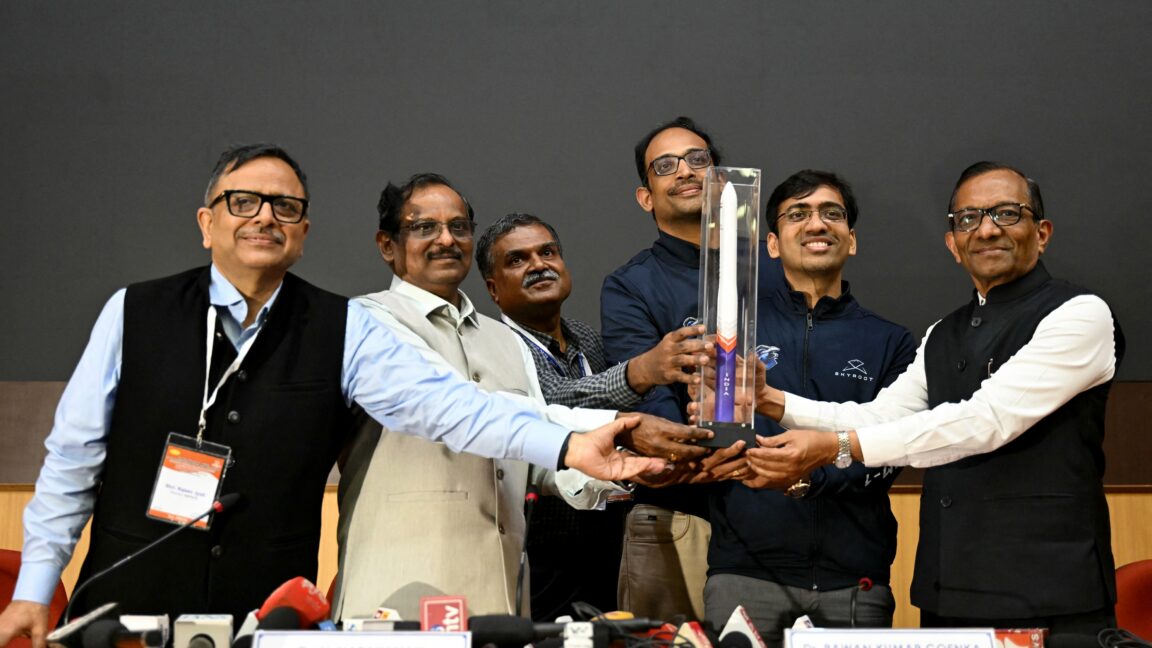
Skyroot Aerospace put its Vikram-1 rocket into orbit on its first try Saturday, a result that gives India’s private space industry something more useful than a pitch deck: a working orbital launcher.
The 22-meter rocket lifted off from the Satish Dhawan Space Centre on Sriharikota Island at 06:35 UTC, after launch controllers paused the countdown for more than 30 minutes to address a late technical issue. Once the count resumed, Vikram-1’s solid-fueled first stage ignited and sent the vehicle off an Indian Space Research Organisation launch pad over the Bay of Bengal.
Skyroot said the rocket reached an orbit about 450 kilometers high at 60 degrees inclination, close to its prelaunch target. U.S. military tracking data also showed the vehicle had made orbit. The company’s upper stage deployed two small CubeSats and carried additional payloads that remained attached, according to Skyroot.
The flight was not entirely boring, which is normal for a first launch and bad for everyone’s blood pressure. During staging, the spent third stage appeared in onboard video to linger near the fourth stage instead of drifting farther away. The liquid-fueled fourth stage still lit its 3D-printed engine and accelerated the stack to orbital speed, about 17,000 mph.
A small rocket with large political weight
Vikram-1 is small compared with India’s government-built launchers, including the Polar Satellite Launch Vehicle and LVM3. Skyroot says its vehicle can carry up to 350 kilograms to low-Earth orbit, putting it in the dedicated smallsat launcher category, slightly above Rocket Lab’s Electron by stated payload capacity.
The vehicle uses three solid-fueled stages and a liquid-fueled fourth stage. Skyroot says it built the blue-and-white rocket largely from carbon composite materials. The rocket is named after Vikram Sarabhai, the physicist widely credited as a founder of India’s space program.
Pawan Kumar Chandana, Skyroot’s co-founder and chief executive, told the company’s launch team that reaching orbit on a first private attempt was a major milestone for India’s space sector. He also described the launch as more suspenseful than the company would have preferred.
The company had set a deliberately low bar before flight. In its mission materials, Skyroot said its main goal was to get off the pad, clear the tower, and collect ascent data. Pawan Goenka, chairman of IN-SPACe, the government body created in 2020 to support commercial space activity, said the mission objective was only about 100 meters of flight, while the rocket ultimately reached 450 kilometers and released its satellites.
ISRO helped, but Skyroot owns the result
ISRO said it supported Skyroot with access to solid motor casting and test facilities at Sriharikota, and by allowing the company to use one of the spaceport’s two active pads. That support matters, but it does not erase the engineering result: a private Indian company designed and built an orbital rocket that worked on debut.
Skyroot was founded in 2018 by Chandana and Naga Bharath Daka, both former ISRO engineers. The company previously flew the suborbital Vikram-S rocket to nearly 90 kilometers in November 2022. Chandana told Ars Technica before the Vikram-1 launch that Skyroot chose a solid-fueled design first to cut development time and launch cost.
Prime Minister Narendra Modi congratulated Skyroot after the launch, saying private-sector participation was opening new frontiers for India. Modi has pushed India’s space sector to grow from about five launches a year to 50 before the end of the decade.
Skyroot says its roadmap includes Vikram-1U, using strap-on solid boosters for heavier payloads, and Vikram-2, with a cryogenic upper stage and a stated low-Earth orbit capacity of 900 kilograms. Chandana has also described longer-term ambitions for larger liquid-fueled reusable rockets and launches from multiple countries. That part remains aspiration. Saturday’s orbit is the part already in the tracking data.
This story draws on original reporting from Ars Technica.