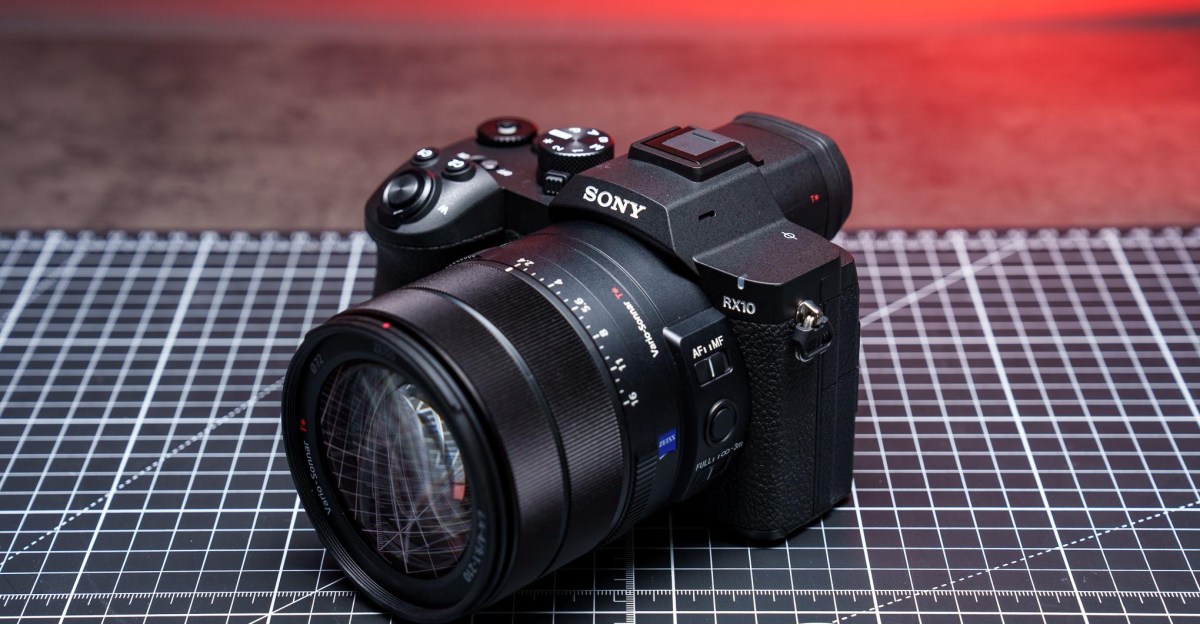
Sony has announced the RX10 V, bringing back its fixed-lens superzoom camera line after almost nine years without a new model. The pitch is familiar: one body, one lens, a lot of reach. The price is less cozy. Sony will sell the RX10 V for $2,299.99 when it launches in early August.
The camera keeps the 24-600mm equivalent f/2.4-4 Zeiss Vario-Sonnar 25x zoom lens used by the RX10 III and RX10 IV. That matters because the lens is the entire point of this kind of camera. Buyers get wide-to-supertelephoto coverage without carrying separate glass, which is why the RX10 line has long made sense for travel, sports, wildlife and other situations where swapping lenses is a chore or a dust invitation.
The real change sits behind that lens. Sony says the RX10 V uses a new 20.1-megapixel 1-inch-type stacked sensor. In practice, that stacked design lets the camera shoot continuous bursts at up to 30 frames per second without viewfinder blackout. The RX10 IV topped out at 24 frames per second, according to The Verge’s earlier coverage of that 2017 model.
That speed bump is aimed at the obvious targets: action, sports and wildlife photographers trying to catch a moving subject at the right instant. A blackout-free burst means the electronic viewfinder does not blank between frames, so the photographer can keep tracking the subject while the camera is firing. That is the sort of feature that sounds boring until a bird, player or race car leaves the frame while the finder is blinking at you.
Alpha parts move into a fixed-lens body
Sony also revised the RX10 V body to resemble its larger Alpha mirrorless cameras. The new model uses the NP-FZ100 battery found in many current A-series cameras, giving it more than 50 percent higher battery capacity than before, according to Sony’s stated specs as reported by The Verge.
The camera includes an OLED electronic viewfinder and a 3-inch rear touchscreen LCD with 1.62 million dots. The screen tilts rather than fully articulating, a choice that fits still-photo use more than vlogging or self-recording. The RX10 V weighs 2.45 pounds, or 1.1 kilograms, according to the published specifications.
Sony has also brought over autofocus and video features from its Alpha line. The RX10 V has 575 autofocus points and Sony’s real-time autofocus tracking system. It can detect subjects as well as the human form, which Sony uses to help the camera find and hold faces and eyes during movement.
For video, the RX10 V records full-width 4K at 60p and cropped 4K at 120p. It also includes S-Log3 and S-Cinetone color options, features more commonly associated with Sony’s larger hybrid cameras.
The price moved, too
The RX10 IV launched at $1,700 in 2017. The RX10 V arrives at $2,299.99, a jump that will test how many buyers still want a premium all-in-one camera in an era where interchangeable-lens mirrorless bodies dominate the serious camera shelf and phones handle casual zoom badly but conveniently.
Sony is betting there remains a market for a camera that does one awkward job well: give photographers a stabilized, long-range zoom package without the cost, weight and fuss of a full-size 600mm lens setup. The unchanged lens will annoy spec-sheet romantics. The stacked sensor and Alpha-derived autofocus are the parts that may actually matter in the field.
This story draws on original reporting from The Verge.