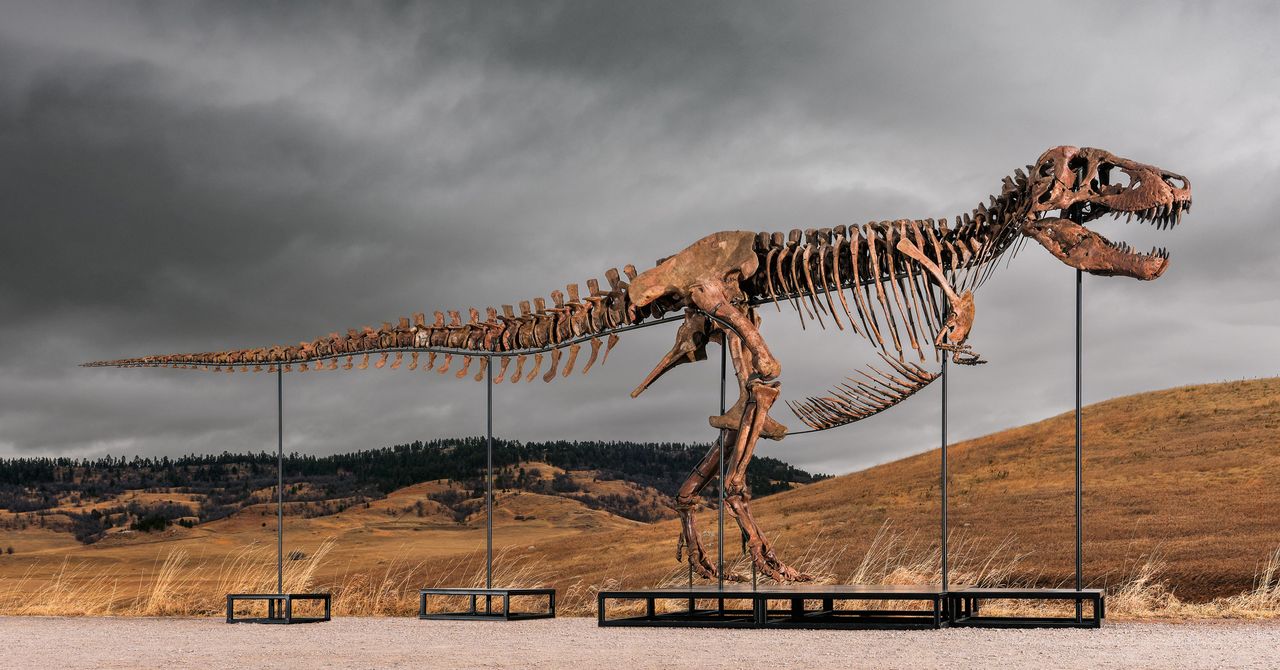
Sotheby’s will open live bidding on July 14 for a 67-million-year-old Tyrannosaurus rex skeleton called Gus, with an estimate of up to $30 million. The buyer could be a museum. It could also be a private collector with enough cash and wall space for a predator assembled like prestige furniture.
That distinction is the fight. Sotheby’s describes Gus, found on a ranch in South Dakota, as one of the largest and most complete T. rex specimens ever discovered. Its listing says the skeleton includes 183 fossil bone elements and is about 61 percent complete by bone count. Missing pieces have been filled in with replicas on a custom steel frame.
Thomas Holtz, a tyrannosaur specialist at the University of Maryland, told WIRED the specimen appears to be scientifically significant because of its completeness and the quality of the fossil bone. He also said a fossil of this caliber belongs in a museum collection where researchers and the public can access it over time.
Why scientists dislike the auction model
Commercial fossil sales in the United States have grown since Sotheby’s 1997 auction of Sue, the most complete T. rex on record. Sue sold for about $8.4 million and ended up at the Field Museum in Chicago. Cassandra Hatton, Sotheby’s vice chairman and head of its science and natural history department, told WIRED that litigation around Sue helped clarify that U.S. landowners own fossils found on their property. In many other countries, the state owns them.
Since then, wealthy buyers have become more visible in dinosaur auctions. Tech entrepreneur Dan O’Dowd owns a T. rex called Samson. A 2025 study found more T. rex fossils in private collections than in public trusts. Sotheby’s sold a Stegosaurus called Apex to hedge fund billionaire Ken Griffin in 2024 for $44.6 million, and sold the only known juvenile Ceratosaurus last year to an anonymous buyer for $30.5 million.
Museums do not have hedge-fund bidding mechanics. Paleontologists say rising prices make it harder for public institutions to compete, and that private ownership can cut off scientific access to specimens that are rare enough to matter.
Sotheby’s argues that auctions can help fossils by getting them excavated, prepared and evaluated before erosion destroys them. Hatton told WIRED that an unexcavated fossil is lost to everyone.
Researchers answer that the sales incentive can damage the science before the auction catalog is even written. They say commercial digs may fail to record enough geological context, which is how scientists infer a fossil’s age, death conditions and ecosystem. Mounting bones for display can also make them unavailable for techniques such as computed tomography, which can inspect fossil structure without cutting into it.
The bite-mark claim
Gus also shows how auction marketing and paleontology can diverge. Sotheby’s describes holes in the jaw and other parts of the skeleton as tyrannosaurid bite marks, suggesting conflict or scavenging by another tyrannosaur. The listing, according to WIRED, does not provide evidence for that interpretation or discuss other explanations.
Stuart Sumida, a paleontologist at California State University, San Bernardino, told WIRED the holes do not look like puncture wounds. He said true bite damage tends to be irregular and splintered, while the holes on Gus are round and smooth. Similar holes on tyrannosaur bones have previously been hypothesized to result from infection.
Hatton disputed that criticism, telling WIRED the marks are clear and include lateral bites where tooth shape can be seen. She did not identify the source of that analysis.
The Society of Vertebrate Paleontology is trying a pragmatic route. Sumida and Kristi Curry Rogers of Macalester College, the society’s president and vice president, are working to connect collectors with museums and encourage buyers to donate major fossils immediately after purchase. Sumida declined to name collectors or museums involved in those discussions, and said there is not yet a plan for approaching Gus’ eventual buyer.
For paleontologists, the issue is reproducibility with bones. Journals generally will not publish research on specimens that are not held by publicly accessible museums, Sumida told WIRED, because future scientists need permanent access to test old claims with new tools. A four-year loan may make a nice gallery. It is a weak substitute for a public collection.
This story draws on original reporting from WIRED.