The US Space Force has added Impulse Space and Relativity Space to the group of companies eligible to compete for some national security launch contracts, widening a program built to give the military more options than the usual heavyweight providers.
Relativity’s entry is the more conventional one. The company is developing Terran R, a partly reusable heavy-lift rocket, and is led by former Google chief executive Eric Schmidt. A rocket company trying to enter the military launch market is not exactly a mystery.
Impulse Space is the stranger case. The company does not build rockets for liftoff from Earth. It builds spacecraft for operations after launch, which makes its addition to a launch procurement program a useful reminder that getting to orbit and getting to the right orbit are different jobs.
Eric Romo, Impulse Space’s president and chief operating officer, said the current phase of the program was not originally designed with a company like Impulse in mind. He said Space Force officials have been clear that they need more ways to reach high-energy destinations, especially geostationary orbit, and do not have much available supply.
How the Space Force program is structured
The awards fall under National Security Space Launch Phase 3, the latest version of the military’s launch procurement system. It covers task orders for missions awarded from 2025 through 2029, with launches generally occurring one to three years after a contract is signed.
The program has two tracks. Lane 2 is reserved for established providers, SpaceX and United Launch Alliance, for the military’s highest-value payloads. Lane 1 is meant for newer entrants competing for missions the government considers more tolerant of risk.
The Space Force has set aside roughly 30 Lane 1 launches, with a combined value of about $5.6 billion. Romo said Impulse has discussed Lane 1 with the government for a couple of years and said military officials have shown flexibility as they look for ways to deliver payloads to demanding orbits.
Impulse is pitching a ride after the ride
Impulse’s relevant hardware is Helios, a kick stage designed to give a payload as much as 9 km/s of delta-v after launch. In practical terms, the company says Helios can take a spacecraft from low Earth orbit to geostationary orbit, about 36,000 kilometers above Earth.
That changes the role of the launch vehicle. A medium-lift rocket such as SpaceX’s Falcon 9 could carry Helios and a satellite to low orbit, then Helios would do the high-energy transfer that otherwise requires a more capable rocket or a different mission design.
Under Lane 1, Impulse would provide the Space Force with an end-to-end service. Romo said the company would buy the launch, then integrate Helios and the customer’s satellite inside the rocket’s payload fairing. Helios is designed to work with vehicles including Falcon 9, United Launch Alliance rockets, Rocket Lab’s boosters, Relativity’s rockets, and others.
Impulse still has to prove the system before it can win Lane 1 task orders. The company must fly Helios, then pass a post-flight Space Force review. If that happens, Impulse could compete for contracts, with launches following 18 to 24 months later.
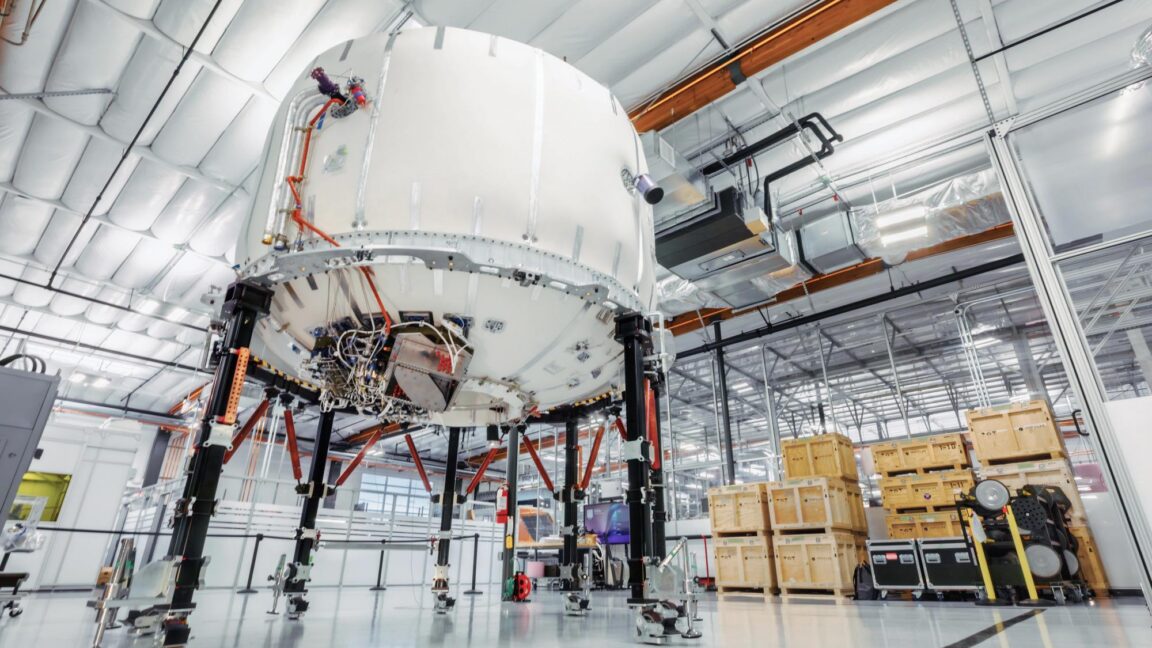
Romo said Helios development is progressing. Impulse has shipped a reusable test tank, known as a run tank, to its test stand at Mojave Air & Space Port in California. The tank is meant to be filled with propellant repeatedly and stressed through tests before the company flies lighter flight hardware.
Romo also said Deneb, the liquid oxygen and methane engine for Helios, is performing well in tests. The engine produces 15,000 pounds of thrust. Impulse is aiming for Helios’ first flight in 2027 on a Falcon 9.
Impulse and Relativity join Rocket Lab, with Neutron, and Stoke Space, with Nova, which were added to Lane 1 in March 2025. SpaceX, United Launch Alliance, and Blue Origin were the original Lane 1 awardees in 2024.
This story draws on original reporting from Ars Technica.