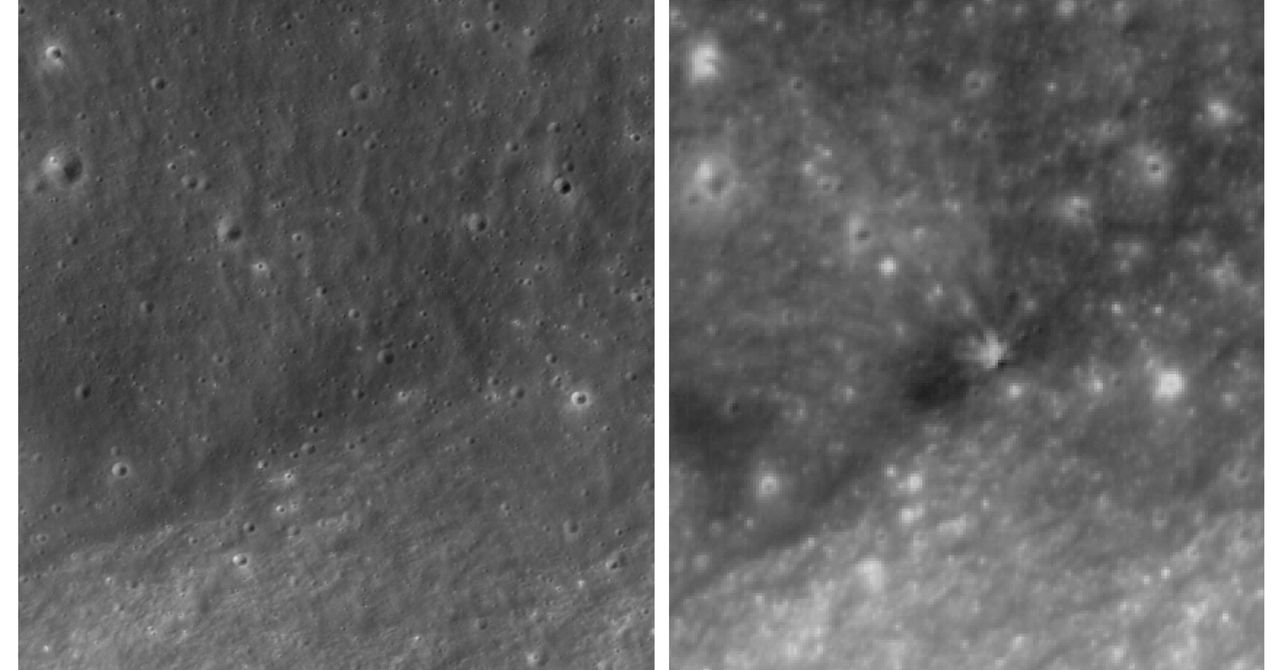
The SpaceX rocket moon crater now has before-and-after orbital imagery, although the published reporting does not provide a confirmed width, depth or shape. South Korea’s Danuri lunar orbiter photographed the area near the moon’s Einstein Crater before and after a Falcon 9 upper stage struck the surface on August 5, according to the Korea Aerospace Research Institute, as reported by Wired and the USA Today Network.
The comparison images show a fresh impact feature and changes to terrain around the site. KARI said it also identified traces of ejecta spread from the collision. The agency’s observation campaign began about 30 minutes before impact and continued afterward, producing eight imaging sessions, the USA Today Network reported.
This was not an entire Falcon 9 falling out of the sky. It was the rocket’s upper, or second, stage, the portion that carries payloads beyond the initial climb from Earth. The lower booster separated earlier in the January 15, 2025 launch and returned to Earth, while the upper stage sent two commercial lunar landers toward the moon and then remained in space, CNN reported.
What do the SpaceX rocket moon crater images show?
The Danuri images establish that an impact changed the surface near Einstein Crater, with a new feature and material disturbed around it. They do not establish final crater dimensions. Reports before the collision offered estimates ranging from roughly 60 feet wide and 12 feet deep to 65 to 90 feet in diameter, but those were forecasts, not post-impact measurements.
The impact itself had other observers. The European Southern Observatory’s Very Large Telescope detected sodium and lithium spectral lines in a plume for five to 10 minutes after the strike, ESO media manager Bárbara Ferreira told CNN. Ferreira said the sodium likely came from lunar soil, while the lithium could have come from the rocket.
Why did the Falcon 9 upper stage hit the moon?
SpaceX said high-energy missions toward lunar-transfer orbits can leave too little performance margin for a controlled deorbit maneuver, unlike many missions closer to Earth that can send an upper stage into the atmosphere over an ocean. The company said solar activity and gravitational forces later shifted this stage onto a lunar-impact path.
SpaceX said it had worked with NASA on a disposal solution and described impacts involving objects in such orbits as rare. The collision was not intended, according to reporting by The Telegraph.
NASA’s Lunar Reconnaissance Orbiter was also attempting to observe the site. Before the impact, NASA said success would depend on lighting, orbital timing and spacecraft position, and that imagery could take several days to arrive if the orbiter captured it. No NASA image release is established in the available reporting.
For researchers, the strike offers a chance to examine an artificial lunar impact and its implications for future exploration. For now, Danuri’s images are the confirmed visual record: a discarded upper stage reached the moon, and it left a new mark.
This story draws on original reporting from WIRED.


