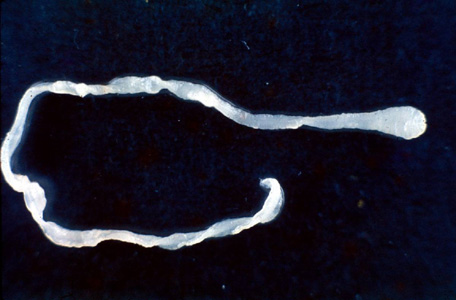
Surgeons operating on a 71-year-old man for a routine inguinal hernia repair found something that was not on the pre-op problem list: a live tapeworm, 26 centimeters long, tucked between his bladder and pubic bone.
The case, described in the New England Journal of Medicine, matters less because it is gross, although it is that, and more because it shows how a rare parasite can sit quietly in the body while ordinary tests look normal.
The man had chosen surgery for a painless bulge on the right side of his groin. According to the case report, doctors identified the bulge as an inguinal hernia, a common condition in which abdominal tissue slips through a weak spot in the abdominal wall. These hernias can hurt, and if trapped tissue loses blood supply they can become dangerous. In this patient, the protrusion was painless.
Before surgery, the man otherwise appeared well, the report said. Blood tests did not show an obvious warning sign such as a raised white blood cell count that might point to a parasite. Surgeons proceeded laparoscopically, using small incisions and instruments to repair the abdominal wall.
During the procedure, they saw a pale, threadlike structure. They grasped a visible loop with forceps and pulled carefully, needing several tugs before the whole organism came free. Once stretched out, it measured 10.2 inches and was still moving on the operating table.
The worm was identified after surgery
Genetic testing later identified the parasite as Spirometra erinaceieuropaei, according to the case report. The infection it causes is called sparganosis. Humans are unusual hosts for these tapeworms, which makes the biology messy in the way parasites tend to be messy.
The normal life cycle runs through other animals. Adult worms live in dogs and cats, which pass eggs in feces. The eggs hatch in water. Small crustaceans known as copepods take up the larvae, then fish, amphibians, or reptiles eat those crustaceans and become the next hosts. The cycle usually continues when a dog or cat eats an infected animal.
People can interrupt that cycle by drinking contaminated water or eating undercooked infected fish, reptiles, or amphibians, the report said. In humans, the larvae typically do not complete the usual life cycle. Instead, they migrate through tissue and may settle in different parts of the body.
Symptoms depend on where the parasite ends up. The report notes that sparganosis can involve many body sites. If the brain or spine is involved, neurological symptoms can occur. In this man, the worm was found in the abdominal cavity during hernia surgery.
This was apparently not the first one
The oddest detail in the case report is that the patient told doctors something similar had happened before. Four years earlier, during surgery for a left-sided inguinal hernia, surgeons had found an 18-centimeter worm in his abdomen. That worm was not identified, and the man did not receive antiparasitic medication afterward, for reasons the report does not explain.
After the second operation, his doctors treated him with antiparasitic medication to address the possibility of additional worms.
They also looked for a likely exposure. The man recalled eating raw snake meat during military service 50 years earlier. The report treats that as a possible exposure, not a solved case. Spirometra can survive for a long time in humans, but reported lifespans are generally around 20 to 30 years, which makes a half-century gap hard to pin down with confidence.
The case is a reminder that normal labs and a mundane surgical indication do not rule out biological weirdness. Sometimes the incidental finding is not a lab value or a shadow on a scan. Sometimes it wriggles.
This story draws on original reporting from Ars Technica.


