Swatch and Omega are selling their latest limited MoonSwatch through an online application process, a notable change for a brand pairing whose past scarcity drops have produced ugly scenes outside stores. Buyers still do not get a clean buy button. They get paperwork, because apparently even a plastic-adjacent hype watch now needs border-control cosplay.
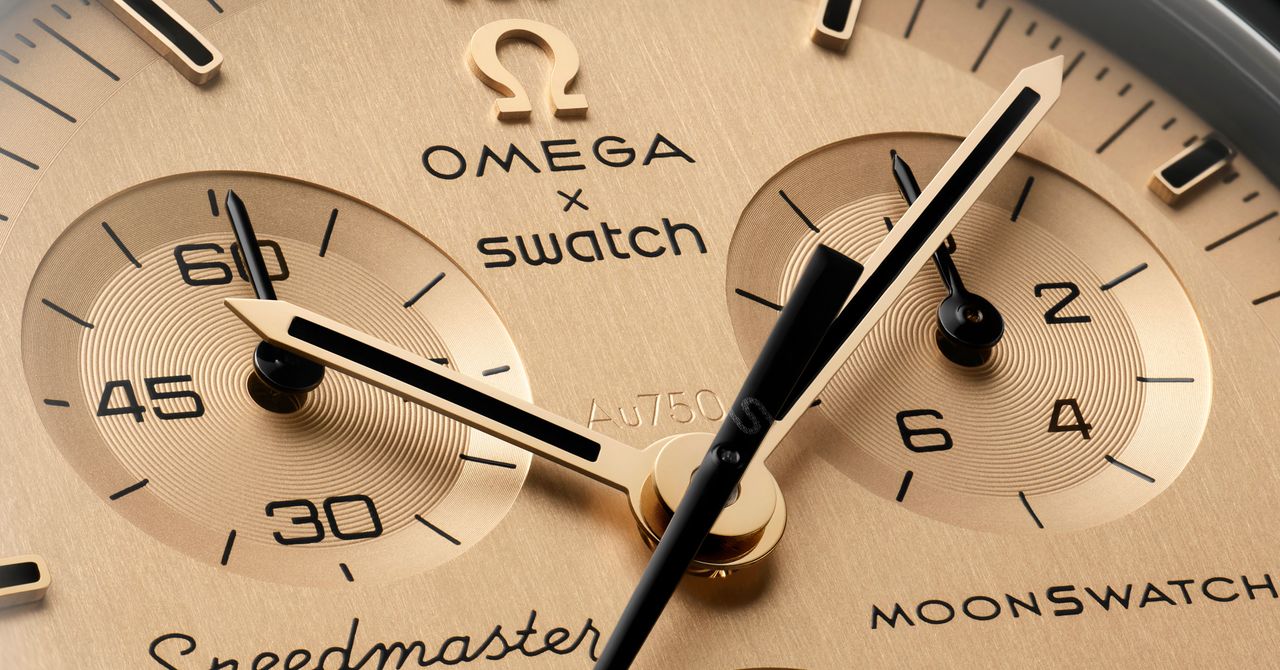
The new model is called the Mission to the Moon 1969. According to Swatch, it marks the Apollo 11 moon landing on July 21, 1969, and will be made in 1,969 numbered pieces. The watch comes on a black-and-gold version of Swatch’s updated rubber MoonSwatch strap.
The hardware pitch is straightforward: more gold than prior special MoonSwatch variants. Earlier limited editions used only a small amount of Omega’s proprietary 18-karat Moonshine Gold alloy. Swatch says this model uses the alloy for the dial, hands, crown, and pushers, for a total gold weight of 11 grams.
Swatch also says the gold has a backstory tailored for collectors. The company says it came from old Omega spare parts dating from around 1969, which were melted down in its own foundry. That is the kind of provenance luxury groups love, although buyers are still being asked to accept Swatch’s account of the metal’s origin.
The pricing is another bit of Apollo-era theater. Swatch says 11 grams of 18-karat gold cost $11 in 1969, so it priced the gold content using the gold price from July 21, 1969, rather than today’s market price. The result is a retail price of about $620.
How the application works
Instead of sending customers to queue at physical shops for a first-come, first-served release, Swatch is requiring would-be buyers to complete what it calls an “Electronic Swatch Timepiece Application,” or ESTA. Swatch says the form has 32 questions and is “similar to the ESTA many travelers have to fill out to travel to the USA.”
Only 1,969 applicants will receive approval. Approval gives the buyer the right to purchase the watch online and then collect it from a Swatch store. Applications must be submitted by July 21 at 5:59 pm Eastern time, which Swatch also lists as 11:59 pm CEST.
The company has not said how it will choose the 1,969 approved applicants. That missing detail matters for anyone trying to work out whether this is a lottery, a scored questionnaire, a bot filter, a marketing data harvest, or some combination of the above. Scarcity is the product strategy here; the selection rules are the mechanism customers actually have to trust.
The online gate follows disorder around Swatch’s May launch of the Audemars Piguet x Swatch Royal Pop, which WIRED described as chaotic at stores worldwide. That release echoed the crowds and frustration around the original MoonSwatch launch four years earlier, according to WIRED. For this drop, Swatch appears to have accepted that making people physically camp for a low-supply watch is a bad system, even if the replacement still leaves buyers guessing how the winners are picked.
This story draws on original reporting from WIRED.


