Neutral atom quantum computing is moving from laboratory showpiece to roadmap fight, and the useful metric is changing with it. QuEra, Atom Computing and Pasqal are all building machines that trap individual atoms with laser beams, then use those atoms as qubits. Their pitch is no longer just more physical qubits. The better claim is logical qubits, the error-corrected units that might survive long enough to do work.
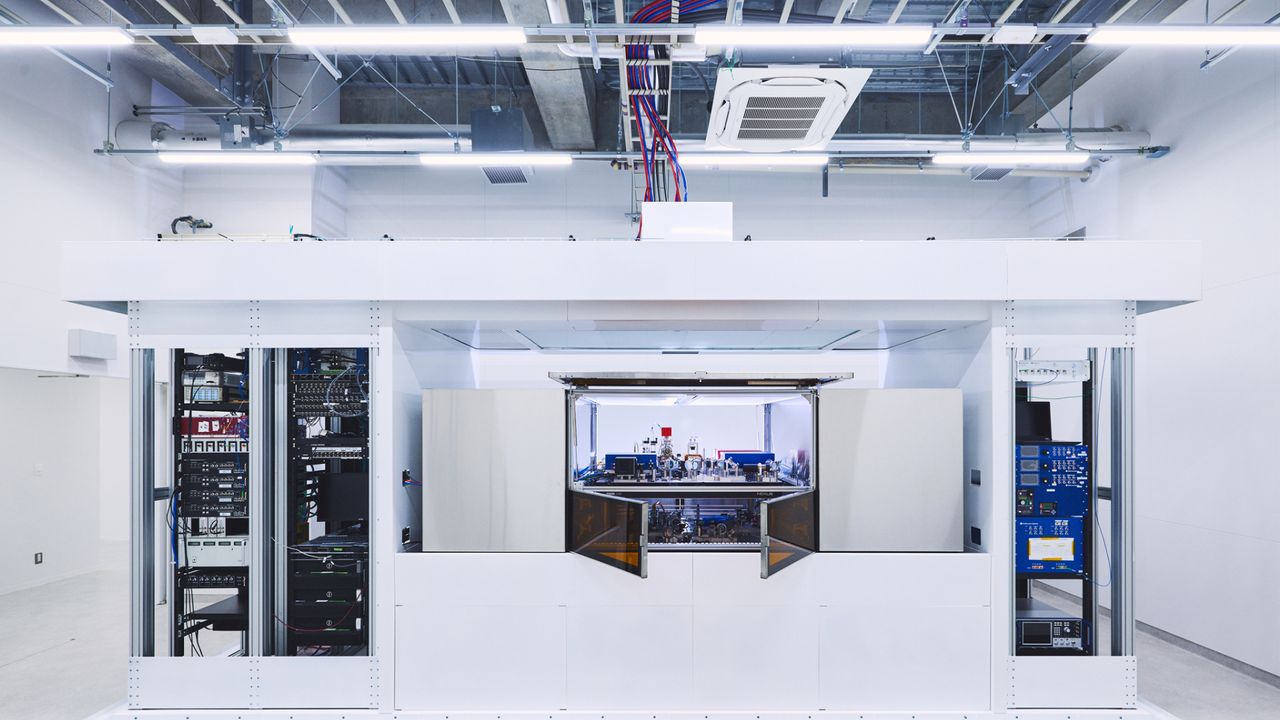
The mechanism is tidy, at least on paper. Neutral atom systems use optical tweezers, tightly focused lasers, to hold atoms in programmable arrays inside a vacuum cell. Information sits in internal atomic states. Two-qubit operations happen when lasers briefly drive atoms into Rydberg states, high-energy states that let nearby atoms interact. Turn the laser drive off, and the atoms return to relatively quiet isolation.
These machines still need serious optics, lasers, cameras and control electronics. They do not, however, require the whole processor package to sit in a dilution refrigerator at millikelvin temperatures, as superconducting systems do. Pasqal has cited total system power use of 4 kilowatts for its approach, a figure more familiar to data center operators than cryogenics specialists.
Most neutral atom companies discussed here use rubidium-87. Its cooling and control tools are mature, and its hyperfine states are well studied from atomic-clock work. Atom Computing made a different call and uses strontium. The company’s founder and chief executive, Dr. Ben Bloom, came from the NIST and JILA optical atomic clock community, where strontium was already a serious tool. Strontium can be less sensitive to magnetic field noise, but it demands more complex laser systems, including ultraviolet sources.
Why the architecture is drawing attention
Neutral atom arrays have two useful properties. Identical atoms do not have the fabrication variation that makes superconducting qubits a calibration slog. The arrays are also reconfigurable. Atoms can be moved between storage, entangling and readout zones, letting selected qubits meet for operations and then separate again.
That spatial layout also helps with mid-circuit measurement. Ancilla qubits can be read optically in a readout zone while other atoms keep their state elsewhere. Atom loss remains a problem: a collision with stray gas or enough thermal disturbance can knock an atom out of its trap. The saving grace is that the error is visible. Imaging shows which site went dark, and an error-correcting code can treat the missing atom as a known erasure rather than a mystery corruption.
The tradeoff is speed. Rydberg gate operations are described as taking roughly one to ten microseconds, slower than superconducting gates and in the broad neighborhood of trapped-ion operations. For circuits needing many operations, that cost is not decorative.
The company roadmaps
QuEra, spun out of Harvard and MIT in 2021, says it has raised more than $507 million, including a $230 million Series B in December 2025 backed by Google Quantum AI, SoftBank Vision Fund and Nvidia NVentures. Its 256-qubit Aquila analog processor launched on Amazon Braket in 2022. A Harvard, MIT, QuEra and NIST collaboration published a 48-logical-qubit demonstration in Nature in 2023, followed by a January 2026 Nature paper reporting 96 logical qubits from 448 physical atoms.
QuEra and AWS said in June 2026 that Libra, QuEra’s planned fault-tolerant system, is slated for Amazon Braket in 2028. The target is 256 error-corrected logical qubits and one million reliable logical operations at a 10^-6 logical error rate, according to QuEra’s terminology.
Atom Computing, founded in Berkeley in 2018, says it has raised more than $300 million. In June 2026 it announced a $100 million Series C and a separate $100 million letter of intent from the U.S. Department of Commerce, tied to development milestones. The company works closely with Microsoft’s Azure Quantum stack. Atom reported a 1,225-site, 1,180-qubit array in 2023, and a 2024 Microsoft collaboration produced 24 entangled logical qubits at 99.6% two-qubit gate fidelity, plus 28 logical qubits running a benchmark with real-time error correction.
Atom’s Magne system is being installed at QuNorth, backed by Denmark’s EIFO and the Novo Nordisk Foundation, with operation expected in early 2027. Atom describes it as a commercial system specified around about 50 logical qubits from 1,225 physical qubits.
Pasqal, founded in Paris in 2019 and co-founded by Nobel laureate Alain Aspect, says it has raised more than $300 million and serves more than 25 clients. Its systems are installed at GENCI, Forschungszentrum Jülich and CINECA as high-performance-computing co-processors. Pasqal’s public roadmap lists Vela in 2026 with 256-plus qubits, Centaurus in 2028 with about 10,000 physical qubits, Lyra in 2029 with 100 high-fidelity logical qubits, and a 2030 target above 200 logical qubits.
Pasqal is currently more analog than gate-based: it lets the atom array evolve as a continuous quantum system for problems such as materials simulation and optimization. That may help explain its enterprise traction, but it also means comparisons with QuEra and Atom Computing need care. Same atoms, different machine.
This story draws on original reporting from Tom's Hardware.