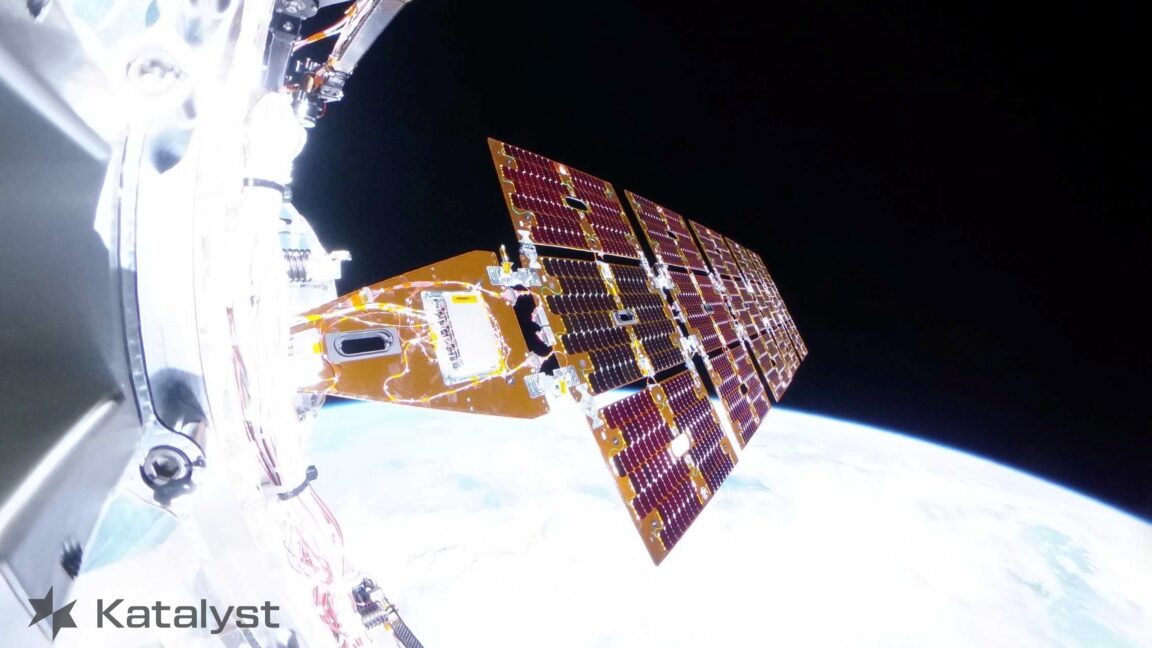
The Swift rescue mission is now trying to rescue itself. NASA said Tuesday that Katalyst Space Technologies’ Link spacecraft, a commercial servicer launched to raise the orbit of NASA’s Neil Gehrels Swift Observatory, ran into attitude-control problems over the weekend that left it spinning and talking to the ground only intermittently.
According to NASA, an early review found that two of Link’s three reaction wheels are no longer working. The agency also said the spacecraft’s cold-gas thruster system has suffered some loss of function. Link is still producing enough electrical power and remains in contact with Katalyst’s ground team, NASA said, which gives engineers room to attempt a recovery instead of immediately writing off the mission.
What went wrong with the Swift rescue mission?
Reaction wheels are standard spacecraft hardware used to control where a satellite points. By spinning internal wheels faster or slower, a spacecraft can change its attitude without firing thrusters. With two of three wheels out, Link has lost much of the system normally responsible for keeping it steady.
The cold-gas thrusters add finer control, especially for close-in operations near Swift. That matters because Link’s job is not just to fly near another spacecraft. Katalyst designed it to approach Swift, grab it with three robotic arms, and then raise the observatory’s orbit.
Katalyst is now using Link’s xenon electric thrusters to help stabilize the spacecraft, NASA said. Those thrusters were a central part of the original mission, but for a different job: raising Link’s orbit so it could rendezvous with Swift, then later boosting Swift itself after capture. Using them for attitude recovery is a workaround, and the mission now depends on whether that workaround gives controllers enough control to continue safely.
Why NASA wants Swift saved
Swift is almost 22 years old and has outlived its planned mission. It cannot raise its own orbit because it has no onboard propulsion system. Without help, NASA says the observatory is expected to reenter Earth’s atmosphere and burn up within the next few months.
NASA wants to keep it operating because Swift is one of the few agency missions designed to detect gamma-ray bursts, the most powerful explosions known in the universe. The agency is paying Katalyst $30 million for the commercial rescue service.
The mission also doubles as a test of the satellite-servicing business. NASA gave Katalyst nine months to build and launch Link, a tight schedule for a spacecraft expected to rendezvous with and physically attach to a decades-old observatory. Link launched July 3 aboard a Northrop Grumman Pegasus XL rocket after weather and a rocket technical issue delayed the flight.
Before the attitude-control failure, NASA and Katalyst had reported early progress. Link deployed its solar arrays, established stable communications with Katalyst’s operations center, and completed initial firings of its electric propulsion system.
NASA officials had already framed the attempt as valuable even before any orbit boost. Shawn Domagal-Goldman, director of NASA’s astrophysics division, said last month that from a program perspective he considered the effort a success because NASA and Katalyst had reached the point of attempting the rescue.
Kieran Wilson, Link’s principal investigator at Katalyst, also described before launch how the team viewed basic spacecraft health as the key to handling later trouble. He said previous programs had encountered power and communications issues, and that a functioning spacecraft would give engineers flexibility during rendezvous and other difficult operations.
NASA said Katalyst plans to restore stable attitude, assess Link’s condition, and then update its guidance, navigation, and control software for the spacecraft’s changed state. Only after that will Katalyst and NASA evaluate whether Link can still approach and capture Swift safely.
This story draws on original reporting from Ars Technica.


