United Launch Alliance has finished flying Atlas V rockets for Amazon’s Leo broadband constellation, leaving the company with six Atlas Vs that are effectively reserved for Boeing’s troubled Starliner spacecraft.
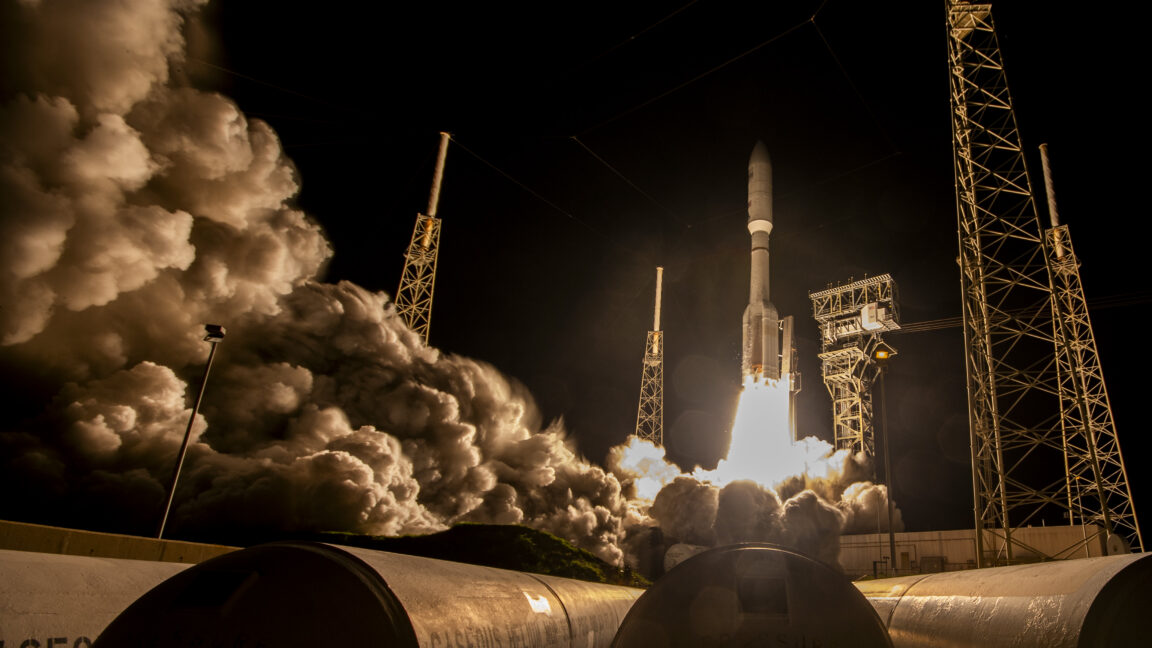
The latest Atlas V mission lifted off from Cape Canaveral Space Force Station in Florida at 12:30 a.m. EDT last Thursday, carrying 29 Amazon Leo satellites. ULA said all 29 spacecraft separated less than an hour after launch. The satellites are expected to raise themselves from about 289 miles, or 465 kilometers, to operational orbits around 392 miles, or 630 kilometers, using onboard propulsion.
The flight was the ninth Atlas V launch for Amazon Leo and the 110th Atlas V mission since the rocket entered service in 2002. It also closed off the rocket’s commercial work for Amazon at an awkward moment: Amazon has satellites waiting for rides, while ULA’s replacement vehicle, Vulcan, is grounded after solid-booster problems.
Why the last Atlas Vs are not useful spares
ULA’s remaining Atlas V inventory consists of six vehicles assigned to Boeing Starliner missions to the International Space Station under NASA’s commercial crew program. NASA reduced Boeing’s guaranteed Starliner crew missions from six to four last year after years of delays, according to Ars Technica. The next Starliner flight is planned to carry cargo to the ISS and would consume one of those Atlas Vs.
On paper, leftover rockets sound like useful launch capacity. In hardware, they are a lot less flexible. Starliner launches without the payload fairing used for conventional satellite missions, and last week’s Amazon mission was the final Atlas V flight with such a fairing. A ULA spokesperson told Ars Technica that the fairing now being built for Vulcan is “not interchangeable” with the Atlas V fairing, which is no longer in production.
The remaining Atlas Vs also use a dual-engine upper stage tailored for low Earth orbit missions such as Starliner. That is less suitable for missions needing higher-energy trajectories or deep-space performance. ULA also has enough stored solid rocket boosters to put two strap-on motors on each of the six Starliner launches, while last week’s Amazon launch used the Atlas V’s most powerful five-booster setup. That caps what the remaining rockets can lift.
The practical result is that any Atlas Vs Boeing does not use would not slide neatly into Amazon’s launch queue. Retrofitting them would be a hardware problem, not a scheduling problem, which is usually where aerospace optimism goes to get audited.
Amazon’s launch plan now leans harder on delayed rockets
Amazon bought nine Atlas V launches from ULA in 2021 as ULA wound down the rocket line in favor of Vulcan. One Atlas V carried two Amazon prototype satellites in 2023, and the other eight launched operational Leo satellites starting last year.
Amazon later booked most of its remaining first-generation Leo launches on ULA’s Vulcan, Europe’s Ariane 6 and Blue Origin’s New Glenn. It has also purchased 13 Falcon 9 launches from SpaceX, whose Starlink network competes with Leo. Amazon has reserved 38 Vulcan launches and funded a dedicated assembly building at Cape Canaveral for higher-rate Vulcan operations.
Vulcan has not flown since February because of problems with its solid-fueled boosters. New Glenn, owned by Amazon founder Jeff Bezos’ Blue Origin, is also out of service after a launch pad explosion at Cape Canaveral in late May. Ars Technica reported that Blue Origin’s investigation initially focused on New Glenn’s engine compartment. New Glenn and Vulcan both use Blue Origin’s methane-fueled BE-4 main engine.
Amazon Leo launch systems director Melissa Wuerl said Atlas V launched 224 operational satellites across eight missions with a 100 percent success rate, and that Amazon plans to transition with ULA to Vulcan. She also said Amazon has “hundreds of flight-ready satellites” at Cape Canaveral and expects an initial service rollout later this year.
Amazon has bought more than 100 launches for Leo. Fifteen have flown, deploying 398 satellites since October 2023, including two prototypes. The planned first-generation constellation totals 3,232 satellites.
Chris Weber, Amazon Leo’s vice president for business and product, wrote on X that the 396 production satellites now in orbit are enough for continuous service across initial latitudes, while future missions add coverage and capacity. Initial service will focus on mid-latitude users, with the current satellites flying between 51.9 degrees north and south latitude before the constellation expands toward wider coverage.
This story draws on original reporting from Ars Technica.