A copper spike once mounted in the hull of the USS Constitution is the strongest candidate for the oldest known piece of American historical memorabilia to have gone to space, according to records cited by space historian Robert Pearlman of collectSPACE.
The spike flew aboard NASA’s space shuttle Atlantis during STS-71, the June 27 to July 7, 1995 mission that made the first shuttle docking with Russia’s Mir space station. The USS Constitution Museum identifies the object as an original hull component removed from “Old Ironsides” in 1992 and dating to 1797, the year the ship was launched.
That makes it older than several better-known patriotic payloads that have ridden NASA hardware, assuming the category is limited to American historical material from the Revolutionary era forward. Pearlman notes that older objects have reached orbit, including a 1611 Jamestown tag flown on Atlantis in 2007, but that predates the United States and falls outside this narrower definition of Americana.
NASA’s official flight kits have long carried small historical objects because rockets are expensive and symbolism is cheap by comparison. The practice has produced a strange inventory: government documents, replica flags, bits of famous structures and, in one case, copper from the Statue of Liberty.
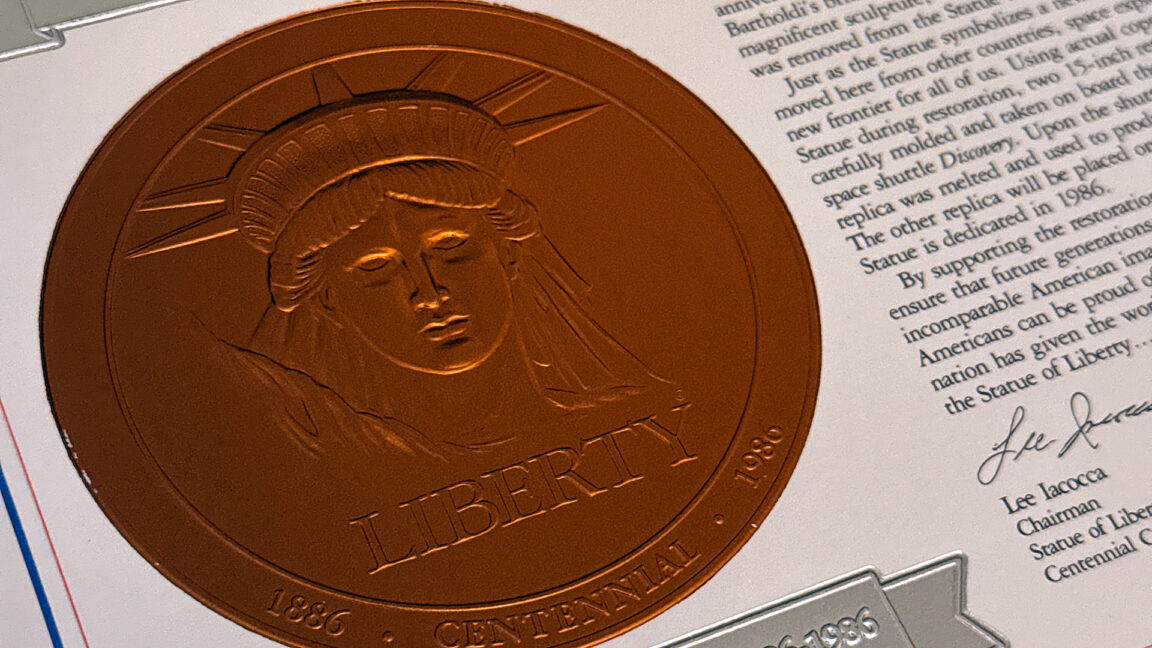
Discovery carried two 15-inch Statue of Liberty replicas in April 1985 on STS-51D. Both were made from copper removed from the full-size statue during restoration work. After the mission, one went on display. The other was melted and turned into copper seals sold by the Statue of Liberty Ellis Island Centennial Commission. The metal came from the statue’s original 1875 to 1884 construction, according to Pearlman.
John Glenn also took American political history into orbit when he returned to space on Discovery in 1998 at age 77. The Senate Curator’s Office said Glenn selected a 1993 reprint of Thomas Jefferson’s 1801 “Manual of Parliamentary Practice” for the STS-95 official flight kit after consulting Senate historical staff. Jefferson wrote the manual while serving as vice president, a role that also made him president of the Senate.
Glenn’s kit also included a replica of George Washington’s Headquarters Flag, the 13-star standard associated with identifying Washington on Revolutionary War battlefields. The Museum of the American Revolution says the flag Glenn flew was a copy made for the 1998 mission, not the original.
That distinction matters. The Jefferson manual and Washington flag point to older originals, but the items that actually flew were modern reproductions. The same applies to a 15-star Fort McHenry flag that NASA astronaut Terry Virts carried aboard the International Space Station from November 2014 through June 2015. The original flag inspired Francis Scott Key’s poem that became “The Star-Spangled Banner,” but Virts flew a replica supplied by Fort McHenry.
Other 19th-century symbols have made the trip. A replica of the 17.6-karat Golden Spike used to mark completion of the First Transcontinental Railroad in 1869 flew on Atlantis with the STS-38 crew.
The USS Constitution spike has a cleaner claim because it was not a reproduction. Pearlman also identifies another Constitution artifact, a similarly aged wood fragment, as having flown on STS-31, the 1990 shuttle mission that deployed the Hubble Space Telescope. That piece was on loan at the U.S. Naval Academy Museum in Annapolis.
For now, the copper spike appears to sit at the top of this very specific and very NASA list: old American objects that were small enough, durable enough and institutionally blessed enough to survive both a museum collection and a shuttle manifest.
This story draws on original reporting from Ars Technica.