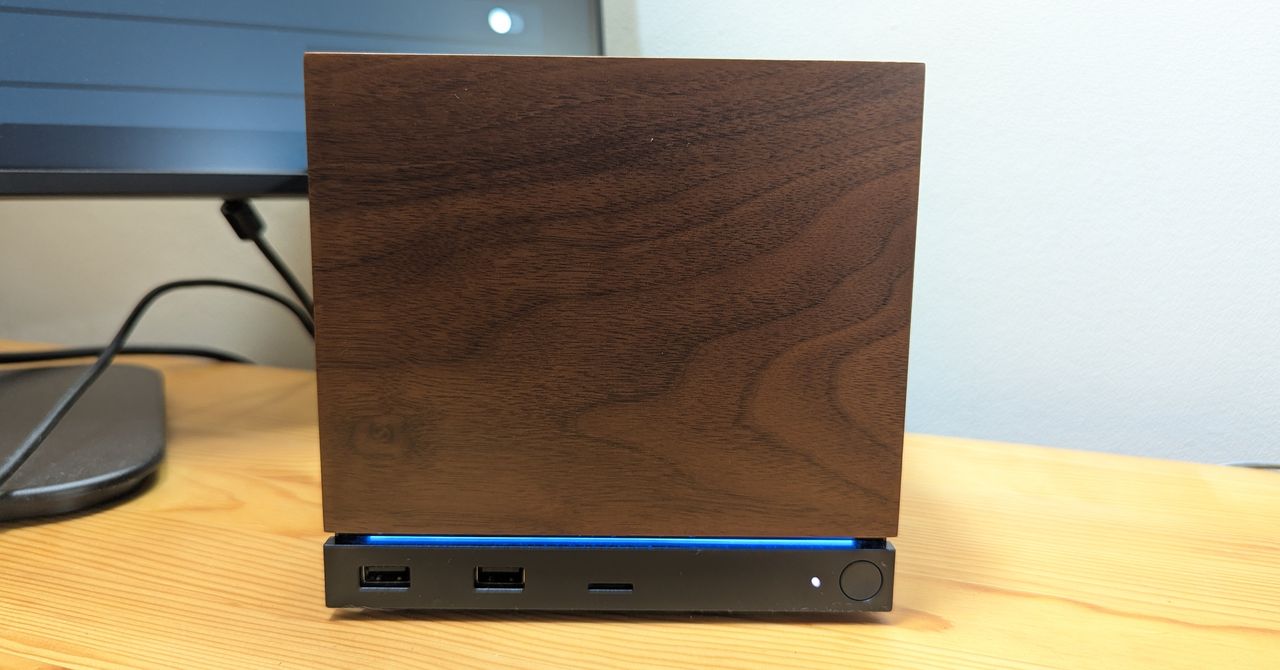
Valve’s new Steam Machine has landed in reviewer hands as a cleaner, more coherent second attempt at putting PC gaming under the TV. WIRED’s Matt Kamen rated the system 5 out of 10, praising its compact hardware and SteamOS setup while finding that its gaming performance falls short of the 4K living-room pitch.
The machine is listed at $1,049 on Steam, according to WIRED. Valve is selling it as a single hardware design with storage options of 512 GB or 2 TB, a tighter plan than the company’s first Steam Machine push a decade ago, when multiple manufacturers shipped boxes with inconsistent specifications.
Kamen wrote that the new model is easy to like as hardware. The cube-shaped case measures 156 by 152 by 162.4 millimeters, roughly in Nintendo GameCube territory, and includes replaceable faceplates on the 2-TB version. Its ports include front USB-A 3.2 Gen 1 connections and microSD, rear USB-A 2.0, USB-C 3.2 Gen 2, DisplayPort 1.4, HDMI 2.0 and Gigabit Ethernet, plus Wi-Fi 6E and Bluetooth 5.3.
The system uses SteamOS in Big Picture mode for the TV interface, and it can switch into a Linux desktop running KDE Plasma. WIRED said the desktop environment was unusually approachable for a living-room box, with basic tools such as settings, a software center, a file manager and a Firefox installer visible without vendor clutter.
The controller problem
One awkward detail arrives before performance does: the Steam Controller is sold separately. WIRED said other PC-compatible controllers work, but Valve’s new controller is clearly the intended partner. Connected by USB, it pairs directly with the Steam Machine and can wake the system from sleep.
For a device trying to behave like a console, charging extra for the controller is a strange bit of PC-brained thrift. Buyers are being asked to assemble the “console” experience themselves, after paying console-plus money for the box.
1080p looks fine, 4K gets messy
The performance complaint centers on Valve’s 4K claim. Valve says the Steam Machine can reach “up to 4K at 120 Hz” on supported displays using AMD’s FidelityFX Super Resolution, or FSR, according to WIRED. FSR is upscaling: the machine renders at a lower resolution and uses AMD’s image reconstruction to output something closer to 4K. Valve’s Steam Machine Verified label, however, is based on a 1920 by 1080 benchmark, WIRED reported.
The hardware explains part of the gap. WIRED compared the Steam Machine broadly with Sony’s PlayStation 5. Valve’s box uses a semi-custom AMD Zen 4 CPU with six cores and 12 threads, plus a semi-custom RDNA3 GPU with 28 compute units. The base PS5 has an older Zen 2 CPU with eight cores and 16 threads and an RDNA2 GPU with 36 compute units. WIRED pointed to the Steam Machine’s 16 GB of DDR5 RAM and 8 GB of GDDR6 VRAM as a weak spot.
In WIRED’s testing on a 4K OLED TV and a 1080p monitor, games behaved unevenly. Marvel’s Spider-Man Remastered ran smoothly at 60 frames per second at lower-than-4K output and could hit 4K at 60 fps with FSR and dynamic resolution scaling enabled. Crimson Desert, which Valve lists as unsupported, reached 60 fps at 1080p but struggled badly at high settings on the 4K TV. Lego Batman: Legends of the Dark Knight and Granblue Fantasy Relink: Endless Ragnarok also required compromises, with frame rates dropping or settings needing manual cuts.
Kamen’s conclusion was that the Steam Machine is strong for 1080p play and lighter PC games, and better than docking a Steam Deck to a television. As a premium box for high-end 4K games, WIRED found it outclassed at launch by dedicated consoles including the PS5, Xbox Series X and Nintendo Switch 2.
This story draws on original reporting from WIRED.


