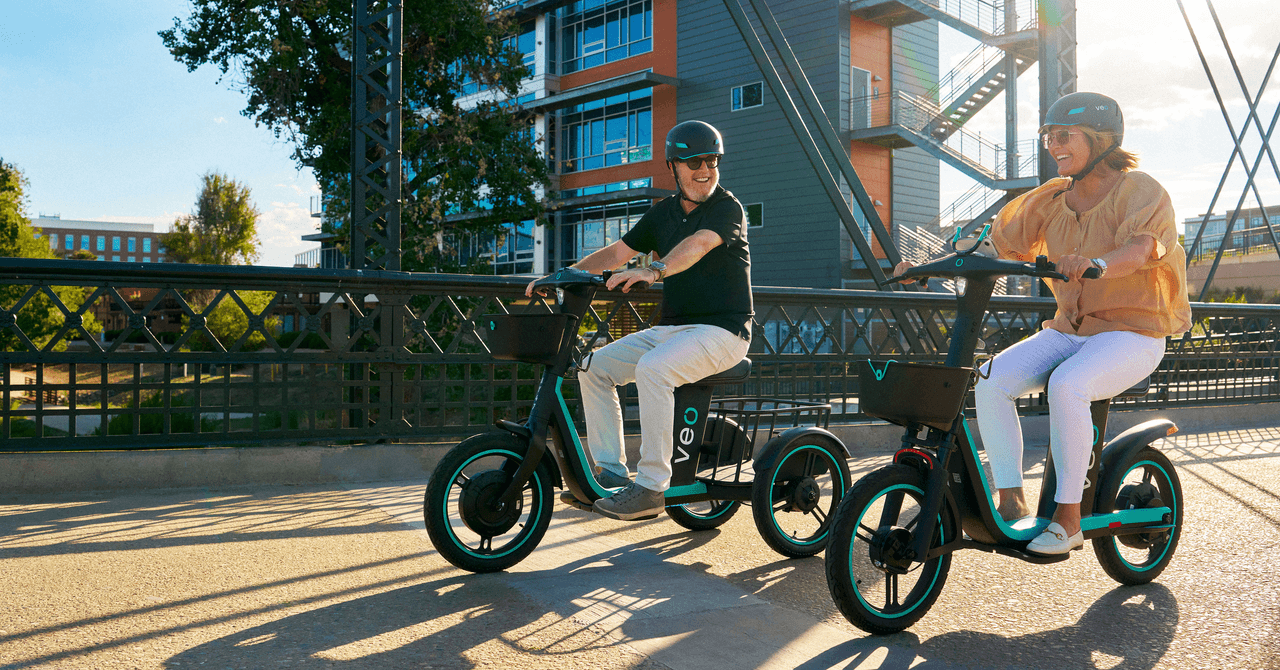
Veo Rover Denver is the company’s new test case for shared micromobility: a sit-down electric tricycle now available in the city after being announced Tuesday at an event there. Veo says it plans to bring the vehicle to other US cities, but Denver gets the first run because the company now controls the city’s shared bikes and scooters under an exclusive contract.
The Rover is meant to be rented like an e-bike or scooter. Riders use the Veo app, pay to unlock the vehicle, and take it for a short trip around town. The pitch is familiar. The hardware is less so: three wheels, a seat, a rear cargo basket, and a lower top speed than most shared scooters.
What is the Veo Rover in Denver?
The Rover is a shared electric tricycle designed for street use and bike-lane travel. Veo says the vehicle is 2.5 feet wide, narrow enough to fit within bike lanes that are commonly three feet wide, and it tops out at 10 mph.
That speed is below the 15 mph limit many cities allow for rented scooters and bikes. Veo says it chose the slower cap for safety. The Rover uses the same batteries as Veo’s other electric vehicles, which the company says gives it about 45 miles of range per charge. Its rear basket can carry up to 100 pounds of groceries, bags, or other cargo.
Denver is a useful showroom for Veo. In May, the city picked Veo as its exclusive shared micromobility provider, replacing scooters and e-bikes from Lime and Bird. Veo is smaller than those better-known rivals and operates in about 60 smaller US cities, according to WIRED.
Why Veo is making a trike instead of another scooter
Veo is positioning the Rover as an accessibility product that does not require a separate rental process. Three-wheeled vehicles can stand upright on their own and are easier to mount than two-wheeled bikes or scooters for some riders, especially people who have balance concerns.
Alexander Keating, Veo’s vice president of policy and partnerships, told WIRED that cities permitting shared micromobility services expect operators to make their systems accessible, much as transit providers are expected to serve riders who use wheelchairs or cannot use certain vehicles.
Other companies have addressed that requirement with separate programs. Lime runs Lime Assist, a free accessible vehicle rental program for eligible users, and Bird launched an accessible rentals program in April. Veo offers accessible options too, but Keating said the company wants riders to avoid extra barriers when using the system.
Veo says it worked on the Rover with disability advocates and groups including the Disability Mobility Initiative, the Parkinson’s Foundation, Capitol Hill Village, and AARP. The company says the goal was to build something usable for riders who want more stability, including older users.
What tech does the Rover collect and use?
The Rover includes the same kind of software stack Veo uses on its other vehicles, according to the company. Veo says that includes an AI-powered voice assistant that can provide directions, location details, and traffic updates during a ride.
Veo also says its vehicles use lidar-based sidewalk detection intended to discourage riding where scooters are not allowed. That is an aim, not a solved civic problem. Westword has reported that Denver residents have continued to complain about sidewalk riding since Veo took over.
The company also collects geolocation and trip information from riders. Keating told WIRED that Veo anonymizes that data and uses it to study how people use the vehicles as the company considers where to expand the Rover.
Electric trikes already exist in the consumer market, including models from companies such as Lectric, and they can be easier for some riders to use. They can also be heavier and harder to steer than bikes. Denver is where Veo will find out whether a shared version becomes a real transportation option or another odd little vehicle cluttering the curb.
This story draws on original reporting from WIRED.


