Wally Funk, the aviation pioneer who waited six decades for a spaceflight after being shut out of NASA’s first astronaut era, died Wednesday at 87.
The City of Grapevine, Texas, Funk’s hometown, said she died at home, surrounded by loved ones. In its announcement, the city called her an aviation pioneer whose career “inspired generations by breaking barriers in aviation and space exploration.”
Funk was the last surviving member of the First Lady Astronaut Trainees, a privately organized group later known as the Mercury 13. The women were experienced pilots who volunteered in the early 1960s for physical and psychological testing similar to what NASA’s original Mercury astronauts faced.
The results did not translate into a NASA flight assignment. The Lovelace Woman in Space Program operated outside NASA, and the agency required astronaut candidates to be military test pilots with jet experience. The military did not admit women to its flight programs, which made the requirement a neatly closed door. Funk and the other women could pass the tests, but the system was not built to let them through.
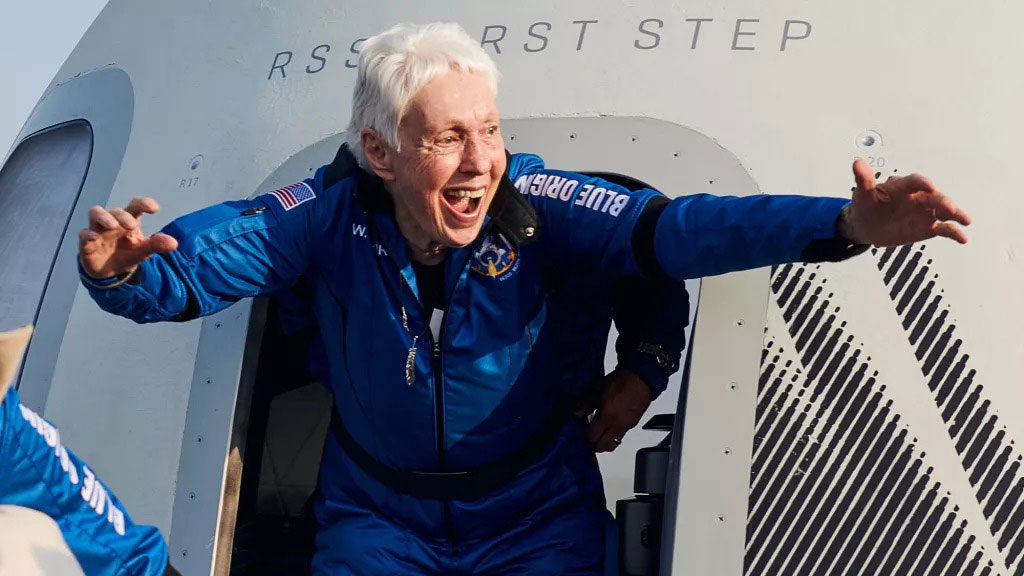
Blue Origin finally put Funk on a rocket on July 20, 2021, when the company flew its first human suborbital mission aboard New Shepard. Funk joined Jeff Bezos and the rest of the NS-16 crew for a roughly 10-minute flight. She was 82.
After landing, Funk said at a press conference, “I felt great! I felt like I was just laying down and I was going into space.” She added: “I have been waiting a long time to finally get up there … I want to go again, fast.”
The flight made Funk the oldest woman to fly in space, a mark recognized by Guinness World Records. It also earned her the Federal Aviation Administration’s 13th pair of Commercial Space Astronaut Wings. According to the Association of Space Explorers’ Registry of Space Travelers, Funk was the 26th person to fly above 50 miles, or 80 kilometers, and the 585th person to enter space.
Born Mary Wallace Funk on February 1, 1939, in Las Vegas, New Mexico, she built her life around aircraft well before the spaceflight that made her famous to a wider public. She earned an associate degree and pilot’s license at Stephens College in Missouri, then received a bachelor’s degree in secondary education from Oklahoma State University while collecting aviation ratings, including commercial, instrument, flight instructor, and ground instructor credentials.
Funk’s aviation career was not a hobby with better branding. She instructed U.S. Army officers and became the first female flight instructor to serve at a U.S. military base. In 1971, the FAA rated her as a flight inspector, the first woman to receive that rating. Three years later, the National Transportation Safety Board hired her as its first female air safety investigator.
She also raced aircraft, trained pilots, spoke on aviation safety, and served as chief pilot for five aviation schools, qualifying thousands of students across multiple flight ratings.
Funk remained closely tied to the Mercury 13 legacy. In 1995, she attended the launch of Eileen Collins, the first woman to pilot a space shuttle. In 2020, Funk published a memoir, Higher Faster Longer: My Life in Aviation and My Quest for Space Flight, with co-author Loretta Hall.
Her later honors included induction into the Texas Aviation Hall of Fame in 2024 and the National Air and Space Museum’s Michael Collins Trophy for Lifetime Achievement in 2022. The New Mexico Museum of Space History is scheduled to induct her posthumously into the International Space Hall of Fame later this year.
Funk was unmarried and had no children. She outlived the other Mercury 13 members and the Mercury 7 astronauts, a final bit of space-age accounting that says plenty about endurance and very little good about the gatekeeping she spent her life flying around.
This story draws on original reporting from Ars Technica.