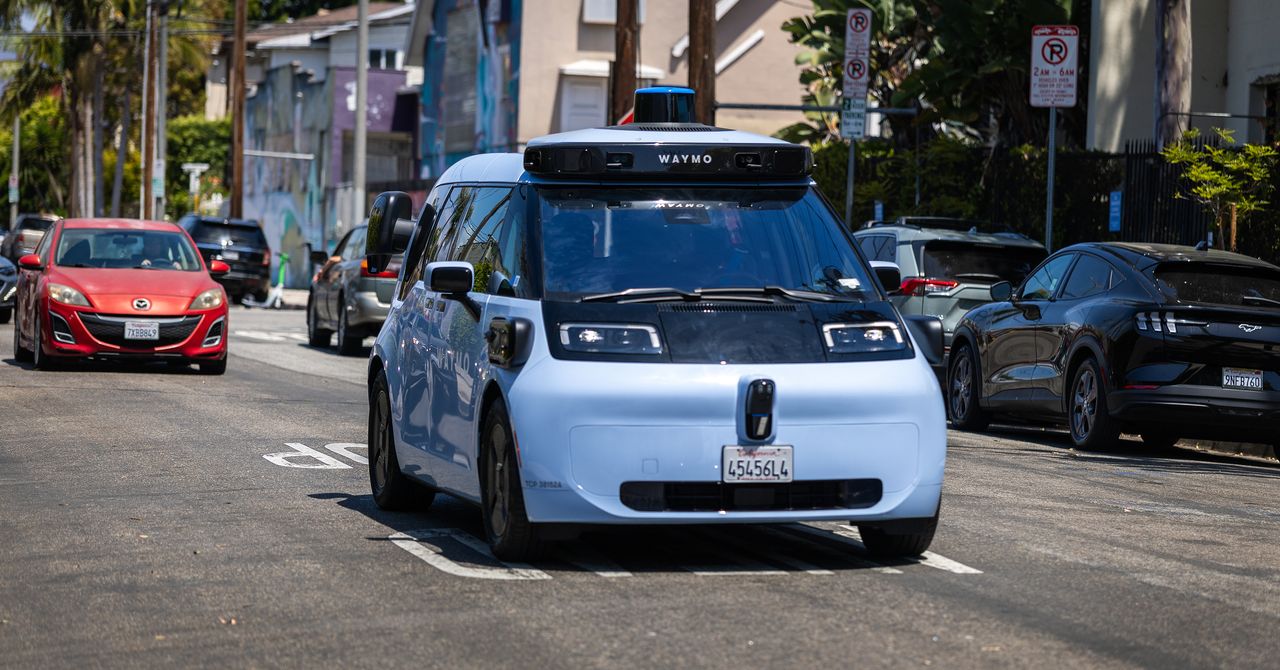
Waymo passengers in California can ride the company’s new Ojai robotaxis without paying for now, because state regulators have not yet cleared Alphabet’s robotaxi unit to use those vehicles for paid service.
The free rides are a side effect of California’s unusually hands-on robotaxi rules. Waymo’s older Jaguar I-Pace robotaxis, which make up most of its fleet, are still charging fares. The new pale-blue Ojai vehicles, which began carrying riders last month, are not yet approved by the California Public Utilities Commission for paid passenger service.
Terrie Prosper, a spokesperson for the CPUC, said the agency’s Consumer Protection and Enforcement Division and Waymo have agreed to extend the review period through September 25. Prosper said Waymo’s request remains under review and that the items Waymo wants approved have not been authorized.
That means Ojai rides could remain free into late September, and possibly longer, if Waymo keeps using the vehicles in its driverless ride-hail service before the CPUC signs off.
California’s two-permit robotaxi funnel
California does not let autonomous taxi companies put vehicles into public service with a shrug and a software changelog. Companies need approval from the state Department of Motor Vehicles to operate autonomous vehicles on public roads. They also need CPUC permission to carry paying passengers, because the agency regulates taxi and other transportation services.
Waymo applied to the CPUC in January to expand its service territory and to add the Ojai vehicles to its California fleet. The requested Northern California territory would stretch from Sea Ranch and Sacramento through Berkeley and Oakland, then down into San Jose. In Southern California, Waymo asked to grow beyond Los Angeles into Thousand Oaks and Santa Clarita, and south past San Diego to the Tijuana border.
The CPUC review has not been routine. In May, the agency asked Waymo for more information about how it handles emergency incidents. One example cited in the record was a December power outage in San Francisco that left more than 60 Waymo vehicles stuck in traffic.
The agency also asked Waymo for more detail on how it prevents unaccompanied minors from riding alone in its cars, which would violate state law. Those questions followed a formal complaint to the CPUC from a labor union representing ride-hail drivers over Waymo transporting unaccompanied minors.
Waymo says it is waiting for approval
Waymo spokesperson Ethan Teicher said in a written statement that the company will not begin charging for Ojai rides until the CPUC approves its application. Teicher said the agency could still approve Waymo’s proposals before September. He also said Waymo is waiting to charge until it is satisfied with progress in its Trusted Tester availability in California and Arizona.
The Ojai is Waymo’s first vehicle built specifically as a driverless taxi. It still includes a steering wheel and brake pedals, but its autonomous system uses 13 cameras, six radar units, and four lidar sensors to perceive its surroundings.
The vehicle is manufactured by Zeekr, a Chinese company. Waymo says the Ojai will not be covered by a coming US ban on Chinese-connected automotive technology because Zeekr builds only the vehicle shell, while the connected systems are built and installed in the United States.
For riders, the outcome is oddly practical: a state review meant to decide where and how Waymo can charge passengers has turned one piece of the company’s rollout into a temporary zero-dollar service. For Waymo, the same delay slows its California expansion and keeps its newest vehicle outside the paid fleet until regulators finish reading the paperwork.
This story draws on original reporting from WIRED.