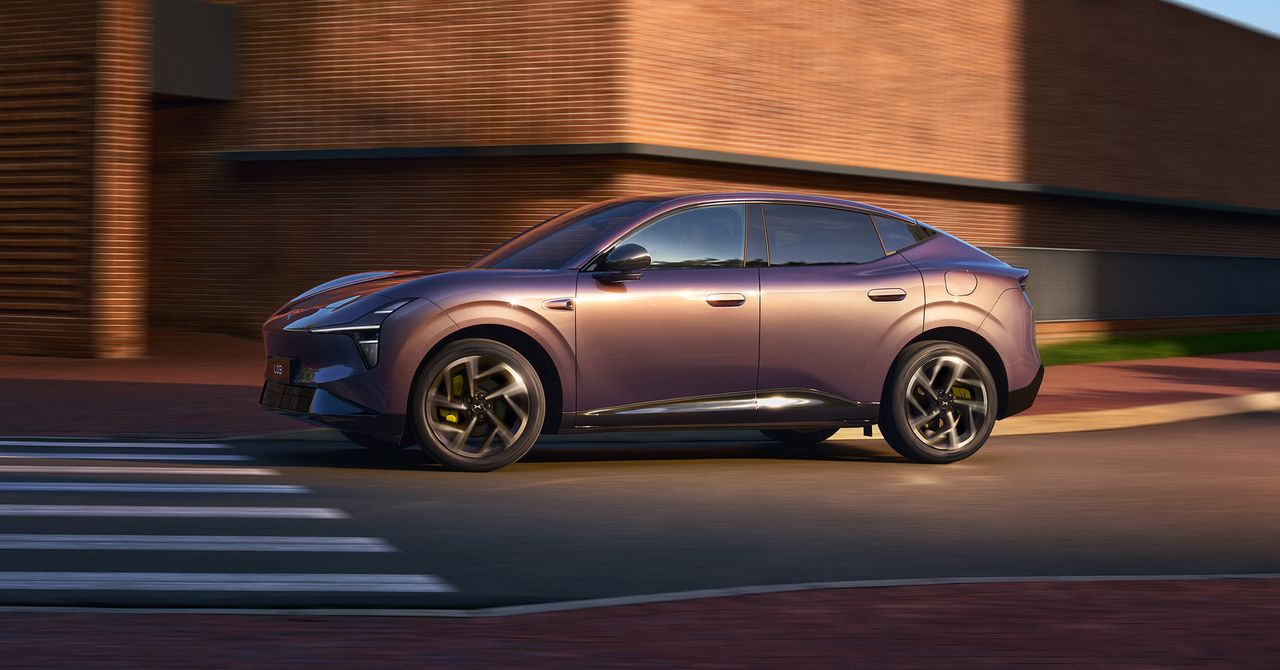
XPeng has introduced the L03, a lower-priced electric vehicle that the Chinese automaker plans to sell across 60 countries in Europe, Latin America, the Middle East and Asia-Pacific. The car matters because XPeng is trying to turn a brand better known among EV obsessives than mainstream buyers into a global volume player, and it is doing so with a model priced from €35,600, about $40,000.
The company showed the L03 at an event in Munich, a pointed venue for a Chinese EV maker trying to grow in the German auto industry’s backyard. XPeng was founded nearly 12 years ago and began shipping EVs to Norway in 2020, according to WIRED. It is not among China’s top 10 EV makers by volume, based on CnEVPost’s ranking cited by WIRED, but it has built a bigger profile outside China than its domestic rank might suggest.
The L03 sits below XPeng’s G6, the brand’s Tesla Model Y rival. XPeng is positioning the five-seat, 4,650-mm car as its mass-market model, though the standard equipment list reads like somebody forgot where the options sheet ends.
XPeng claims the L03 will offer up to 320 miles of WLTP range and charge from 10 percent to 80 percent in 20 minutes. Standard kit across the Standard Range, Long Range, all-wheel-drive and Ultra versions includes a panoramic glass roof, heated and cooled massage seats, 256-color ambient lighting, smart parking, a 15.6-inch 2.5K center display, a 27-inch head-up display, AI voice controls and built-in Google Maps. The company also cites a 0.228 drag coefficient, the kind of number automakers like because aerodynamic efficiency can turn into real range if the rest of the engineering behaves.
Performance depends on trim. XPeng says the quickest versions reach 60 mph in 4.5 seconds, while the base Standard Range takes 7.5 seconds.
Driver assistance comes with caveats
Most L03 versions use Level 2 driver-assistance features. XPeng says the Ultra model moves to what it calls L2++ capability, using three of the company’s Turing 7-nanometer AI chips to support point-to-point, hands-off navigation. XPeng says that system is expected in Europe in 2027 and can be enabled by an over-the-air update.
That is still not autonomy in the way the term gets abused in car marketing. Xianming Liu, XPeng’s senior director of engineering, told WIRED that although the Ultra has enough compute for future Level 4 operation, the L03 lacks hardware meeting the required six levels of redundancy. In plain English: the car does not have the backup systems needed to let it drive itself without human supervision. Liu said it will be limited to L2++.
XPeng is also skipping lidar on the L03, joining Tesla’s camera-first camp rather than the approach taken by Chinese rivals including BYD, Zeekr and Nio, according to WIRED. Liu argued that XPeng’s compute, models and camera system can compete with lidar-equipped alternatives. That remains XPeng’s claim, not settled physics.
A budget car with expensive-car lines
The L03 is sold in China as the Mona L03 under XPeng’s budget Mona sub-brand. WIRED reported that XPeng is not emphasizing that connection for the global version and says specifications have been changed for international markets.
The exterior is likely to get attention for another reason: WIRED reported that the L03’s shape appears close to Ferrari’s Luce EV and not far from Denza’s Z9 GT. The three cars occupy different price tiers, from budget to luxury, which says something awkward about how hard EV design is becoming to read by price.
There is a personnel link, though not a direct Luce one. XPeng’s design chief, JuanMa López, previously led Ferrari exterior design from 2010 to 2018 and worked on models including the LaFerrari, SF90 Stradale and Monza SP. WIRED reported that López did not design the Luce, whose work was outsourced to LoveFrom, the agency founded by former Apple design chief Jony Ive.
Rafik Ferrag, XPeng’s head of creative design, told WIRED that cheaper cars can now use technology and trim once reserved for luxury models. That is XPeng’s pitch in one sentence: sell the premium look and feature stack at a lower price, then dare buyers to care where the badge came from.
This story draws on original reporting from WIRED.


