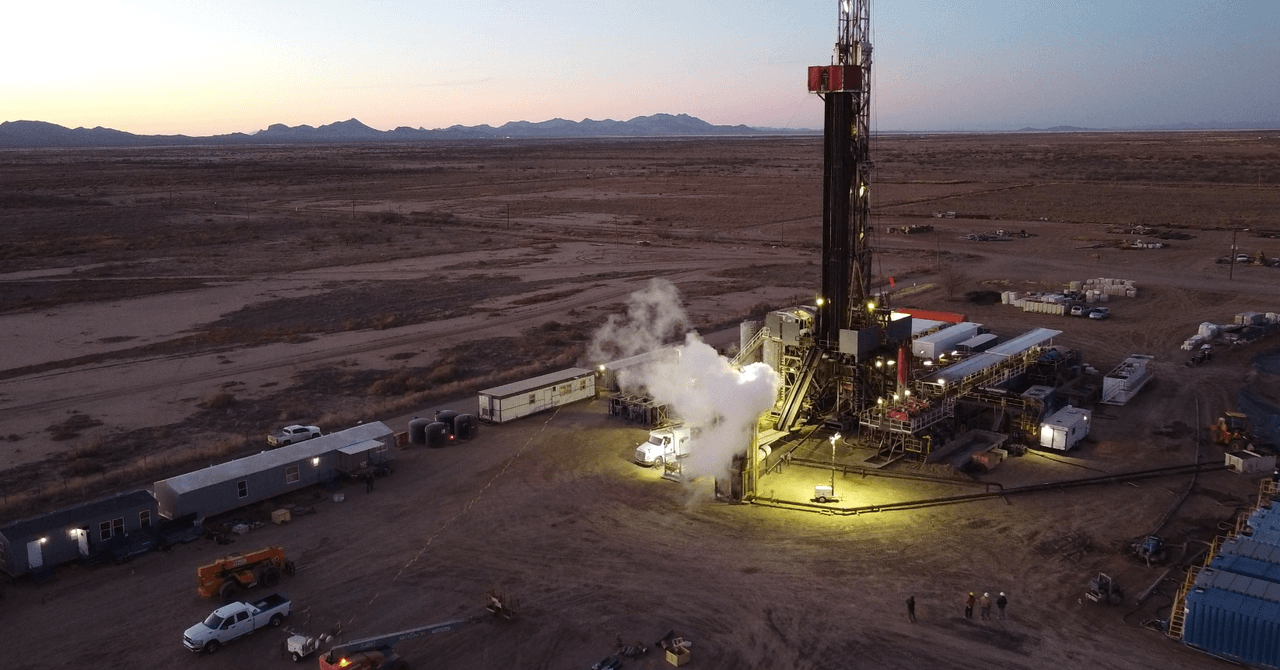
Zanskar says its Lightning Dock geothermal site in New Mexico has recovered after the company drilled a deeper well, a useful data point for an industry that keeps promising clean, round-the-clock power and then running into geology with a bill attached.
The company bought the Lightning Dock power plant in 2024, when its shallow wells were losing heat fast enough to threaten generation. After a year of running a new 8,000-foot well, Zanskar says figures it shared with WIRED show the site is now among the most productive pumped geothermal wells in the United States and is supplying enough heat for the plant to operate without trouble.
Traditional geothermal power plants bring hot underground water to the surface and use that heat to spin turbines. The attraction is steady renewable electricity, but the catch is location: viable reservoirs are concentrated in places such as the western United States, and the US Geological Survey has put geothermal at less than 1 percent of the US electricity mix.
How did Zanskar revive Lightning Dock geothermal?
Zanskar’s answer was to drill below the struggling shallow reservoir and aim for hotter water. The company says the original wells, less than 2,500 feet deep, had cooled by about 50 degrees Fahrenheit, or 10 degrees Celsius, to roughly 250 degrees F by 2024. That was a bad fit for the site’s 15-megawatt plant, which Zanskar says was built to run above 300 degrees F and supplies power to New Mexico’s largest utility.
Zanskar cofounder Joel Edwards told WIRED that the company bought the field with the expectation that it would have to drill deeper. He said the new well has sometimes delivered more heat than the existing plant can use, which Zanskar argues points to potential support for a larger facility. Edwards also said wells with similar attributes could remain productive for decades.
The mechanics are familiar, even if the bet was risky. Conventional geothermal wells often run 3,000 to 5,000 feet deep, while deeper drilling can reach hotter water. Stanford University’s Roland Horne told WIRED that the decision is mostly economic because costs rise faster than depth: in his example, a well drilled twice as deep can cost four times as much.
Zanskar says it used artificial intelligence models to look for “hidden systems,” sites with geothermal promise that do not advertise themselves at the surface. The company says those models helped choose where to drill at Lightning Dock, alongside drill-bit technology refined by the oil and gas industry. Zanskar says that let it drill deeper holes 35 percent faster at a competitive cost, though it did not provide detailed cost figures.
How much of this is a breakthrough?
Horne gave the less press-release-friendly read: he told WIRED the company has not shown a revolutionary technique. He also said Zanskar benefited from buying a site that already had a power plant, avoiding a major expense, and from a deep exploratory well another company drilled at Lightning Dock in 2022.
Ben Brenner, Zanskar’s director of federal affairs, told WIRED by email that the earlier well data was used in Zanskar’s models, while adding that the company did not view it as decisive or essential. Horne said Zanskar’s statistics still support calling Lightning Dock one of the highest-flow geothermal wells in the country. Brenner said at least one Nevada facility has higher-flow wells, but that they are much colder than Lightning Dock’s.
The timing helps Zanskar’s story. BloombergNEF senior associate Stephanie Diaz told WIRED that venture capital and private equity investment in geothermal startups reached $432 million in the first six months of the year, putting 2026 on track to be the strongest year since BNEF began tracking the category in 2022. Zanskar raised $115 million in January.
Much of the recent attention has gone to enhanced geothermal companies such as Fervo Energy, which went public in May and raised $2.2 billion, though its stock has pulled back since. Enhanced geothermal uses fracking-like methods in hot rock rather than relying on naturally occurring hot water, which could open more places to development. Diaz said Zanskar’s data-driven approach may help reduce risk in conventional geothermal by finding productive areas near places that have already worked.
This story draws on original reporting from WIRED.


