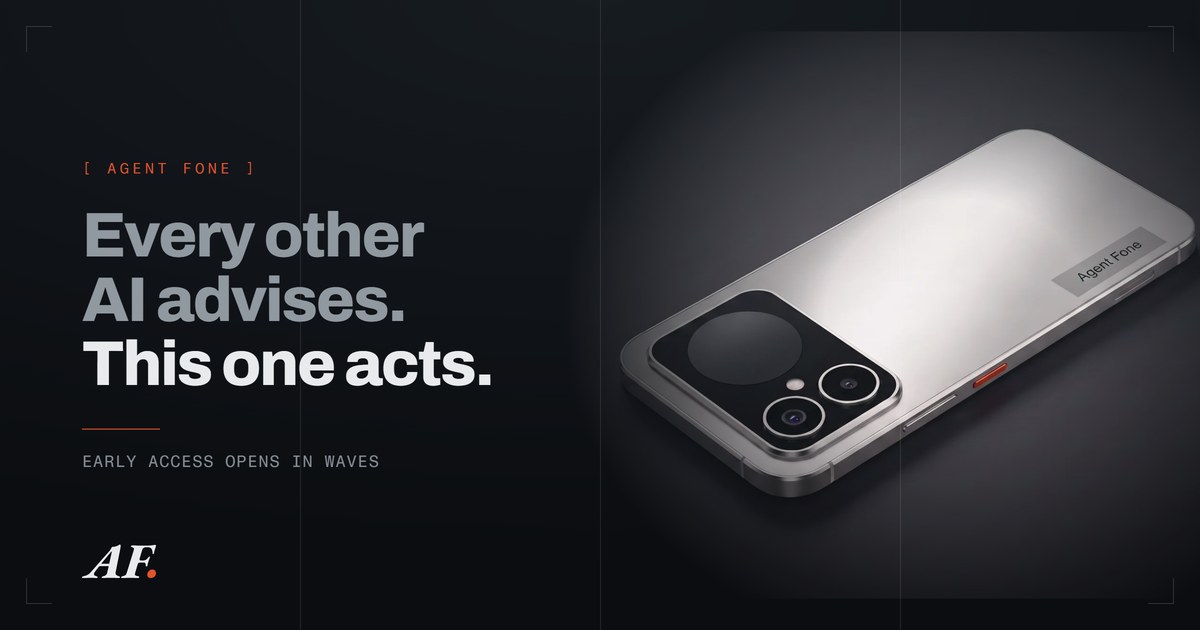
Agent Fone is being pitched as an AI-first handset that can act on a user’s data, build small apps from descriptions and run background agents, according to a public product page hosted at fail.xyz. The team says the device is already “in hand” and that the first 50 units are being placed with selected partners rather than sold through a normal consumer launch.
The pitch is aggressive, as pitches for AI hardware tend to be. Agent Fone’s creators describe the smartphone as having spent two decades as a container for other companies’ apps, then argue that the next version should generate software around the owner instead. The claim: a user describes what they need, and the phone creates an app or widget using that person’s own contacts, chats, receipts, photos and other data.
That is the headline promise. The public page does not provide processor details, operating system architecture, battery specifications, price, shipping date, model partners or a security white paper. For a device whose main claim is broad access to a user’s private life, those missing details matter.
What is Agent Fone?
Agent Fone is presented as a phone built around AI agents rather than rows of static apps. In the team’s description, the device can use native chat, native data access, a native app store, a creative suite, social features, background agents and a smart camera.
The product film listed on the page runs 7 minutes and 52 seconds. Its chapter list says the demo covers who the phone is for, a user named Tanishq, the interface, native chat, native data access, app building, widget building, an app store, creative tools, friends and social features, background agents, a smart camera and a section called “the soul.”
The team’s language frames the phone as a “lever” for work and creativity. It says a trainer could become a business, a student could become a developer and an idea could become software quickly. Those are marketing claims, and the public material does not include independent testing or third-party validation.
How the partner rollout works
Agent Fone says there are 50 devices and “a short list of partners.” The team is asking interested groups to introduce themselves if they want to build at what it calls the frontier of agentic hardware. The page lists possible partner types:
- AI or hardware labs
- Platform or model teams
- Device makers or ODMs
- Investors
- Open source groups
- Other teams
The team says conversations with potential partners will stay confidential. It also says the first 50 units are allocated to labs.
There is one wrinkle for the public. A section labeled “Unit 51” says the production run was meant to be 50 devices, but the line produced one more. According to the page, that extra unit will go to one person from the public, and applicants can use AI to help claim it.
Agent Fone’s creators are making a clear argument: personal AI needs hardware with cameras, radios, storage and access to private context. The harder question, left unanswered on the public page, is how much control users actually get over that context once the device leaves the demo and meets real life.
This story draws on original reporting from Agent Fone.