Astronomers say they have found evidence for a giant planet orbiting Tabby’s Star, the famously weird object whose flickering helped turn a normal stellar light curve into a decade of Dyson-sphere discourse.
The finding comes from researchers led by Cristina Madurga-Favieres of the University of Warwick, who report in Monthly Notices of the Royal Astronomical Society that archived observations from NASA’s Transiting Exoplanet Survey Satellite, or TESS, contain a previously unreported transit on Sept. 3, 2019. A transit is the small drop in starlight seen when an object crosses in front of a star from Earth’s point of view.
The event lasted 21 hours. The team says the signal is consistent with a giant companion roughly 10 times the mass of Jupiter. That would make it a substantial object in a system already famous for refusing to behave neatly.
A natural suspect for a strange light curve
Tabby’s Star, also known as KIC 8462852, became widely known after its unusual brightness changes were identified in 2015. The star’s light does not merely wobble in the tidy, repeating way astronomers expect from many planet transits. Its dips have been unusually strong and irregular, which left room for a pileup of proposed explanations.
One of the loudest, and least conservative, ideas was that the star might be partly obscured by alien megastructures, including a Dyson sphere-like collector built to harvest stellar energy. That idea made the star famous. It did not make aliens the best explanation.
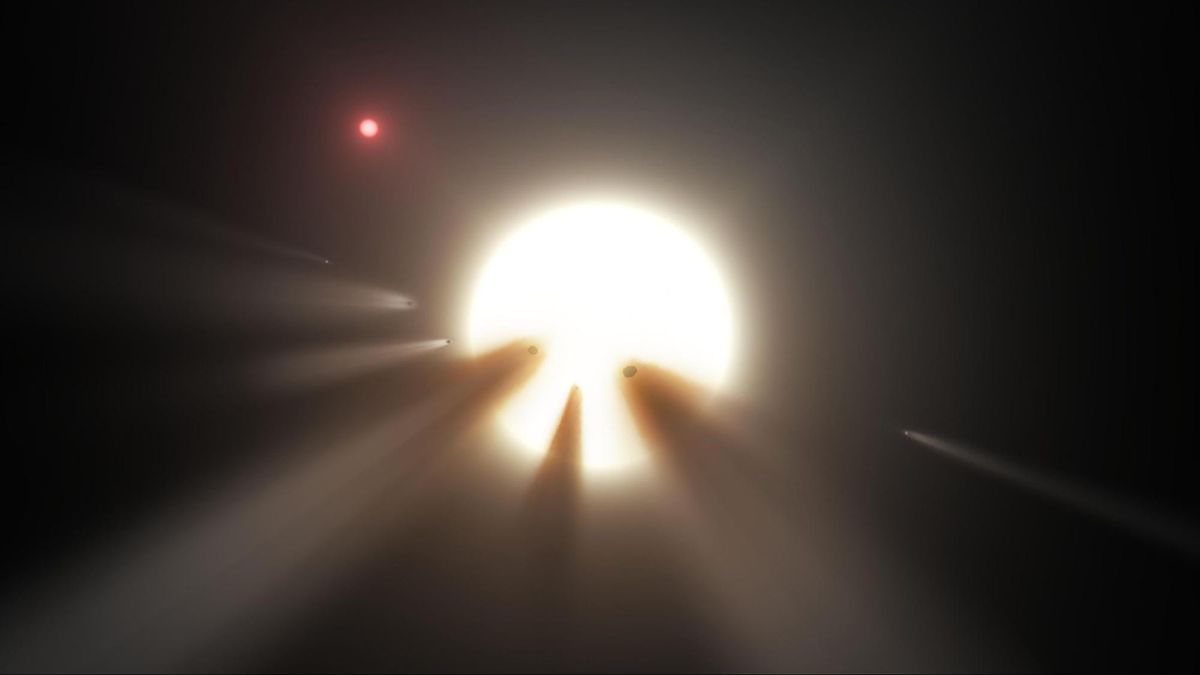
The stronger natural model, according to Madurga-Favieres and colleagues, involves swarms of exocomets or fragments of planetesimals. Those smaller bodies could pass near the star, break apart, and create clouds of material that block varying amounts of light. Messy debris produces messy dimming, which is the point.
The newly reported giant companion gives that model a plausible engine. The researchers say a large object in orbit could gravitationally disturb smaller bodies and send them toward the star, where they would fragment and generate the kind of irregular dips that made KIC 8462852 famous.
Evidence, not a victory lap
The team stresses that no transiting companion had previously been detected around Tabby’s Star. That makes the TESS event notable, but the paper describes it as potential evidence for a candidate, not a sealed case.
That distinction matters. A single transit can point to an orbiting object, but it does not provide the repeated pattern astronomers prefer when confirming planets. The study’s value is that it adds a concrete, testable object to a system where the public conversation has often sprinted past the data.
If the giant companion is confirmed, it would not be the alien megastructure people joked and argued about. It would be a large planet or planet-like body doing ordinary gravitational work in an unusually unruly system. For Tabby’s Star, that is still a useful answer.
This story draws on original reporting from 404 Media.