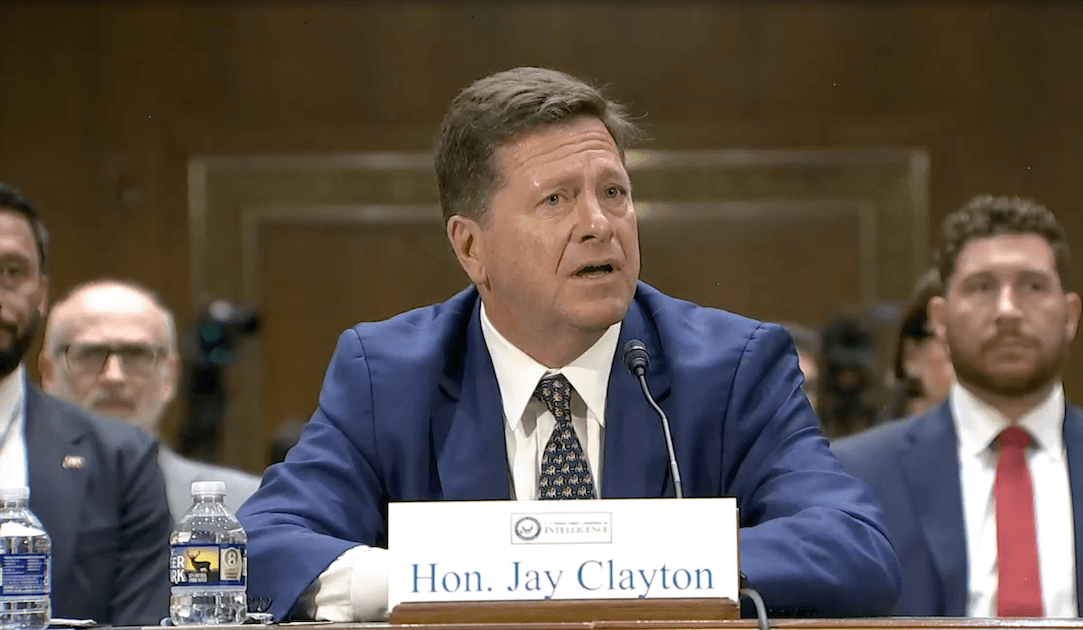
Jay Clayton, President Donald Trump’s choice to run the U.S. intelligence community, struggled Wednesday to give Senate Democrats the clean answer they wanted on a basic question: whether Joe Biden won the 2020 presidential election.
At a Senate Intelligence Committee confirmation hearing, Clayton tried to reassure lawmakers that he would act independently as director of national intelligence. His answers on election security did the opposite for several Democrats, who pressed him on Trump’s false claims about widespread voter fraud and on Clayton’s own past comments about election systems.
Clayton, now the U.S. attorney for the Southern District of New York, previously chaired the Securities and Exchange Commission during Trump’s first administration. Asked by Sen. Angus King, an independent from Maine who caucuses with Democrats, who won the 2020 race, Clayton said the country went through its procedures and Biden “became the president of the United States.”
King rejected that as an evasion, saying Clayton had promised to speak honestly to power but would not answer a straightforward question. Sen. Mark Warner of Virginia, the committee’s top Democrat, said near the end of the roughly two-hour hearing that members had tried repeatedly to get Clayton to acknowledge Biden’s presidency more directly.
The exchange landed in a live political fight, not a history seminar. Democrats on the panel have raised concerns about election security before the November midterms and about whether Clayton would resist pressure from Trump over past or future election results.
Trump is expected to give a prime-time national address Thursday. He said Tuesday that he would discuss elections, calling free and fair voting central to the country. The president’s remarks are widely expected to revisit his unproven allegations of fraud in the 2020 contest against Biden. Clayton told senators he did not know what Trump planned to say.
Clayton also defended earlier comments questioning the auditability of U.S. elections. He told the committee that some jurisdictions do not have the kind of audit trail one would expect for something so significant. He said election access and integrity could both be improved. Election experts have said there is no evidence of widespread ballot fraud.
Senators also questioned Clayton about subpoenas issued to several journalists over their reporting on the Air Force One aircraft Qatar gave to Trump. Some policymakers have described the subpoenas as an attempt to intimidate reporters and an attack on press freedom. Clayton told Sen. Kirsten Gillibrand, Democrat of New York, that he understood the concern and was comfortable with how the matter was being handled.
The hearing spent less time on the usual DNI terrain: Russia, China, other foreign threats and the state of the Office of the Director of National Intelligence. Lawmakers also did not hold a substantive public discussion of Section 702 of the Foreign Intelligence Surveillance Act, a surveillance authority that lapsed last month.
Section 702 lets U.S. intelligence agencies collect digital communications of non-U.S. people overseas without a warrant. Renewal talks collapsed after Trump named federal housing official Bill Pulte as acting DNI. Pulte, a Trump loyalist without military or intelligence experience, has drawn attention for making mortgage fraud allegations against the president’s critics and has fired or reassigned numerous intelligence officials with Trump’s support.
In written answers to the committee, Clayton said he wants to understand how to reduce the national security damage caused by the lapse of Section 702 authorities. The hearing, however, made clear that Democrats first wanted to know whether Trump’s nominee would state plain election facts without routing them through procedural fog.
This story draws on original reporting from The Record.