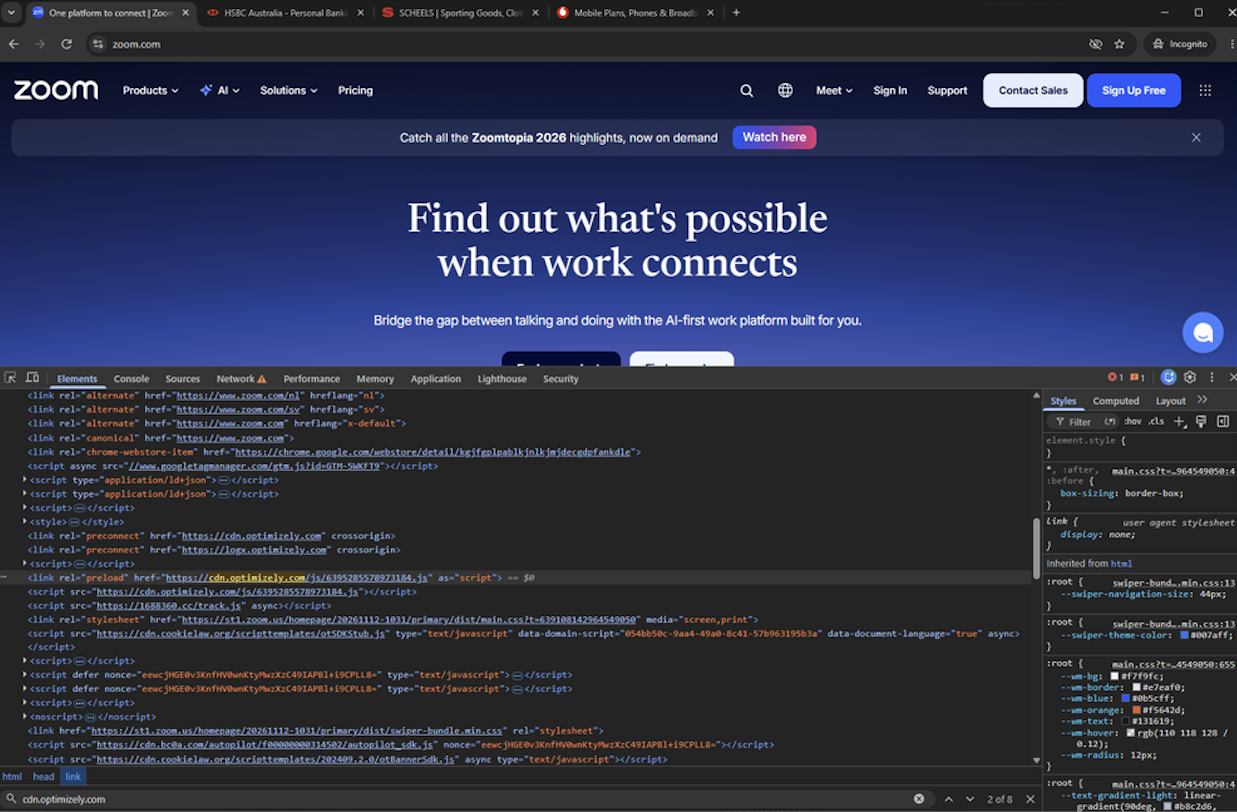
An Optimizely malware attack sent malicious JavaScript to visitors of 178 organizations on November 16, according to security firm Report URI. KrebsOnSecurity reported that affected sites included the BBC, CNN, Equifax, Ledger and Zoom. Optimizely said an unauthorized party exploited a vulnerability in its Experimentation service to add malicious code to some customer projects.
The incident is a supply-chain compromise: the attackers did not need to break into every affected website. Instead, they altered code delivered by a third-party service that those sites had already chosen to run in visitors' browsers. That distinction is not much comfort to a visitor whose browser received the script.
How did the Optimizely malware attack reach website visitors?
Websites use Optimizely to customize pages and run experiments, including A/B tests. Its JavaScript is loaded as visitors open a page. JavaScript runs in the browser, where it can change a page's content and access information displayed there. Once malicious code entered affected Optimizely customer projects, downstream sites served it from that trusted dependency, Report URI researcher Scott Helme said.
Report URI said the payload was rebuilt 26 times during the day. The firm reported capabilities including payment-card data theft, cookie and screenshot collection, and replacement of cryptocurrency payment addresses with addresses controlled by the attackers. It also found exploit code aimed at known vulnerabilities in older iPhones and iPads.
That changing payload does not establish that the attackers performed controlled A/B testing of malware. The available reporting establishes that Optimizely is an experimentation product and that the malicious code changed repeatedly, not that attackers compared variants against defined visitor groups or measured results.
Optimizely said it blocked the vulnerable route, issued a fix, removed injected code from affected projects, ended active sessions, revoked tokens and reset access for affected accounts. The company also said it had added protections against malicious code delivery through Cloudflare and was investigating with outside experts.
Why did site security policies not stop every script?
A Content Security Policy, or CSP, is a browser rule that tells a page which domains may provide third-party content. It can limit where a compromised script is allowed to load more code from, although it has to be configured carefully and is not a universal cleanup button.
Report URI found that 68 of the affected sites had no CSP. Another 50 had policies that still allowed the payload and data theft, while 24 sites, or 15%, had policies that fully blocked the malicious payload, according to the firm. The figures show the practical problem with outsourced browser code: a site can have intact servers and still pass an attacker's script to readers because a vendor was trusted to execute code on the page.
For operators, the immediate work is unglamorous: identify third-party scripts, determine what each can load, and review whether CSP rules admit unnecessary sources. For visitors, the reporting does not establish that every visit to an affected organization resulted in data theft. It does establish that third-party scripts deserve the same scrutiny as code a site writes itself.
This story draws on original reporting from Krebs on Security.