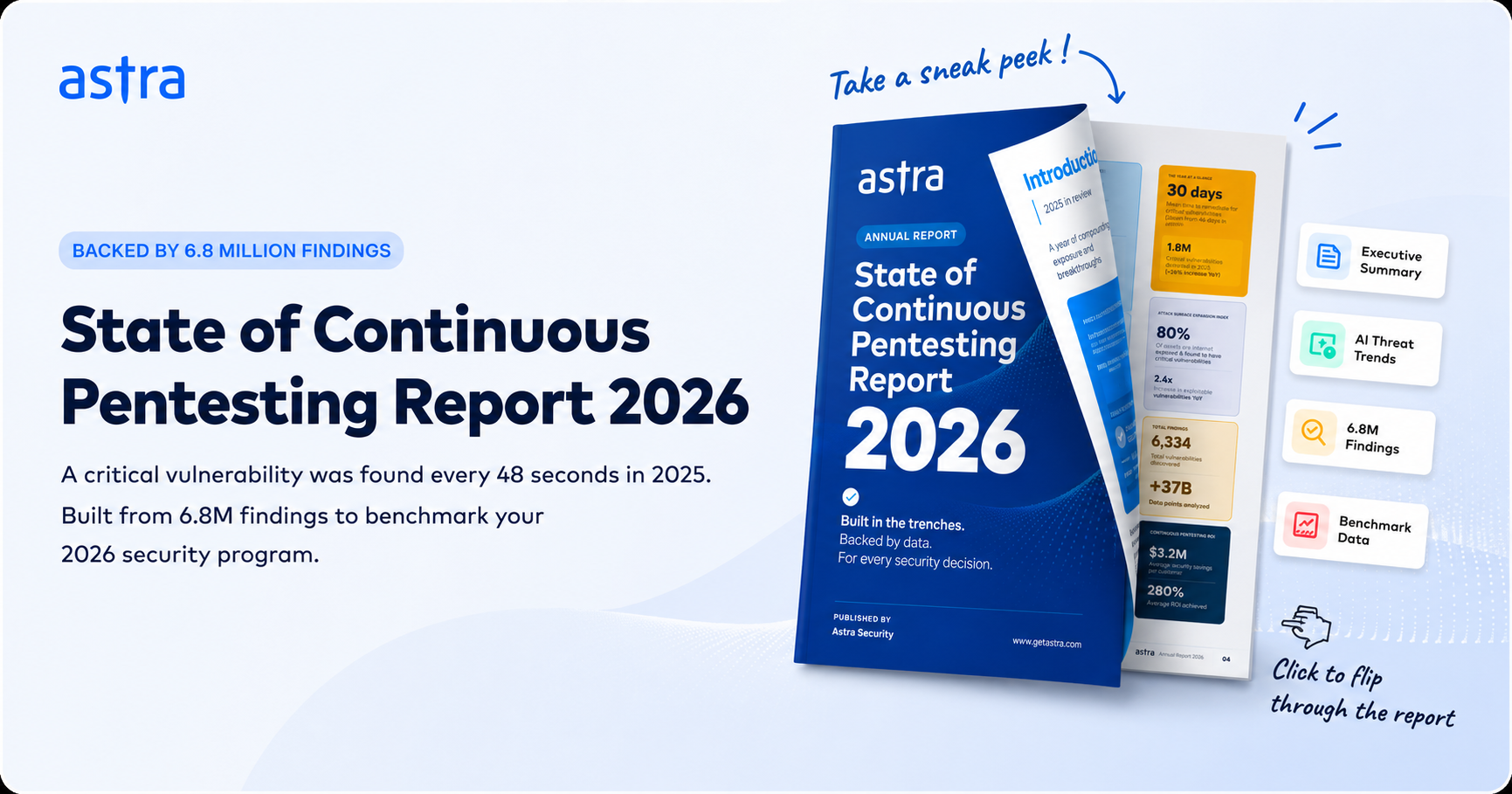
Astra Security has published its State of Continuous Pentesting Report 2026, reporting that critical vulnerabilities accounted for one in 10 findings on its platform in 2025, compared with one in 40 previously. The Astra continuous pentesting report 2026 draws on 6.8 million findings from more than 150,000 scans and 8,000 penetration-testing engagements involving more than 1,000 organizations in over 70 countries.
The result is Astra platform data, not an industry-wide survey. It describes the share of findings the company classified as critical rising from 2.5% to 10%. Astra forecasts that critical findings could reach one in five by the end of 2026 if that trend continues, which is a projection rather than an observed result.
What did Astra’s continuous pentesting report find?
Astra reported that November 2025 was its quietest month for scanning, followed by 1.8 million vulnerabilities recorded in December. That December total exceeded all vulnerabilities recorded on the platform during 2024, according to the report.
The report also said 80% of tracked AWS credential exposure in 2025 surfaced during mobile-app testing rather than cloud scans. The finding identifies where the exposure was detected in Astra’s data; it does not establish why mobile testing produced that share.
Astra’s broader argument is that periodic tests struggle to keep up with software that changes frequently. The company presents continuous testing as its answer, but its findings do not establish that autonomous testing has become the standard across the security industry.
How does Astra’s autonomous pentesting work?
Astra says its software runs autonomous testing agents continuously against web applications and APIs. It says a separate validator attempts to exploit a finding before it is reported, while human pentesters take on work requiring greater context. In practice, the distinction matters: a vulnerability finding can identify a possible weakness, while an attempted exploit is intended to test whether that weakness can be used.
The company says its autonomous pentesting platform produced first findings up to 80 times faster than a traditional manual engagement in an internal benchmark. That comparison is not an independent study, and the supplied results do not detail the benchmark’s methodology.
What controls should govern autonomous testing?
Continuous testing software that can probe applications needs operational guardrails, not a vague promise that the bot knows what it is doing. Astra says it helped develop the OWASP Autonomous Penetration Testing Standard, or APTS, an open framework addressing scope enforcement, auditability and human-override controls.
Those controls give buyers concrete questions: whether the system remains within its defined scope, whether its actions can be examined afterward, and whether people can intervene. Astra says the report includes evaluation questions tied to those areas.
Co-founders Shikhil Sharma and Ananda Krishna said organizations are “under-secured because they are mis-measured.” For security teams, the report’s usable contribution is narrower than its market pitch: test frequency, cross-surface coverage and controls over autonomous actions are governance questions worth examining alongside the vendor’s platform-specific numbers. Readers can review Astra’s description of its autonomous pentesting platform for the company’s stated operating model.