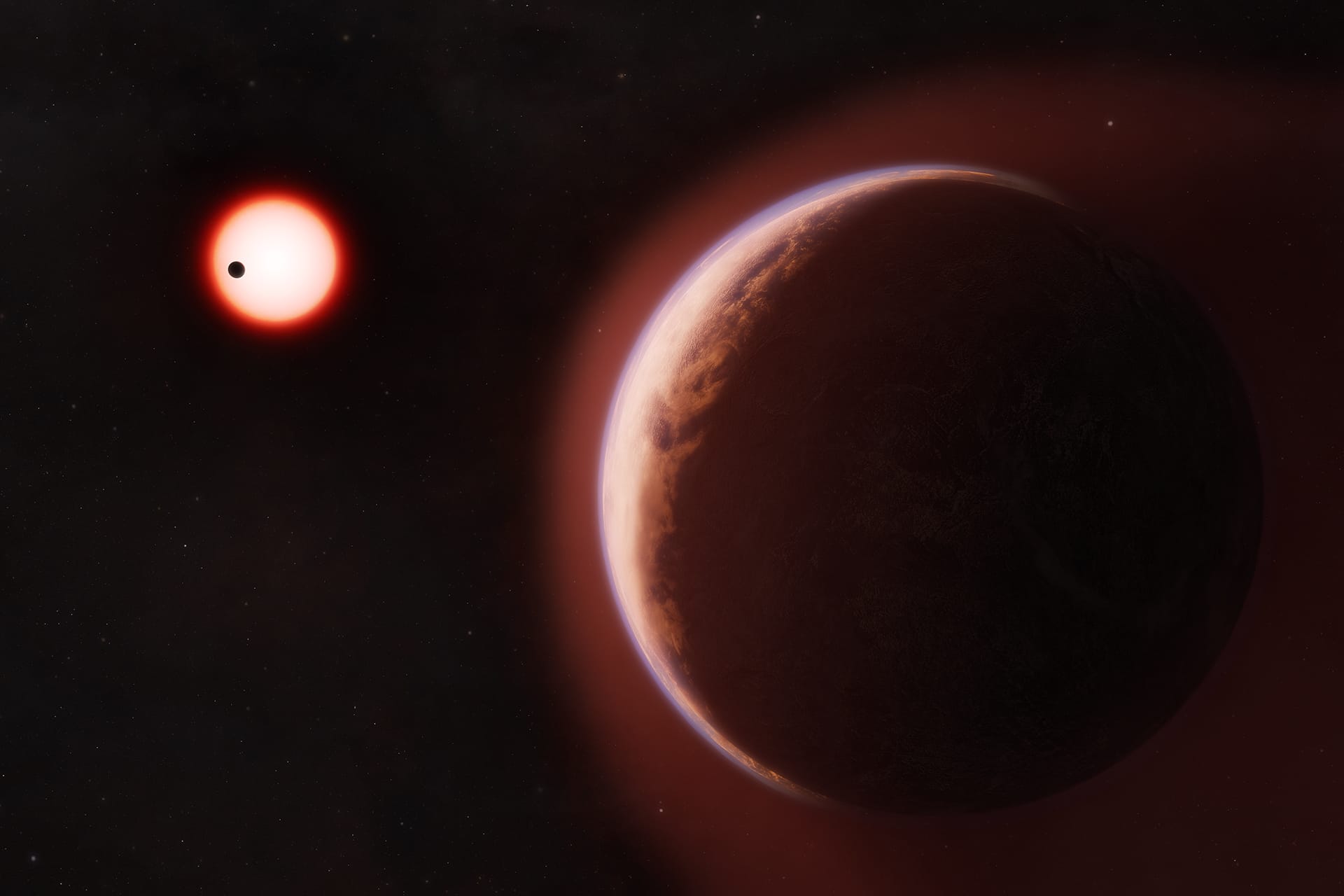
Astronomers say they have detected an atmosphere around LHS 1140-b, a rocky planet in the temperate region around its star, according to a study published Thursday in Science. If the finding is borne out, it gives researchers their first direct atmospheric detection on a rocky exoplanet sitting in a star’s habitable zone, the orbital range where surface liquid water could exist.
LHS 1140-b is about 5.6 times Earth’s mass and orbits a small dwarf star roughly 48 light years from the solar system. Astronomers have found atmospheres on many gas giants and on some rocky planets outside habitable zones. The new claim is different because it concerns a rocky world in the zone where researchers bother asking the life question without immediately sounding ridiculous.
The detected signal is helium. Collin Cherubim, a NASA Hubble Fellow at the University of Chicago who led the work while he was a Harvard PhD student, told 404 Media that finding atmospheres around rocky, Earth-like planets has been one of the field’s stubborn measurement problems. Small planets produce small signals, and their stars do not politely dim themselves for astronomers’ convenience.
The team’s route to the observation began with models, not a lucky telescope stare. Cherubim modeled mass fractionation, the process in which lighter atmospheric particles escape into space more readily than heavier ones. In those simulations, hydrogen can be stripped away while helium remains abundant enough in the upper atmosphere to become detectable as it leaks from the planet.
Cherubim described the scenario to 404 Media as a narrow range: enough hydrogen escapes to change the atmosphere, but not so much atmospheric loss occurs that helium gets dragged away with it. The result, according to his model, is a class of planets with unusual chemistry and helium-rich upper atmospheres.
To test that idea, the researchers observed LHS 1140-b and another planet in the same system, LHS 1140-c, during 2024 and 2025. They used the Warm Infrared Echelle Spectrograph, or WINERED, at the Magellan Observatory in Chile.
The 2024 observations showed a strong helium signal at LHS 1140-b, according to the study. The 2025 observations did not repeat the detection, which the team says may indicate that helium escape changes over time. LHS 1140-c showed no atmospheric signature, a result the researchers expected from that planet’s orbit and properties.
The team also predicts LHS 1140-b has likely kept its atmosphere for billions of years. Cherubim and his colleagues think the planet may have substantial liquid water on its surface, another requirement for life as Earth knows it. Cherubim told 404 Media that habitability, at the broadest level, requires a mostly rocky planet, temperatures compatible with surface liquid water, and an atmosphere that can retain water and block radiation. He said LHS 1140-b now appears to meet all three criteria.
That does not mean anyone found aliens. Researchers have already used the Hubble Space Telescope and the James Webb Space Telescope to search LHS 1140-b’s atmosphere for biosignatures, according to 404 Media. Those efforts have not produced obvious signs of life. Cherubim said the planet is still one of the best nearby targets for future biosignature searches.
This story draws on original reporting from 404 Media.