AI robotics breakthroughs are giving machines better ways to interpret instructions and manipulate objects, but a compelling demo remains a long way from a robot people can depend on every day. Google DeepMind has reported advances in models that directly control robots, while researchers and Google’s own disclosures identify unresolved problems in reliability, long-term planning, dexterity and deployment around people.
That distinction is the useful test for the current humanoid frenzy. A machine has to complete useful work repeatedly in varied physical settings, rather than complete a selected task once for a video or benchmark. Ingmar Posner, director of the Oxford Robotics Institute, told a Royal Society event that real value comes from doing the job many times and succeeding every time. He said there remains a significant gap between laboratory demonstrations and robust performance.
Why aren’t AI robots ready for everyday use?
Language models can generate or interpret text from patterns in training data, as explained in how large language models work. A robot also has to turn perception and an instruction into physical motion. That means understanding a three-dimensional setting, the relationships among objects and the consequences of contact while carrying out the task.
Google DeepMind’s Gemini Robotics work is a concrete sign of progress, not proof that this problem has been solved. In a March 2025 arXiv preprint, the Gemini Robotics team described a vision-language-action model, or VLA, that produces robot actions from inputs including language and visual information. The authors reported that, after additional fine-tuning, the system could be adapted for specialized tasks such as folding an origami fox and playing cards, and for new robot forms. Those are developer-reported findings in a preprint, not an independent validation of general-purpose autonomy.
MIT Technology Review described DeepMind testing Gemini Robotics on ALOHA 2, a two-arm platform with grippers and cameras. A video showed the system packing bread and grapes into containers and a lunchbox. The publication characterized that as an advance over what robots could do roughly three years earlier. It does not demonstrate dependable general-purpose use beyond tasks the system has been trained to perform.
Some of the hard parts are less glamorous than a humanoid silhouette. Posner said AI still struggles with general long-range planning outside constrained settings. He also pointed to touch: people routinely use dense tactile feedback when manipulating objects, whereas available robotic tactile sensing remains limited. Opening a laptop illustrates the issue, he said, because a person can locate the groove by feel even when it is out of view.
Safety adds another deployment requirement. Google DeepMind’s safety report says emergency stops, barriers, and speed and force limits remain necessary for robots near people. It also says systems may need to ask humans for help when an instruction or scene is uncertain. In its benchmark results, Google reported strong text-only safety classification, but more variable results when models had to turn constraints into spatial predictions or tool use. The report did not assess the certified hardware, redundancy and real-time safety systems needed for a compliant deployment.
Google’s July 2026 model card for Gemini Robotics On-Device 2 says the model was available only to select trusted testers. It lists limitations with tasks outside its training distribution and with robots that have many controllable joints; its evaluations focused mainly on standing, two-arm manipulation.
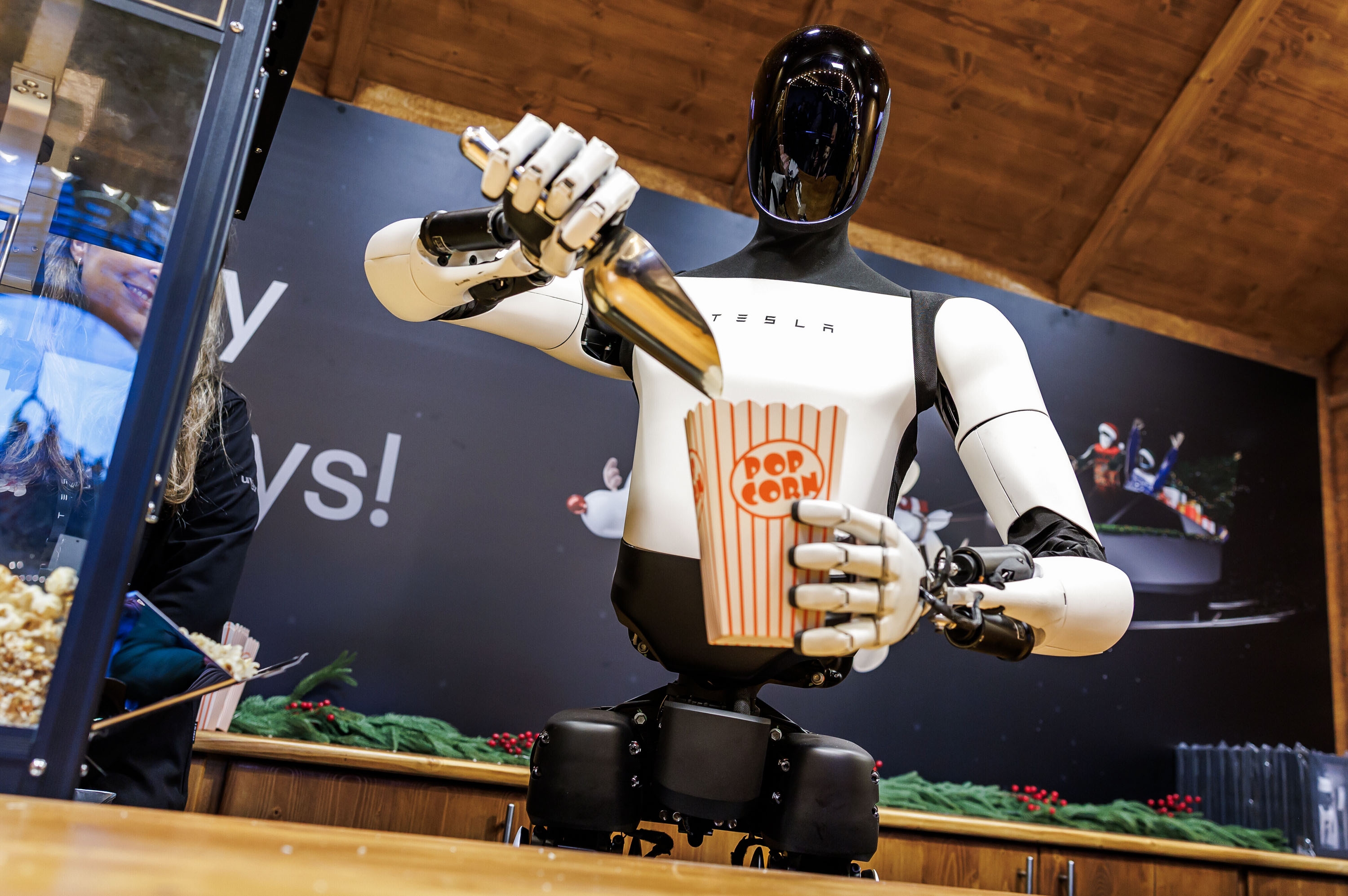
That is a more grounded picture than the public forecasts. Tesla CEO Elon Musk has predicted Optimus could go on public sale by the end of 2027 and has made claims about its price, dexterity and potential to automate labor. Those remain Musk’s predictions, not established delivery dates or demonstrated capabilities.
This story draws on original reporting from MIT Technology Review.