SourcingGPT.ai deployed an AI sourcing assistant at Eletrolar Show 2026, putting supplier search, booth routing and attendee-behavior analytics into the middle of a high-traffic trade show rather than leaving buyers to wander aisles with a tote bag full of paper.
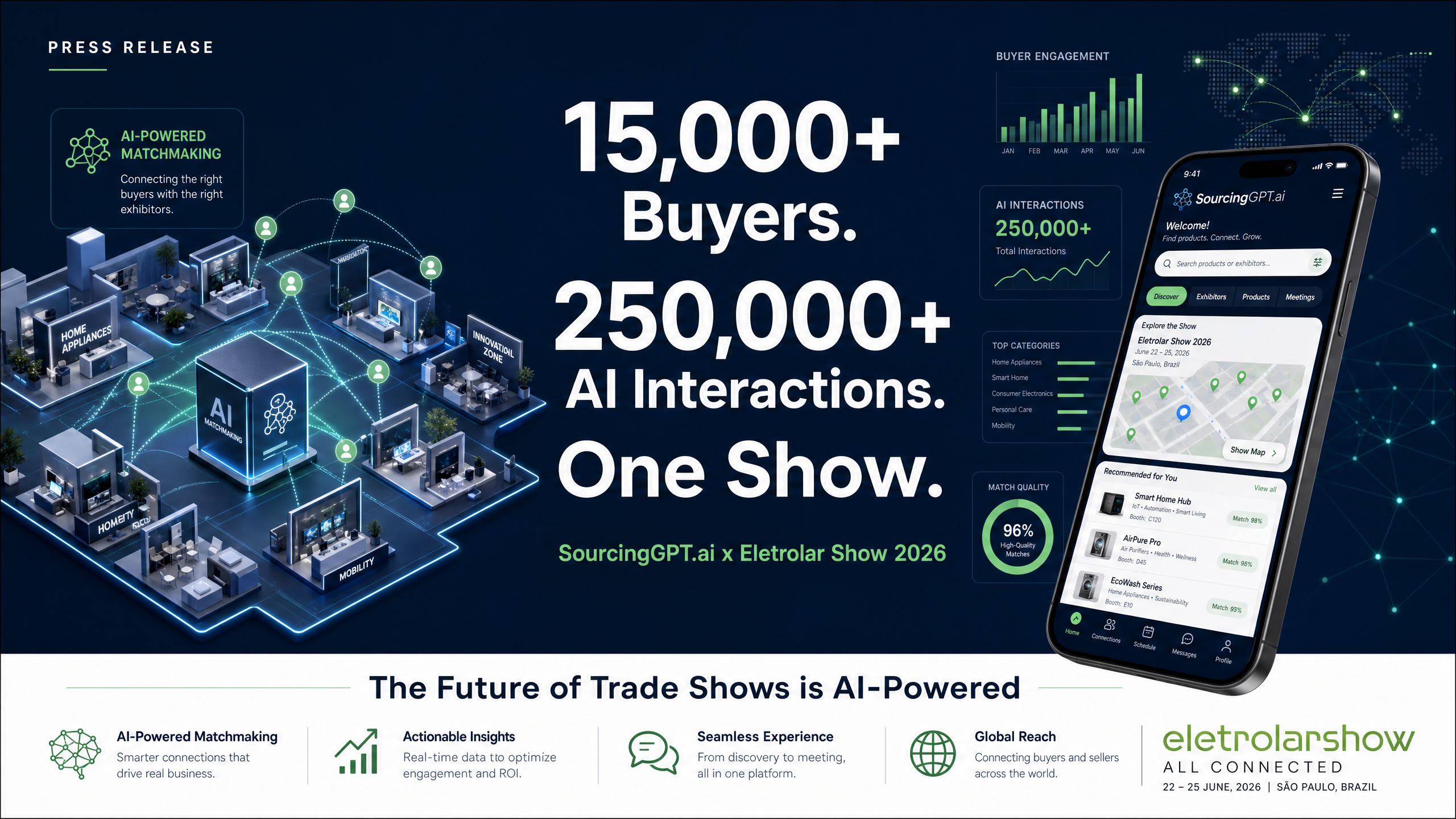
The company said the event drew more than 45,000 attendees across Brazil and Mexico, with more than 15,000 registered buyers actively using its platform. Those buyers generated more than 250,000 AI interactions, including more than 35,000 searches for products, brands and categories.
The mechanics are straightforward: a buyer searches for what they are trying to source, the system matches that request against exhibitors, and the app points the buyer to relevant booths through an interactive 3D floor map. SourcingGPT said users opened more than 40,000 map navigation sessions and that mobile devices accounted for 85% of usage, which suggests the tool was used on the show floor rather than as a post-event directory.
That is the more useful part of the announcement. Enterprise AI is often sold as a chat window bolted onto existing software. Here, the chat-like matching layer feeds a procurement workflow and an event-intelligence system: search intent becomes booth routing, saved suppliers become digital follow-up records, and organizer dashboards turn buyer behavior into sellable analytics.
What organizers could see
Traditional event metrics tend to stop at badge scans, lead forms and footfall estimates. SourcingGPT said Eletrolar organizers could see product-demand signals, exhibitor interest rankings, hourly activity patterns, device and session data, and a 3D heatmap showing where attention clustered on the floor.
Those dashboards matter because trade-show economics are built on proof that exhibitors met the right buyers. If a system can show which categories buyers searched, which booths they saved, and which routes they followed, organizers get a more concrete story than attendance totals. Whether exhibitors treat that data as proof of return on investment will depend on how clean the matching and follow-up records are, but the pitch is obvious.
For buyers, the tool replaces some of the manual triage that defines large sourcing events: scanning directories, asking around, collecting cards and trying to remember which supplier made which promise. The platform allowed users to save supplier contacts, record meeting notes, track pricing and minimum order quantities, and receive a structured post-show summary, according to SourcingGPT.
Buyer testimonials released by the company were heavy on time saved. One buyer, identified as Jhonatas, compared the experience with a previous visit to Canton Fair and said the QR code at the entrance helped him find what he needed faster. Another buyer, Paulo, said the app made it easier to classify and locate suppliers, even when connectivity was poor.
A white-label product, not a one-off demo
SourcingGPT is also positioning the deployment as a repeatable product for event organizers. Its AI sourcing assistant for trade shows is offered as a white-label system with organizer branding, an analytics dashboard, 3D heatmaps, product-demand reporting, exhibitor ROI reports and post-show buyer engagement tools.
The company said it is in advanced discussions with several large trade-show groups about deployments in Europe, Asia and the Americas. It did not name those groups.
Minesh Pore, a spokesperson for SourcingGPT, said the Eletrolar deployment showed the platform could analyze trade data in real time and change how businesses connect globally. Strip out the press-release gloss and the underlying move is still notable: procurement AI is being pushed into physical events, where matching quality, latency and behavior tracking are harder to fake than in a canned software demo.