Creator Uwoslab has managed to run a desktop PC from a pile of alkaline AA batteries, a stunt that is silly on its face and useful as a reminder that power delivery, not vibes, decides whether a computer boots.
The system was an AM4 desktop without a discrete graphics card, according to Uwoslab’s build details, which points to one of AMD’s G-series chips with integrated graphics. The machine also skipped internal storage and booted from a USB flash drive. The operating system was Hannah Montana Linux, the novelty Linux distribution from 2009 that was recently revived with a modern refresh. The setup also played FreeDoom, according to the project description.
How the battery rig was built
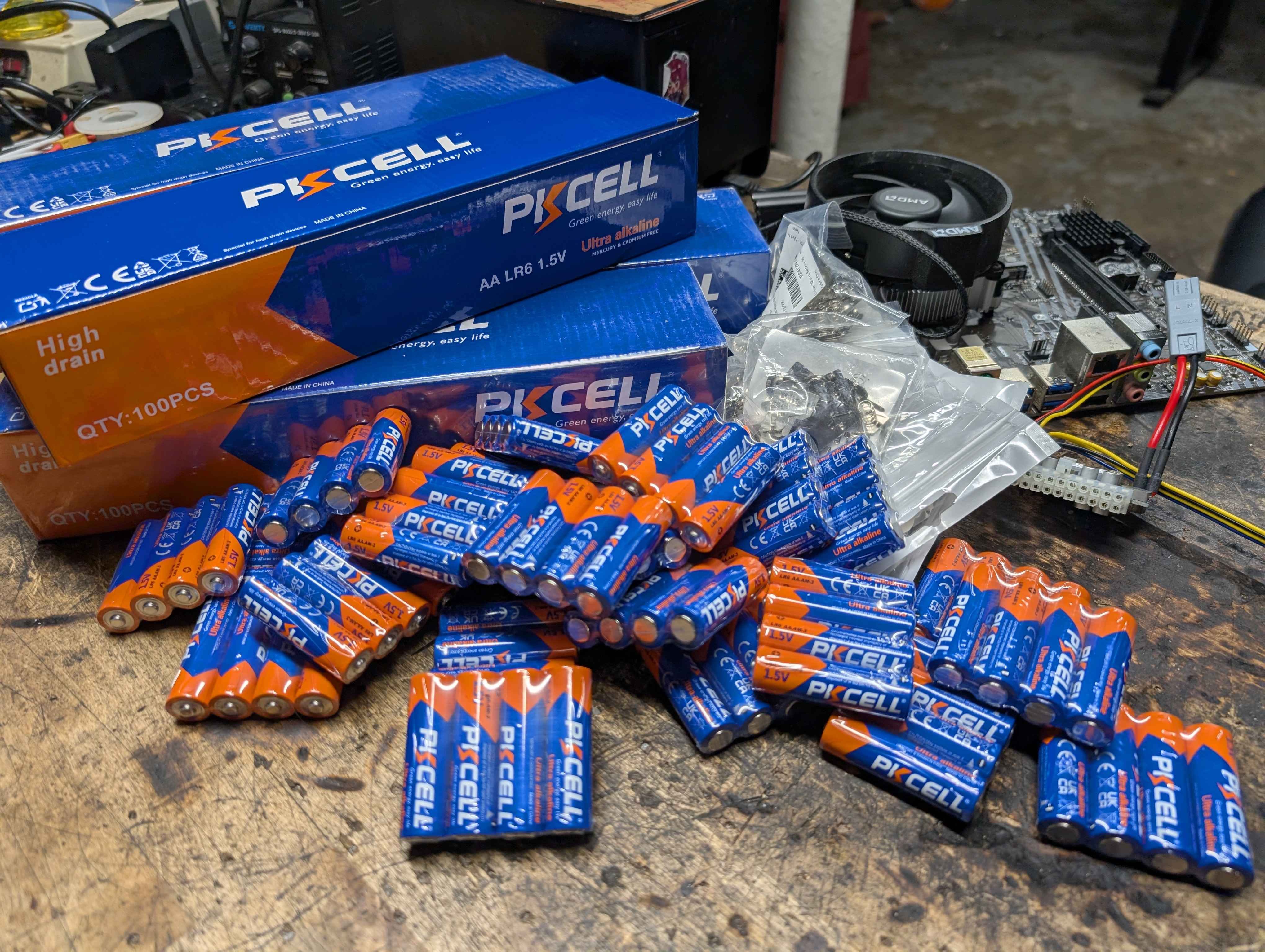
Uwoslab began with 400 AA cells, bought as four packs of 100. The original plan called for a larger battery array, but the finished version used 192 AA batteries spread across three wooden boxes. Each box held 64 cells.
The wooden frames were laser-cut so the batteries would sit in fixed positions. Uwoslab added clips and contact pads at the ends of the assembly to act as terminals, with four cells fitted into each slot, then reinforced the boxes with duct tape. It is the kind of construction method that looks chaotic until the electrical path matters, at which point the tape is doing less comedy and more mechanical work.
The choice of batteries mattered. Uwoslab had previously tried to run a PC from 9V zinc-carbon batteries, but that attempt reportedly kept the machine alive only for a few seconds. For this build, he switched to high-drain Pookell alkaline AA cells rated at 1.5V. A PC expects 12V on its main rail, so eight 1.5V cells in series provide the nominal voltage needed for that part of the system.
Capacity and current are the harder parts. AA alkaline cells sag as they discharge, and that voltage drop can make a desktop unstable before the cells are technically empty. The build avoided a common wasteful route: feeding a 12V battery pack into an inverter to make wall AC, then sending that through a normal PC power supply. Uwoslab instead connected the battery grid to a 12V DC-to-ATX adapter board plugged into the motherboard.
The PC stayed up under load
Uwoslab said on X that the AA-powered machine ran for 30 minutes without dying, unlike the earlier 9V attempt, and that the remaining capacity suggested it could keep running for a couple more hours before voltage drop became the problem. The post described the setup as running from “200 AAs,” while the build details put the assembled count at 192 cells.
During testing, the machine booted into Hannah Montana Linux on the first try and ran the Linux stress-ng CPU test. Uwoslab reported CPU usage at 98%. The battery bank started at about 13V and fell to a steady 11.95V during the stress test.
No one should confuse this with a practical desktop power supply. It is bulky, disposable-cell hungry, and electrically dependent on a voltage curve AA batteries were not designed to hold for PCs. Still, the result is clear enough: with enough cells, a direct DC-to-ATX path, and modest hardware, an AM4 desktop can run from alkaline AAs long enough to boot, benchmark, and play a little FreeDoom.
This story draws on original reporting from Tom's Hardware.