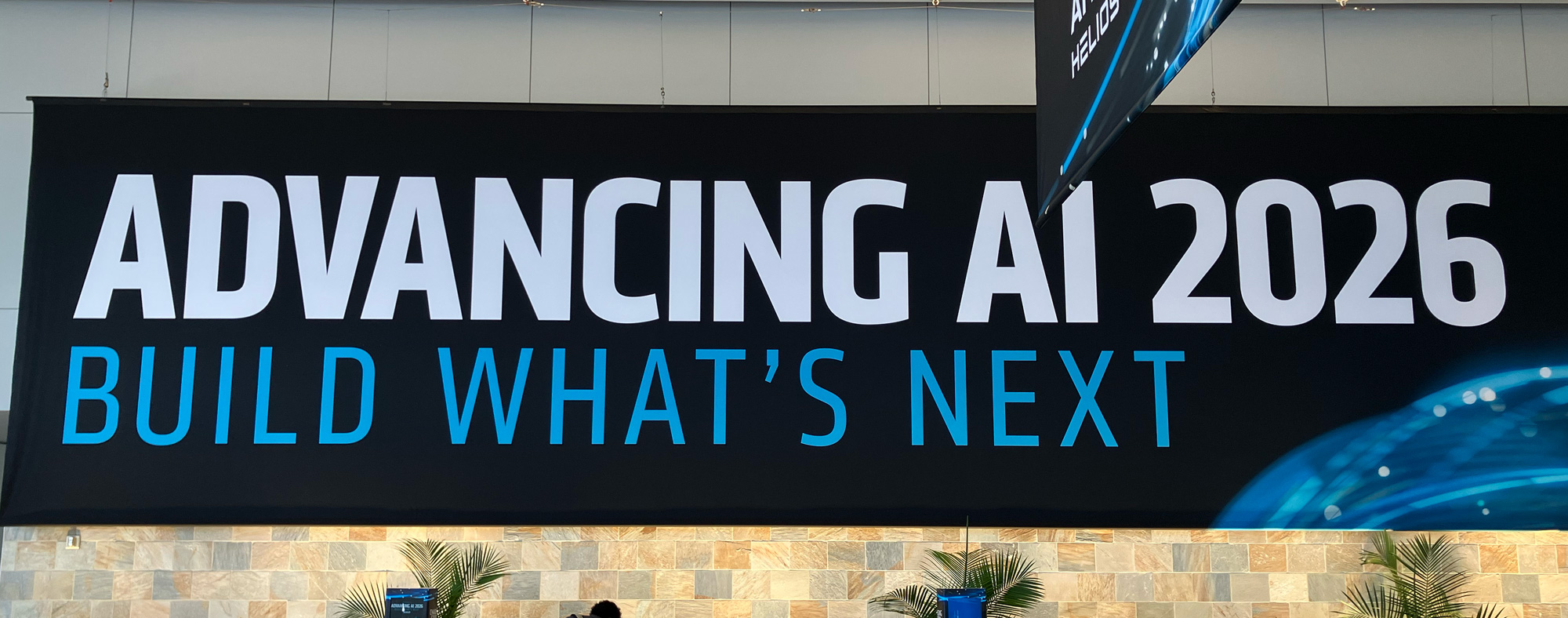
AMD Advancing AI 2026 is underway in San Francisco, and the company’s annual enterprise AI show is expected to revolve around Helios, AMD’s first rackscale AI system. ServeTheHome reported that AMD has turned what used to be closer to a press event into a full trade show at Moscone Center West, with developer sessions, product booths and a keynote led by CEO Dr. Lisa Su.
AMD told ServeTheHome that this is its largest Advancing AI event so far. ServeTheHome said the claim is backed up by the venue footprint: the show is using all of Moscone Center West. The comparison hanging over the event is obvious enough. ServeTheHome described Advancing AI as AMD’s counterpart to Nvidia’s GTC, just farther down the road in the Bay Area.
The keynote is scheduled for 9:30 a.m. Pacific, 12:30 p.m. Eastern and 16:30 UTC. AMD is also streaming the session on YouTube.
What is AMD Helios?
Helios is AMD’s planned rackscale AI system, previously teased by the company at last year’s event. According to ServeTheHome, the system combines AMD MI455X GPUs, EPYC “Venice” CPUs and Pensando DPUs in a single rack, using a scale-up network so the rack can operate more like one large machine than a pile of separate servers.
That mechanism matters in AI infrastructure because big model training and inference workloads depend on moving data quickly among accelerators. A rackscale design tries to reduce the penalty of splitting work across many chips by treating the rack as the unit of computing. Nvidia has pushed a similar idea with its NVL72 systems, and ServeTheHome described Helios as AMD’s answer to those racks.
What is AMD expected to announce?
ServeTheHome expects much of the two-hour keynote to focus on Helios and the parts that make it work. The likely subjects include the MI455X GPU, EPYC “Venice” server CPU, Pensando DPU and AMD’s ROCm software stack.
ROCm is AMD’s software layer for running accelerated computing and AI workloads on its GPUs. For buyers comparing AMD with Nvidia, software support is not a side quest. Hardware specs look neat on slides, but clusters spend their lives running frameworks, libraries and orchestration code, where compatibility and developer friction tend to show up fast.
AMD has already named customers for Helios, including Microsoft, according to ServeTheHome. The rack has not been fully detailed publicly, so the keynote is expected to fill in some of the missing architecture and deployment information.
The timing question is also still open. ServeTheHome said AMD has previously given only a broad shipping window for Helios and its components: the later part of 2026. The event may clarify volume production dates and when the first racks are expected to ship.
ServeTheHome also said it will be watching for a refreshed roadmap covering future AMD chips and rack systems beyond Helios, though AMD may keep the keynote centered on products closer to launch. That would be the safer play. In AI hardware, roadmaps are cheap; racks that ship, boot and run real workloads are the part customers can actually use.
This story draws on original reporting from ServeTheHome.