AMD BC-250 gaming performance has moved beyond the board’s factory limits, according to testing by Tom’s Hardware, after community developers produced tools that can expose disabled graphics units and, more recently, CPU cores. The payoff is a cheap Linux gaming machine built from an ex-crypto mining board. The catch is that it remains a pile of hardware, firmware work and airflow problems, not a console substitute.
The ASRock BC-250 uses AMD silicon closely related to the PlayStation 5’s APU. In its standard configuration, however, it exposes six Zen 2 CPU cores and 12 threads at about 3.5 GHz, plus 24 RDNA 2 compute units, or CUs, running at 1,500 MHz. It also has 16GB of shared GDDR6 memory.
Tom’s Hardware reports that community-developed BIOS and graphics-driver work made Linux gaming possible on the board in the first place. Newer tools can attempt to enable all 40 graphics CUs present on the silicon. Initial fixes for the two disabled CPU cores had also appeared by the time of its report, potentially taking the processor from six to eight cores.
That word, “potentially,” is doing real work. Tom’s Hardware found that unlock results vary: some boards operate with 40 CUs, some reach 32 or 36, and some remain at the stock 24. Its own sample ran all 40 CUs stably at up to 1,850 MHz, but that is one board’s result, not a specification buyers can count on.
Can the AMD BC-250 replace a Steam Machine?
Tom’s Hardware said its testing put a fully configured BC-250 in the range of Valve Steam Machine performance. The report did not include comparative game results, settings or frame-time data in the available material, so that conclusion should be read as its test finding rather than a general performance guarantee.
The price gap is clearer, even if the products are not equivalent. Tom’s Hardware lists a Steam Machine starting at $1,050, while it estimates a BC-250 system assembled from scratch at $400 to $500. That works out to roughly 38% to 48% of the reported Steam Machine entry price. Its own completed build cost about $350, including roughly $200 for the board, while it said boards were listed around $175 on eBay.
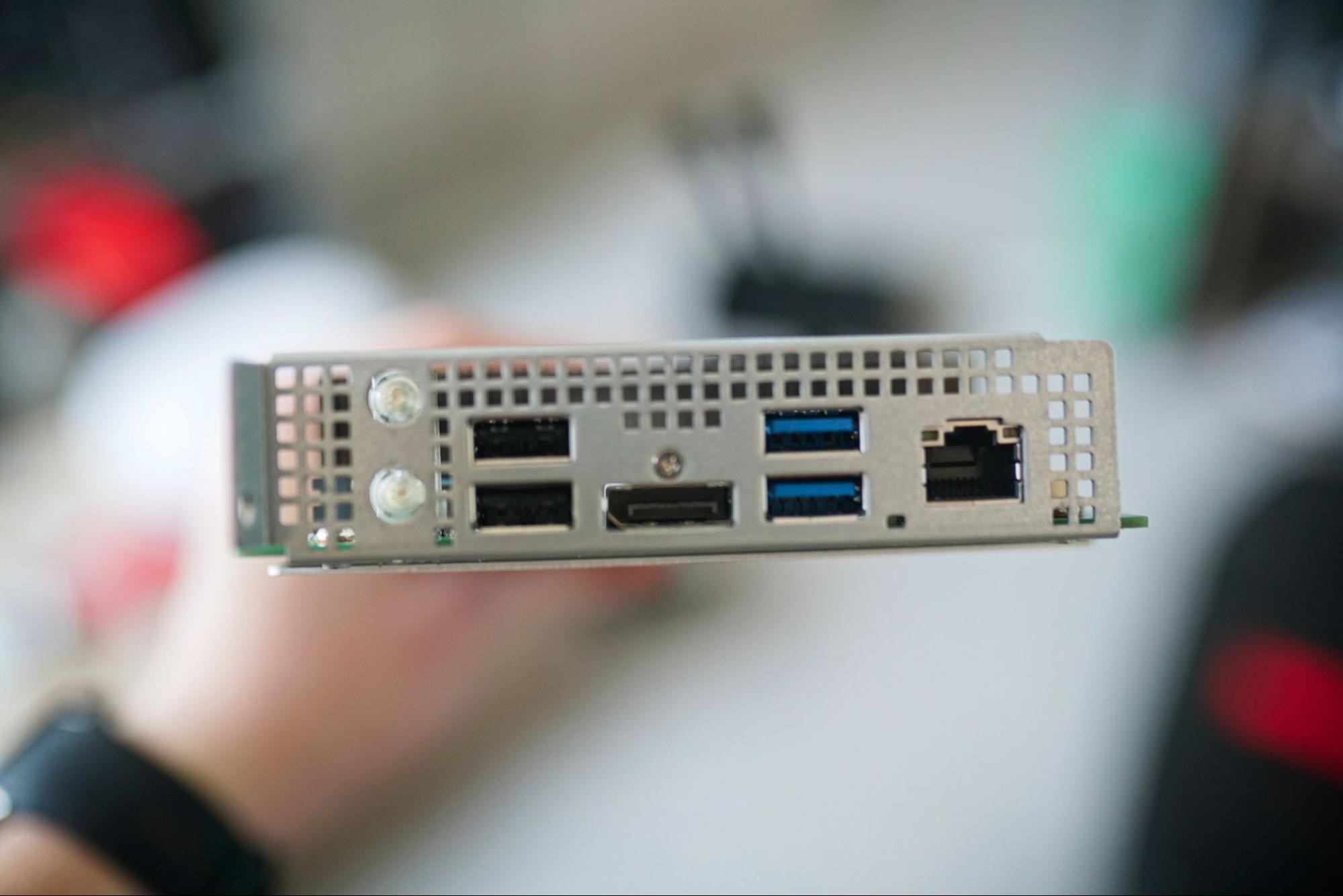
The board alone is not the computer. A build needs storage, a power supply, cooling and an enclosure or case solution. It takes one PCIe eight-pin power connector and offers one M.2 2280 slot, two PWM fan headers, DisplayPort 1.4, four USB ports and gigabit Ethernet.
What are the limits of a BC-250 gaming build?
The board is related to a PS5 at the silicon level, not at the system level. Tom’s Hardware cites less L3 cache, a PCIe 2.0 x2 M.2 connection estimated at about 1 GB/s with an NVMe SSD, and the lack of Sony’s specialized I/O and software layers. The outlet says the restricted storage link means a lower-performance, higher-capacity drive can make economic sense; our guide to SSD speed-versus-capacity considerations explains the broader trade-off.
Cooling also decides how far a board can run. Tom’s Hardware says the BC-250 is thermally constrained even with active airflow. A GPU governor is needed for dynamic graphics clock scaling, while a CPU governor is optional. Aftermath separately reported that the board was designed for rack-server airflow, making a conventional DIY enclosure and cooler an awkward fit.
For tinkerers, that is the assignment. For anyone seeking a machine that works without custom BIOS files, thermal experimentation and variable unlocks, Tom’s Hardware’s verdict is more useful: this is not a set-it-and-forget-it gaming device.
This story draws on original reporting from Tom's Hardware.