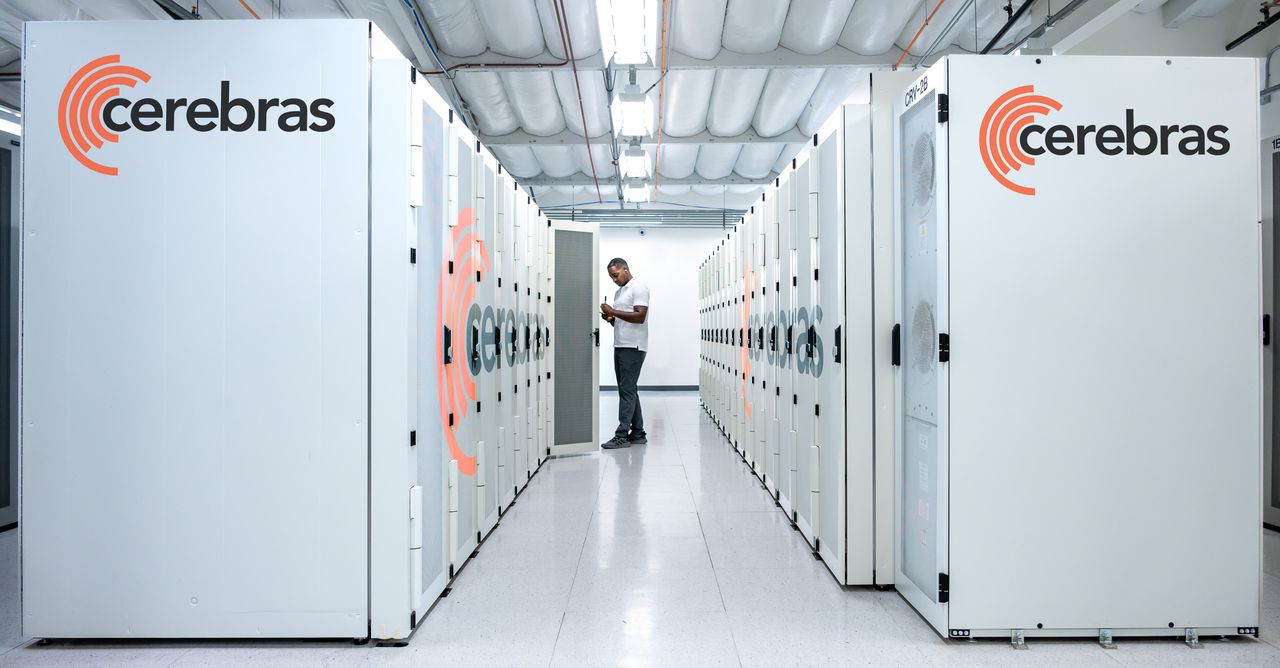
AMD and Cerebras Systems said Thursday they plan to build an AMD Cerebras inference platform that splits large AI inference jobs across two kinds of hardware: AMD Helios racks using EPYC CPUs and Instinct MI400-series accelerators, and Cerebras racks built around its Wafer-Scale Engine processors.
The pitch is straightforward, at least in the way infrastructure vendors describe unfinished systems. AMD and Cerebras say the combined platform will route different parts of an inference workload to hardware suited for that stage, with AMD’s rack-scale systems handling prompt processing and large context windows, while Cerebras’ WSE systems handle token generation.
The companies claim the design can deliver up to five times more tokens per second per watt than a less specialized setup. They did not publish detailed benchmark results, name a baseline system, or explain how the AMD and Cerebras racks will be connected inside the single inference workflow. That missing plumbing matters, because latency and bandwidth between racks can turn neat architecture diagrams into expensive heat.
What is the AMD Cerebras inference platform?
The planned system is a disaggregated AI inference platform, meaning one model-serving job is divided across separate compute systems rather than run end to end on one type of accelerator. In the companies’ design, AMD Helios infrastructure processes the input side of the job, including prompts and long context, and Cerebras’ wafer-scale chips process the output side, where the model generates tokens.
In practical terms, the platform is aimed at the two pressure points of modern inference: accepting large, complex requests and producing responses quickly without burning too much power. AMD brings EPYC CPUs and Instinct MI400-series accelerators inside Helios racks. Cerebras brings its WSE processors, which the companies describe as suited to the memory-bandwidth-heavy generation stage.
Inference is the phase where a trained AI model answers a request. The prefill, or context, stage reads the prompt and any supplied context; the decode, or generation, stage produces the answer token by token. The AMD-Cerebras plan assigns those stages to different machines in the same workflow.
How does it compare with Nvidia’s CPX idea?
The design resembles Nvidia’s CPX concept in that both separate inference into context processing and token generation. The hardware assignment differs.
Nvidia’s disaggregated approach put the canceled Rubin CPX GPU, equipped with GDDR7 memory, on the compute-heavy context and prefill stage. Standard HBM-equipped Rubin GPUs were intended to handle the memory-bandwidth-bound generation stage.
AMD and Cerebras are proposing the inverse arrangement. AMD’s Helios racks with Instinct GPUs take the prefill stage, while Cerebras’ WSE racks take the decode stage for latency-sensitive token generation.
Cerebras plans to deploy AMD Helios systems in its own data centers and tie them into its WSE racks. AMD and Cerebras said the combined service is expected to be available first through Cerebras Cloud in the second half of 2026.
Until the companies disclose interconnect details and fuller performance data, the five-times efficiency claim should be treated as a target, not a proven operating result. The announcement does show where high-end AI inference is headed: less one-size-fits-all accelerator worship, more awkward but potentially efficient specialization across the serving pipeline.
This story draws on original reporting from Tom's Hardware.