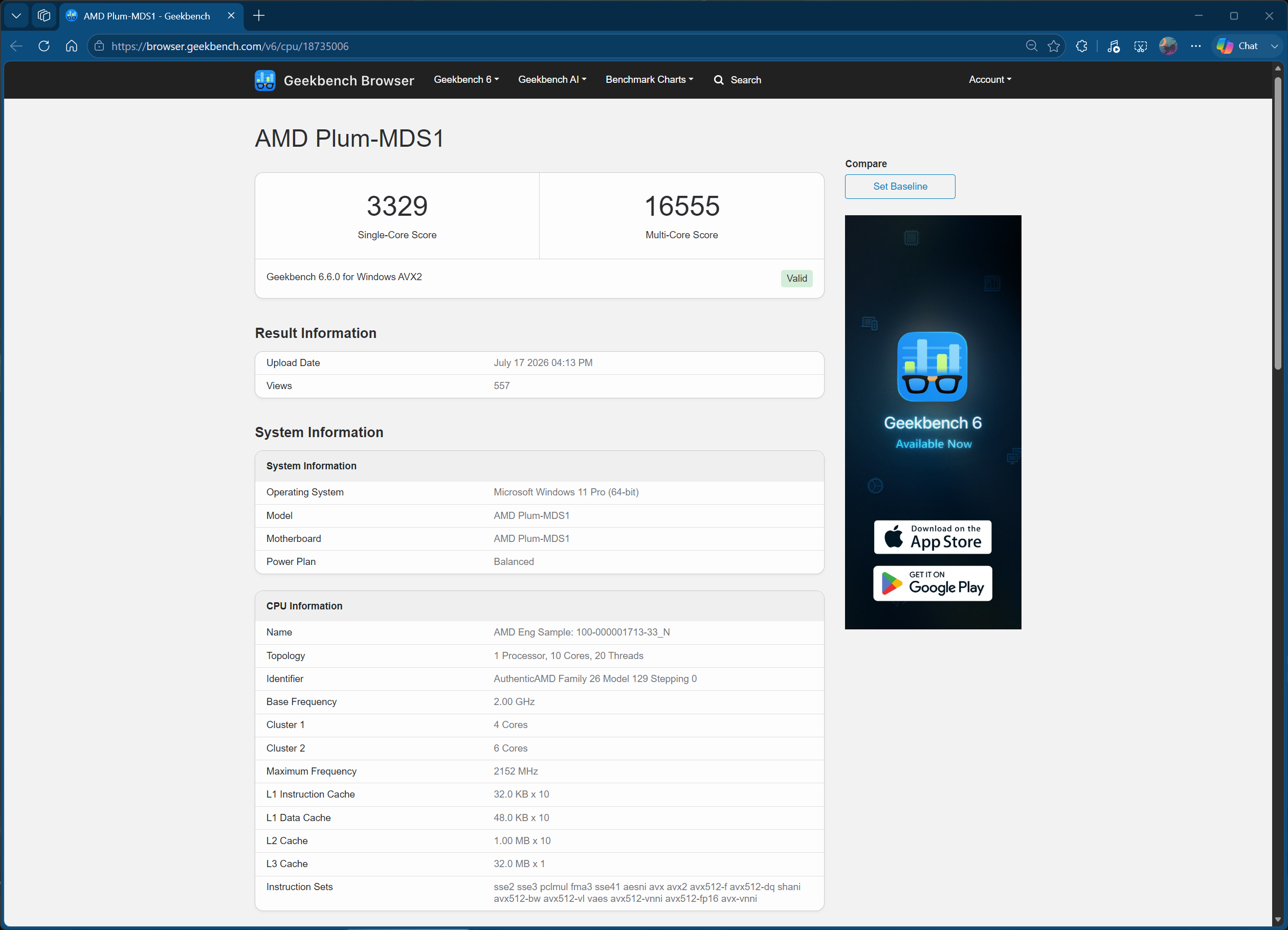
A new Geekbench result for an unreleased AMD laptop processor points to a sharp single-core gain for the company’s next mobile generation, assuming the listing is genuine and representative. The entry identifies the test platform as “AMD Plum-MDS1” and the processor as “AMD Eng Sample 100-000001713-33_N,” the same engineering-sample string seen in an earlier leak tied to AMD’s Medusa Point family.
The Geekbench listing reports 3,329 points in the single-core test and 16,555 in multi-core. Those are the best scores yet for this apparent 10-core part. Compared with the earlier leaked run, the single-core result is nearly 5% higher and the multi-core result is about 9.7% higher, according to the figures cited for the previous appearance.
That single-core number is the headline item. In Geekbench’s database comparisons cited in the report, the chip lands above current mobile x86 processors from Intel and AMD. Qualcomm’s Snapdragon X2 Elite lineup still posts a higher mobile single-core score, with the X2E-90-100 listed at 3,573, but that is an Arm chip rather than an x86 part.
What the listing says
The leaked AMD sample is reported with 10 CPU cores. The benchmark entry lists a 2.0 GHz base frequency and a 5.37 GHz boost clock. It also shows 10MB of L2 cache and 32MB of L3 cache.
The previous run apparently reported less plausible clock information, so the newer boost figure is useful context. It does not make the result final. Engineering samples can run with firmware, power limits, memory configurations, and scheduler behavior that differ from retail laptops. Geekbench is also a narrow benchmark, useful for comparison, and bad at telling the whole story about battery life, thermals, sustained performance, or graphics.
The chip’s identity remains unofficial. The report infers that the part could be a Ryzen AI 9 565 because it has 10 cores, matching the configuration pattern used by Ryzen AI 9 365 from Strix Point and Ryzen AI 9 465 from Gorgon Point. AMD has not confirmed that retail name in the information cited here.
How it compares
The leaked score sits close to several desktop processors in single-core Geekbench results cited in the report:
- AMD Ryzen 9 9900X: 3,333 single-core
- AMD Ryzen 7 9800X3D: 3,333 single-core
- Leaked AMD Medusa Point sample: 3,329 single-core
- AMD Ryzen 5 9600X: 3,318 single-core
- Intel Core i9-14900KS: 3,226 single-core
- Intel Core Ultra 9 285K: 3,195 single-core
Multi-core is less dramatic, which makes sense for a 10-core mobile part competing in lists that include higher-core desktop CPUs. The Medusa Point sample’s 16,555 multi-core score is near the Ryzen AI Max+ 390 in the cited comparison and below the top desktop chips listed, including Intel’s Core i9-14900KS at 23,008 and AMD’s Ryzen 9 9950X3D at 22,169.
Against AMD’s existing 10-core Ryzen AI 9 365, which is cited with an average multi-core score of 12,410, the leaked Medusa Point result is about 33% faster. That is the kind of uplift people expect AMD to chase with Zen 6, but a leaked benchmark is still a starting point, not a buying guide.
AMD is expected to use Medusa Point for its next mainstream Ryzen AI 500 mobile family. The report frames it as the lineup that will compete with Intel’s Panther Lake, while AMD’s Gator Range and Intel’s Nova Lake mobile parts are described as higher-end CPU offerings.
This story draws on original reporting from Tom's Hardware.