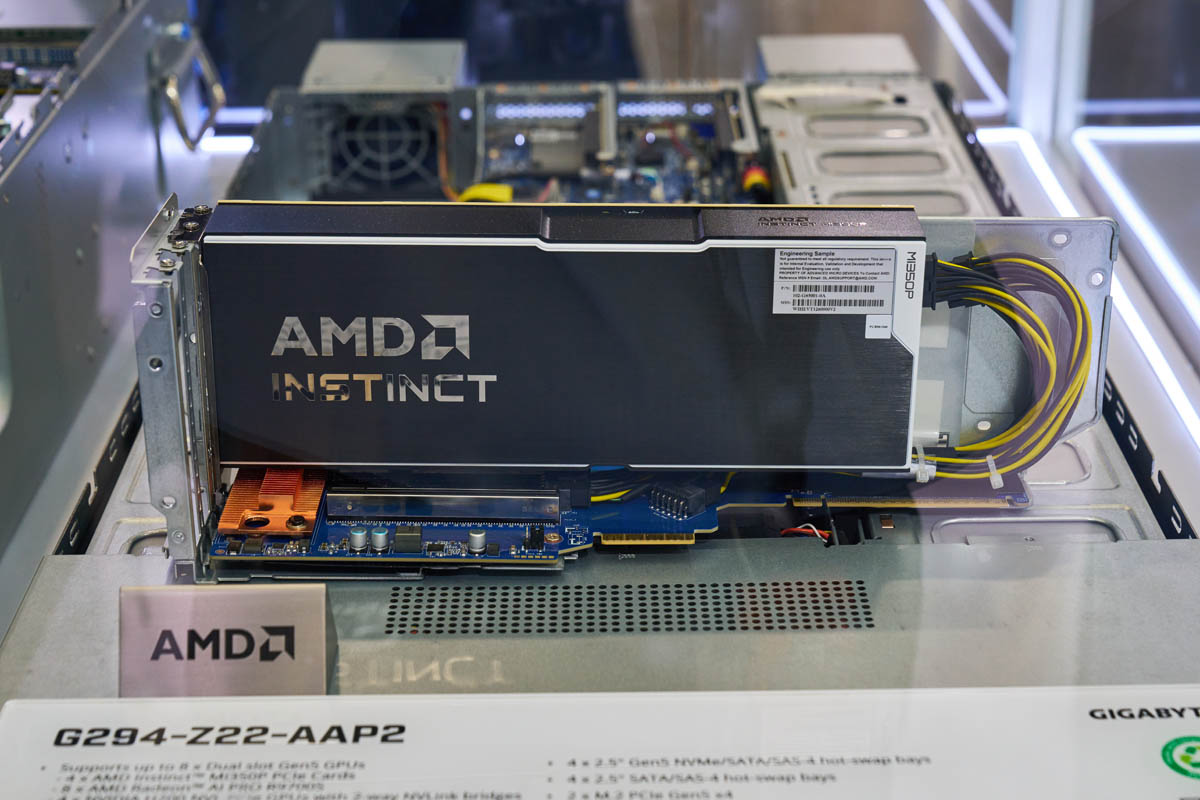
AMD’s Instinct MI350P is turning from a spec-sheet announcement into a card that server vendors are willing to put on a show floor. ServeTheHome reports that the 144GB HBM3E PCIe accelerator has appeared in systems at Dell Tech World, HPE Discover, Computex 2026 and other recent events.
That matters for AI infrastructure buyers because PCIe accelerators are easier to fit into a wider range of servers than OAM modules, even if the thermal and power budgets are still not exactly friendly. ServeTheHome says the MI350P is a 600W passively cooled PCIe card with no display outputs, aimed at compute rather than graphics.
ServeTheHome disclosed that Dell and HPE sponsored its travel to shows where systems were seen, and that AMD provided access to some systems. Treat the vendor enthusiasm accordingly. Show-floor presence is not the same thing as volume availability, but it is a useful signal that OEMs are building around the part.
Why the card exists
The MI350P is related to AMD’s MI350X, but ServeTheHome describes it as roughly half of the OAM MI350X in compute, memory and power. The mechanical reason is boring and important: a full MI350X-class device would draw too much power for a standard PCIe CEM card. AMD’s answer, as described by ServeTheHome, was to package a scaled-down version for PCIe servers.
The card is based on AMD’s newer Instinct line and brings CDNA 4 into a PCIe form factor, according to ServeTheHome’s earlier coverage referenced in its report. The site also notes that the power connector sits at the front of the card, opposite the I/O bracket, matching the layout used by current Nvidia server cards.
How it compares with Nvidia’s PCIe options
ServeTheHome compared the MI350P with two Nvidia PCIe accelerators it describes as the main current alternatives: the H200 NVL and the RTX Pro 6000 Blackwell Server Edition. The MI350P carries 144GB of HBM3E. The H200 NVL is listed at 141GB, while the RTX Pro 6000 Blackwell Server Edition has 96GB of GDDR7.
Memory type and capacity are the point here. For inference workloads, especially those trying to fit larger models or more context into a single accelerator, more memory and more bandwidth can matter more than a prettier brand slide. ServeTheHome says the RTX Pro 6000 Blackwell Server Edition has the newer Blackwell architecture and RT cores for mixed workloads, but trades away HBM capacity by using GDDR7.
On numeric formats, ServeTheHome says AMD publishes stronger FP4 and FP6 figures for the MI350P than the Nvidia cards in its comparison. It also warns that accelerator comparisons are messy because vendors publish different metrics, sometimes mixing sparse and dense numbers or peak and delivered performance. That caveat is doing real work. AI accelerator marketing remains a swamp with tables.
The lower-precision formats are relevant because inference operators often try to use compact numeric representations such as FP4 or FP6 instead of FP8. According to ServeTheHome, doing so can increase the amount of model data that fits inside the card’s memory footprint, while AMD’s MXFP6 support gives the MI350P a useful position between FP8 and FP4.
Video workloads are part of the pitch
ServeTheHome also compared decode capabilities, noting that many deployments now handle images and video feeds rather than text tokens alone. The site says the relevant vendor spec pages present video decode information in different ways, so its comparison is a best-effort read rather than a clean like-for-like benchmark.
The practical takeaway is narrower than AMD would probably prefer, but more useful: the MI350P gives server makers a high-memory HBM PCIe accelerator at 600W, and ServeTheHome has now seen it in multiple vendor systems. The harder questions, including delivered software performance and supply, still require tests beyond a trade-show floor.
This story draws on original reporting from ServeTheHome.