ASML is weighing higher prices for its current Low-NA extreme ultraviolet lithography machines, and TSMC is already unhappy about it, according to The Information. That is a supply-chain fight with consequences well beyond two companies: ASML is the sole supplier of EUV scanners, and TSMC is its largest customer.
Roger Dassen, ASML’s chief financial officer, told investors on the company’s quarterly earnings call that Low-NA EUV systems have become more productive, giving ASML room to seek higher prices. He also cautioned that the effect would not show up immediately because customers order these machines years before they arrive.
The timing is awkward for chipmakers and useful for ASML. The Dutch equipment maker reported second-quarter 2026 net sales of €9.326 billion, or $10.67 billion, and net income of €2.918 billion, or $3.338 billion. ASML now expects 2026 net sales of €43 billion to €45 billion, above its earlier guidance and analyst expectations cited in the report.
Why ASML thinks it can charge more
ASML has long raised average selling prices as its EUV scanners gain throughput and precision. Its logic is value-based pricing: if a machine lets a fab process more wafers or print tighter patterns, ASML wants part of that extra economic value.
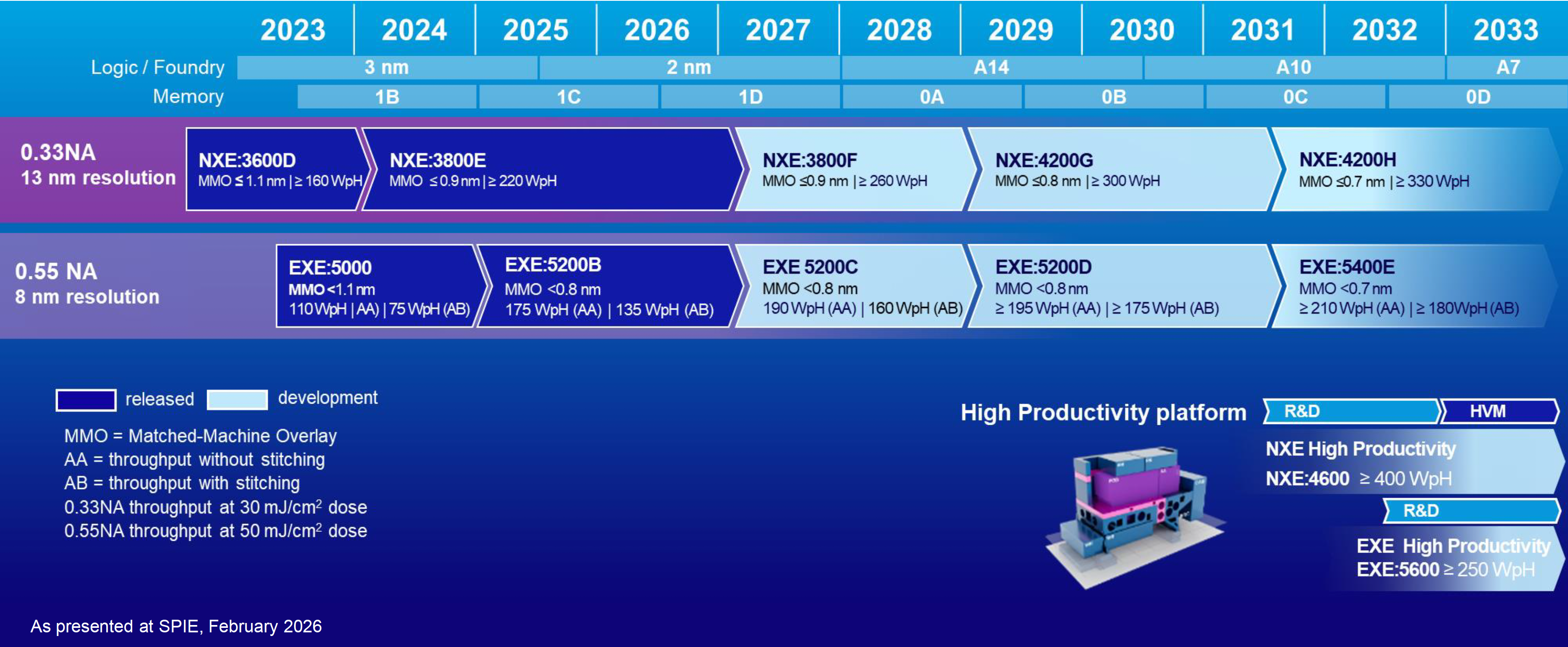
The performance gains are real, according to the figures cited. Older NXE:3400C and NXE:3600D Low-NA systems process about 160 to 170 wafers per hour with matched machine overlay of 1.1 nanometers or better. The NXE:3800E and NXE:3800F raise throughput to 220 and 260 wafers per hour, respectively, with 0.9 nanometer overlay. Future NXE:4200G and NXE:4200H systems are expected to exceed 300 wafers per hour and improve overlay further.
The machines have also become costlier. Earlier Twinscan NXE tools were commonly discussed around €100 million to €120 million. Later production systems moved toward €140 million to €170 million, while High-NA EXE systems cost more than €350 million per machine, according to industry reports cited in the account.
Dassen said ASML has historically charged customers for throughput improvements while leaving gains in overlay and imaging quality less directly priced. He said ASML is now talking with customers about being paid for that additional value too.
TSMC’s Low-NA bet gets more expensive
TSMC has built much of its near-term manufacturing plan around extending Low-NA EUV rather than moving quickly to High-NA EUV. The company has argued for years that High-NA tools are too expensive, and adopting them also requires changes in photoresists, masks, pellicles, metrology, design rules and computational lithography flows.
That strategy depends on Low-NA machines staying meaningfully cheaper than High-NA systems. TSMC’s leading-edge roadmap through 2029 relies on Low-NA EUV production tools, according to the report. If ASML lifts prices across new Low-NA generations, the economic gap narrows.
Scale makes the dispute sharper. TSMC needs many EUV scanners for fabs in Taiwan, the United States and Japan. Even a modest percentage increase across dozens of systems could add billions of dollars to capital spending, according to the report.
ASML’s order book limits how fast any increase can bite. Dassen said ASML is close to fully covered with Low-NA EUV orders for 2027 and has already received a significant number of 2028 orders. Existing backlog generally carries agreed sales values, so broad repricing is more likely to affect later orders unless contracts are renegotiated.
ASML plans to expand Low-NA EUV capacity by about 30 percent in 2027, to roughly 84 or 85 systems, from an expected 65 EUV tools this year. It is also studying another 30 percent increase for 2028, when it plans to produce 110 EUV scanners.
This story draws on original reporting from Tom's Hardware.