AMD introduced AMD X100 robotics processors for embedded systems, moving its Strix Halo-style APU design into machines expected to run all day, every day. The Ryzen AI Embedded X100 line is aimed at robotics and other “physical AI” deployments, with AMD promising a 10-year lifecycle for embedded customers.
The lineup borrows heavily from the Ryzen AI Max family used in client devices, according to AMD, but it is packaged for industrial use rather than laptops. The company is pitching the chips against Intel’s Panther Lake physical AI SoCs, which Intel launched earlier this year.
What is AMD X100 for robotics?
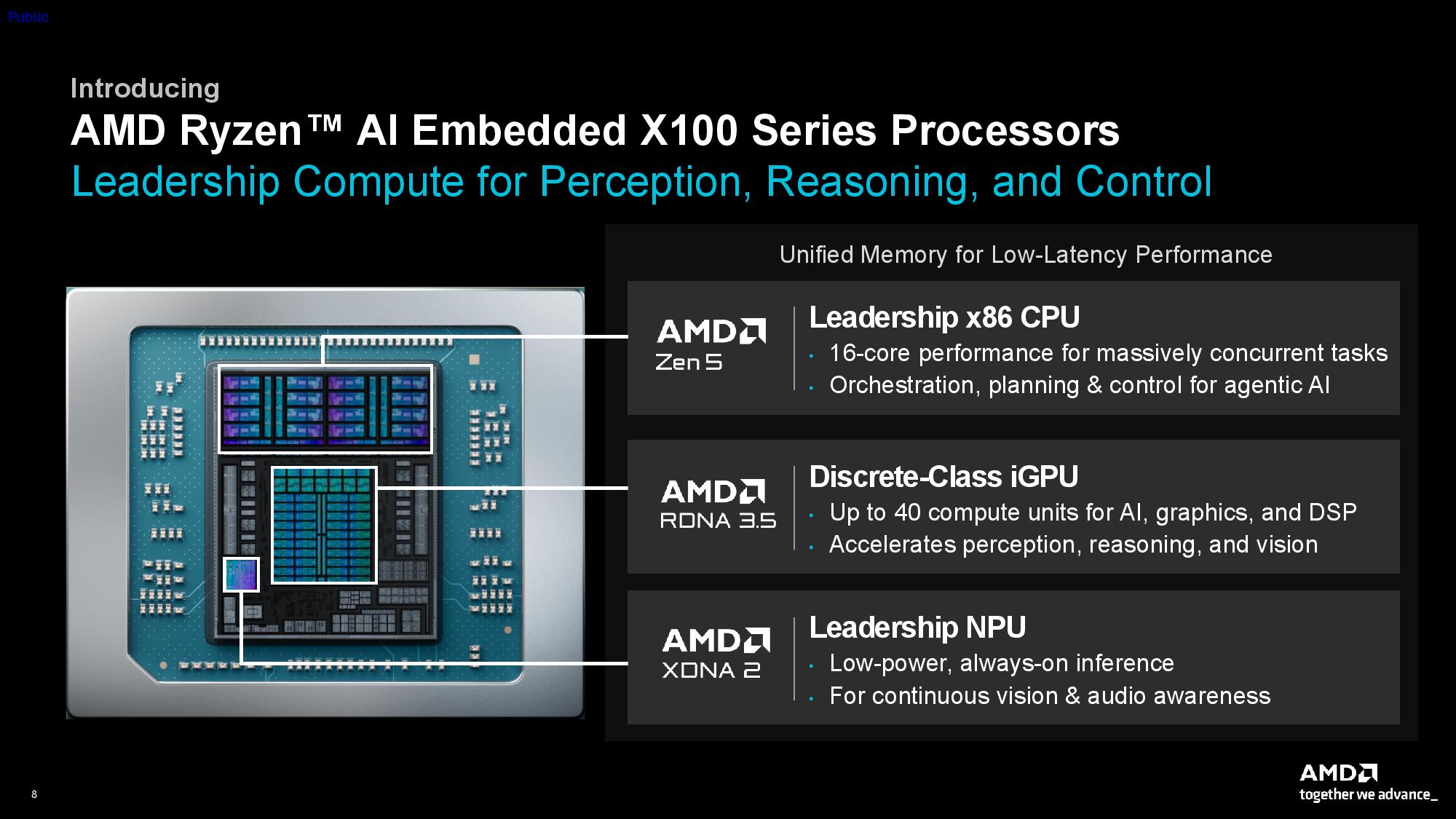
AMD’s X100 is a system-on-chip family that combines Zen 5 CPU cores, RDNA 3.5 graphics, an XDNA 2 neural processing unit and unified memory for robot and industrial AI systems. The pitch is latency: keeping compute, graphics, AI acceleration and memory closer together can reduce the delays that come from splitting those jobs across separate chips.
AMD listed three X100 models. The X199 sits at the top with 16 Zen 5 CPU cores and 40 RDNA 3.5 compute units. The X188 has 12 CPU cores and 32 graphics compute units. The X168 has eight CPU cores and 32 graphics compute units.
AMD has not published a full per-model specification table. For the family, it says the chips support up to a 5.1 GHz boost clock, up to 128 GB of unified memory, an XDNA 2 NPU rated at up to 50 TOPS, configurable power from 45W to 120W, and an operating temperature range from minus 40 degrees Celsius to 105 degrees Celsius.
How AMD compares X100 with Intel
AMD shared benchmark claims for the X199 against Intel’s Core Ultra X7 358H, a 16-core Panther Lake chip with Arc B390 integrated graphics and 12 Xe3 cores. AMD says the X199 leads by 1.2 times in Geekbench 6.1, 1.3 times in PassMark and 1.5 times in an unofficial SPECrate 2017 integer workload run.
For graphics, AMD claims 1.4 times faster Vulkan and 1.7 times faster OpenGL performance in GFXBench 5 on Ubuntu, plus a 1.6 times lead in Unigine Heaven Extreme. For AI inference, AMD says it saw 1.4 times better time to first token and 3.5 times higher tokens per second in Llama-bench using a Vulkan backend at 45W.
Those numbers need a hard squint. AMD said it tested a Ryzen AI Max 395+ “configured to reflect” Ryzen AI Embedded X199 specifications on its Maple reference board, with a 5.1 GHz CPU clock, 2.9 GHz GPU clock and sustained 45W power limit. The Intel system was an MSI Prestige 16 Flip AI+ held to 30W, after which AMD projected 45W performance using scaling factors from public benchmark data. That is vendor math on proxy hardware, not a clean retail-chip shootout.
What is the Kria X100 robotics platform?
AMD is also offering the X100 through a Kria system-on-module and a robotics developer platform. The Kria X100 board measures 120mm by 120mm and uses the standardized COM-HPC form factor.
The developer platform combines the X100 Kria module with AMD’s Spartan UltraScale+ FPGA baseboard. AMD says it includes connectivity for cameras, industrial networking and robotic sensors. Early access is available now, with full production planned for Q4, according to the company.
AMD also published Kria-related benchmark claims against Nvidia’s Thor T5000. Those tests were commissioned by AMD and run by Open Navigation and Mimix. They did not compare a final Kria robot platform directly against Nvidia hardware. AMD compared Nvidia’s Jetson AGX Thor developer kit with a GMKtech EVO-X2 AI mini PC using a Ryzen AI Max+ 395 configured to reflect X199 specifications, so thermals and power delivery remain major variables.
On software, AMD is still trying to pull developers away from Nvidia’s CUDA stack. AMD says its HIPIFY tool can convert 70% to 80% of the porting effort from CUDA to AMD’s HIP C++ portable code. That claim came from a test involving 15 CUDA applications and 1,199 lines of code on a Ryzen AI Max+ 395 configured to match the X199.
AMD says X100 Kria is intended to serve as the compute “brain” of a robotics platform, alongside its Spartan UltraScale+, Zynq UltraScale+ and Versal AI Edge Gen 2 FPGA and SoC families.
This story draws on original reporting from Tom's Hardware.