AMD's Zen 7 EPYC roadmap now has three named server CPU families for 2028: Florence, Ferrara and Fidenza. The company disclosed the split at its Advancing AI 2026 event in San Francisco, where it also launched sixth-generation EPYC “Venice” processors, Instinct MI400 Series GPUs and Helios rack-scale systems.
AMD is stretching its server pitch around AI systems rather than only sockets and cores. In its launch release, the company extended its annual CPU, GPU, networking and rack roadmap through 2030 and put its 2030 total addressable market at about $2 trillion. That is a company estimate, and the fine print matters.
What are AMD's Zen 7 EPYC families?
AMD chair and CEO Lisa Su said Florence will use new Zen 7 cores, add AI compute extensions and support newer memory technologies, according to the keynote. Ferrara is the host CPU for AI systems and appears on AMD's later roadmap inside the Helios 600 rack, paired with MI600 Series GPUs and Pensando “Palma” and “Levanzo” networking. Fidenza is described as the product for sandboxed agentic AI deployments.
AMD did not give core counts, socket details or a manufacturing node for any of the three Zen 7 lines. The company said only that Zen 7 will use leading-edge process technology, which is useful as a slogan and thin as a spec sheet.
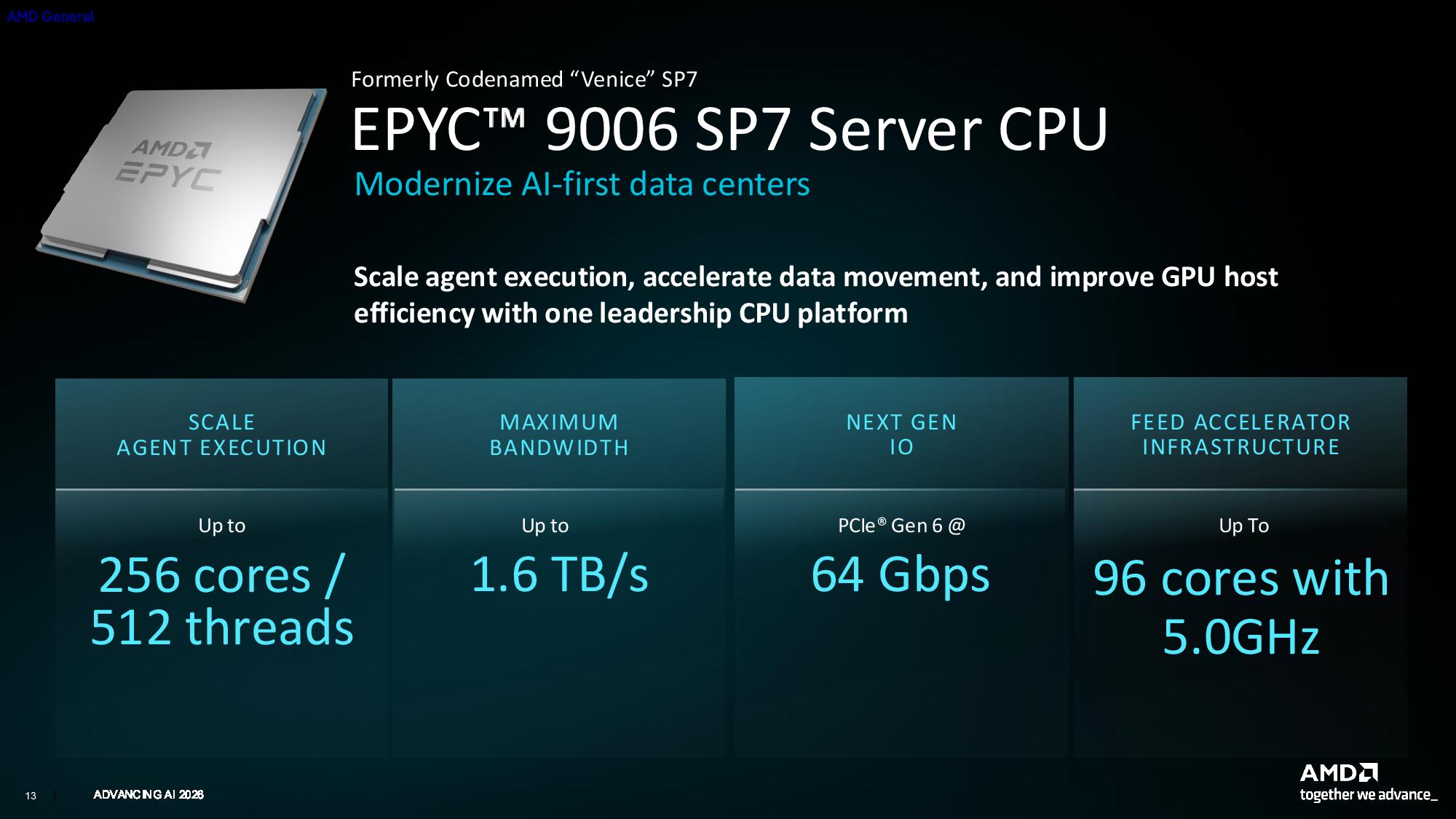
The split marks a wider opening move than AMD has used for recent EPYC generations. Zen 4 EPYC parts were spread across Genoa, Bergamo, Genoa-X and Siena. Zen 5 “Turin” pulled the lineup back into a single launch stack across Zen 5 and Zen 5c parts. Zen 6 “Venice” fans out again with the 9006 series on the SP7 socket, followed by Venice-X in 2027 with 1,152MB of 3D V-Cache, 96 cores and a 5.15 GHz boost clock, according to AMD details cited in the reporting.
How does AMD count AI agents on CPUs?
AMD introduced a new comparison point for sixth-generation EPYC: the most AI agents per watt, per dollar and per rack. Its own endnote says those agent counts are estimates based on available CPU thread resources used as a proxy under a theoretical workload. Actual capacity depends on the workload, model, memory, software, orchestration and system configuration, AMD said.
The per-rack comparison uses core count inside a 100 kW rack power envelope, comparing the 256-core EPYC 9996 with Nvidia's 88-core Vera, AMD's 192-core EPYC 9965 and Intel's 128-core Xeon 6980P. The per-dollar figure is based on top-end thread count divided by 1,000-unit list pricing. That is benchmarking by arithmetic, not by independently measured production deployments.
AMD also replaced TDP with a new value called Default CPU Power for sixth-generation EPYC. The company defines it as power consumed across the compute and I/O dies at a stated performance target. AMD says both figures can be used for product comparison and performance-per-watt analysis, though its own endnote compares an EPYC 9956 at 400W Default CPU Power against TDP figures for Nvidia, Intel and Arm parts.
Where does Helios fit in AMD's AI plan?
AMD said Helios racks are in production now. Each rack combines 72 Instinct MI455X GPUs, 18 Venice CPUs, 31TB of HBM4 and 1.4 PB/s of aggregate memory bandwidth. AMD claims Helios can deliver up to 30% more inference tokens per dollar than Nvidia's Vera Rubin NVL72, based on AMD Performance Labs estimates from July 2026 using a Kimi K2 Thinking workload and projected hourly GPU pricing. Those are vendor numbers, not independent results.
The roadmap puts MI500 Series GPUs in 2027 Helios 500 racks with EPYC “Verano” and Pensando “Como” and “Monza” networking. In 2028, MI600 Series GPUs move into Helios 600 systems using Ferrara. AMD also listed Ravenna on Zen 8 for 2030.
AMD said OpenAI expects to bring Helios online starting in the fourth quarter of 2026, with deployments growing through 2027. Meta is validating sixth-generation EPYC platforms and has started testing Helios racks, according to AMD. Anthropic committed to as much as 2GW of MI455X GPUs in Helios systems, with the first gigawatt due in the first half of 2027.
SemiAnalysis reported in February that manufacturing delays would push mass production and first production tokens for an MI455X UALoE72 system to the second quarter of 2027. AMD software chief Anush Elangovan rejected that report publicly and said Helios remained on target for the second half of 2026. AMD's own cautionary language names component availability, including memory supply, as a risk to its projections.
This story draws on original reporting from Tom's Hardware.